Trekking Poles vs Nordic Walking Poles: What’s the Difference?
Trekking poles and Nordic walking poles look alike, but they are built for opposite jobs. A trekking pole is planted in front of you and takes weight for balance and braking on rough or steep ground; a Nordic walking pole is planted angled behind you and pushed back through a glove-like strap to drive you forward on flatter paths. You can Nordic walk with trekking poles, but the strap, the tips and the length usually hold your technique back.
Quick Answer
Trekking poles support you: they go in front, you lean weight on them, and a simple wrist loop plus a firm grip hold them. Nordic walking poles propel you: they are planted angled back, you push through a glove-style strap, and your hand opens behind your hip. Trekking poles win on mountains, descents and for balance; Nordic poles win for fitness walking on paths and pavement.
- Strap: Nordic poles use a glove-style strap so the hand can open; trekking poles use a loop you have to grip against.
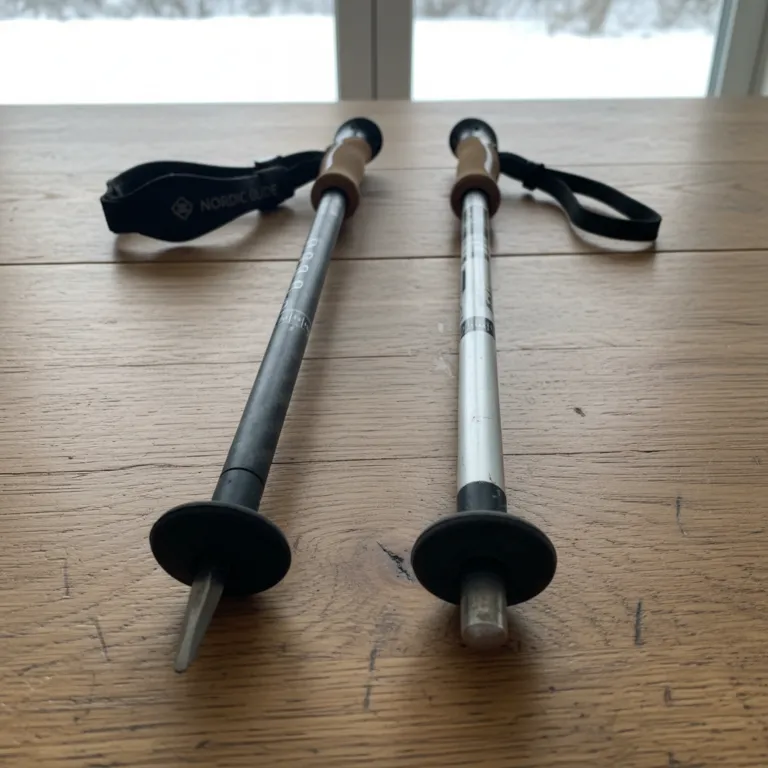
- Tips: Nordic poles come with angled rubber “paws” for asphalt over a carbide tip; trekking poles usually have a carbide tip, round rubber caps and baskets for soft ground.
- Length: Nordic poles are commonly fixed length (about height × 0.68); trekking poles are telescopic or folding so you can change length on hills.
- Force: trekking = weight down and in front; Nordic = push backward, behind the body.
- Using trekking poles for Nordic walking: yes, as a way to start. Shorten them, fit paws, loosen your grip and plant the tips behind you.
Are Trekking Poles and Nordic Walking Poles the Same?
No. They share a shaft, a handle and a tip, which is why the confusion is so common. It is the most-asked gear question in Nordic walking forums: people with a pair of hiking poles in the closet want to know whether they already own “Nordic walking poles.”
The simplest way to put it, borrowed from a reply on the UK forum Gransnet: trekking poles take weight off your joints, while Nordic poles drive you forward.
- A trekking pole is a support tool. You reach it forward, plant it and lean on it for balance on rough ground.
- A Nordic walking pole is a training tool. You plant it behind you and push back, so your arms, shoulders and upper back join the work of walking. The International Nordic Walking Federation (INWA) describes poles used “diagonally behind the body” to create propulsion while keeping your natural walking pattern.
What’s the Difference Between Nordic Walking Poles and Trekking Poles?
The strap and the planting direction matter most; everything else is detail.
| Feature | Nordic walking poles | Trekking (hiking) poles |
|---|---|---|
| Main job | Propulsion and an upper-body workout | Balance, support and braking |
| Strap | Glove-style or half-glove strap, often clip-in; hand opens behind the hip | Adjustable wrist loop; hand stays wrapped around the grip |
| Grip | Slim handle you hold lightly | Larger, contoured handle made to be held and leaned on |
| Tip | Carbide tip plus an angled rubber paw for asphalt | Carbide tip, round rubber cap, trekking or snow baskets |
| Length | Often fixed; roughly height × 0.68, elbow near 90° | Telescopic or folding; changed for uphill and downhill |
| Where it’s planted | Angled back, tip between your feet | In front of you, fairly upright |
| Force direction | Backward, through the strap | Downward, through the handle |
| Best terrain | Pavement, park paths, gravel, rolling trails | Mountains, rocky or steep trails, long descents |
Grip and glove strap vs a simple loop
This is the difference that changes how walking with poles feels. A Nordic strap wraps around your hand like a fingerless glove. You press through it with the heel of your hand, and as your arm swings past your hip, you open your fingers and let the pole trail in the strap. INWA says the strap lets “the hand to open naturally” while keeping contact with the pole, and LEKI’s technique guidance tells walkers to open the hand completely on the follow-through.
A trekking loop cannot do that. If you open your hand, the pole flops away, so you end up squeezing the grip the whole time. Forum users describe it well: cheap trekking poles “must be gripped all the time.” One r/nordicwalking user reported thumb and wrist pain with trekking straps that went away after switching to glove straps.
Paw tips vs carbide tips
Both types usually have a hard carbide point underneath. The difference is what goes over it. Nordic poles come with a boot-shaped rubber paw, angled backward so its sole sits flat on the ground when the pole leans behind you. It grips asphalt and softens the tap on pavement. Trekking poles have a round rubber cap, if anything, plus baskets that stop the tip sinking into mud or snow. On grass, gravel and ice, bare carbide gives the best bite on either pole.
Fixed vs telescopic length
Nordic walking poles are often fixed length. Fixed poles are lighter and stiffer, can’t slip or collapse, and don’t rattle. Trekking poles are almost always telescopic or folding, because hikers shorten them for climbs and lengthen them for descents. Our poles buying guide suggests about 5 cm shorter for steep climbs and 5 cm longer for steep descents.
Planting angle and force direction
On flat ground a Nordic pole should never land ahead of your front foot. INWA, SportMedBC and LEKI all describe the pole angled backward; SportMedBC gives “about 45 degrees” as a teaching cue (it is instructor guidance, not a measured optimum). The tip lands between your feet, and you push back until your hand passes your hip. A trekking pole lands in front of you and takes weight straight down, like a light cane. Plant a pole the trekking way on a flat sidewalk and it acts as a brake instead of a motor.
To see both styles on the same walker, use the GaitLab Motion Lab below and tap Trekking style, then Nordic style. Watch where the tip lands and which way the arm pushes.
When Are Trekking Poles the Better Tool?
Trekking poles are not “wrong” Nordic poles. For some jobs they are the right choice:
- Steep descents. Hikers plant poles ahead on the way down to control speed and share the load with their legs. Even Nordic walking instructors allow a forward plant on steep descents.
- Rough mountain terrain. Rocks, roots and stream crossings call for a pole that goes where you need balance, not where the rhythm says.
- Balance and confidence. If you mainly want steadiness rather than a workout, a trekking-style plant in front gives more support.
- Travel and multi-day hikes. Telescopic and folding poles pack down and adjust for every slope.
If you use poles for balance because of a health condition, or you are recovering from surgery, ask your doctor or physiotherapist which style and length suits you. Poles are not a medical walking aid, and the right setup depends on your situation.
Can You Use Trekking Poles for Nordic Walking?
Yes, with limits. Plenty of people learn the Nordic stride on hiking poles they already own, and forum users say the motion works; it’s just less comfortable. What you can’t fully copy with trekking poles is the open-hand release, because the loop strap doesn’t hold the pole when you let go.
What to change if you use hiking poles for Nordic walking
- Shorten them. Set the length so your elbow is close to 90° with the tip beside your foot, roughly your height × 0.68. Trekking poles are often set longer, and poles that are too long push the tip out in front and lift your shoulders. Our pole length calculator gives a starting point.
- Fit angled paws and remove the baskets. Angled “paw” tips are sold for most poles and grip pavement much better than a round cap.
- Use the loop as a strap. Put your hand up through the loop from below, then press down on the strap rather than squeezing the handle. Walk leaders warn that straps put on from the top can hurt your wrist in a fall.
- Relax the grip behind you. You can’t let go completely, but you can loosen your fingers as your arm passes your hip.
- Plant behind, push back. The tip lands between your feet, angled back, never out in front on flat ground.
- Check the locks before each walk. A Nordic push loads the pole every step, and a slipping lock will collapse under you.
If you walk several times a week, dedicated Nordic poles are worth it for the glove strap alone; a good strap matters more for technique than upgrading from aluminum to carbon shaft material.
Trekking Pole vs Walking Stick vs Hiking Pole
These terms get mixed up too:
- Hiking pole and trekking pole mean the same thing. Brands use both names for adjustable poles sold in pairs for trail walking.
- A walking stick is usually a single pole or cane, used on one side for balance. It gives steady support but no rhythm and no upper-body workout.
- Nordic walking poles are always used as a pair, in the diagonal rhythm of normal walking: left pole with right foot, right pole with left foot.
How to Choose: Trekking Poles or Nordic Walking Poles?
- Fitness walking on pavement, parks and gentle trails, several times a week: Nordic walking poles with a glove strap and paws. See how to choose Nordic walking poles for sizing and materials.
- Hills, mountains and long descents: telescopic trekking poles with baskets.
- A mix of both, or sharing with a partner: adjustable poles. Some adjustable models come with Nordic-style straps; otherwise use the trekking-pole tweaks above.
- Mainly balance and confidence: a trekking-style plant in front, set up with help from a physiotherapist or a qualified instructor.
Whatever you choose, technique matters more than the price tag. In a 2018 PLoS One study, Pellegrini and colleagues compared the INWA diagonal technique with weak poling and with elbow-only or shoulder-only arm action. Every variation produced less muscle activation and a lower metabolic response than the standard technique.
Nordic walking poles and a trekking-style option
Leki Micro Flash Carbon
Carbon fiber · Folds to 15″ · Shark grip · Speed Lock+
Buy on AmazonOpens the product page on Amazon, where you can see the current price and delivery options.
Swix CT5 Carbon
High-mod carbon · EasyCross strap · Cross-country ski heritage
Buy on AmazonOpens the product page on Amazon, where you can see the current price and delivery options.
Exel Nordic Walker Carbon
Carbon blend · Rubber asphalt paws included
Buy on AmazonOpens the product page on Amazon, where you can see the current price and delivery options.
TrailBuddy Adjustable Poles
Aluminum · Telescoping · Cork grip · Flip locks
Buy on AmazonOpens the product page on Amazon, where you can see the current price and delivery options.
For the full field, see our best Nordic walking poles of 2026 and the Leki vs TrailBuddy comparison.
Frequently Asked Questions
Are trekking poles and Nordic walking poles the same?
No. Trekking poles are built for support: you plant them in front, lean on them and hold the grip through a wrist loop. Nordic walking poles are built for propulsion: you plant them angled behind you and push back through a glove-style strap that lets your hand open. They can look similar, but the strap, the tips, the usual length and the planting direction are all different.
Can I use trekking poles for Nordic walking?
Yes, as a way to start. Shorten the poles until your elbow is near 90°, fit angled rubber paws for pavement, remove the baskets and put your hand up through the loop from below. Plant the tips behind you and push back. You won’t get the full open-hand release a glove strap allows, so regular walkers usually upgrade to dedicated Nordic poles.
Are Nordic walking poles shorter than trekking poles?
Usually, yes. Nordic poles are commonly sized at about your height in centimeters × 0.68, with the elbow near 90° when the tip is beside your foot. Trekking poles are adjustable and are often set longer, especially on descents. A pole that’s too long for Nordic walking pushes the tip out in front and lifts your shoulders, so shorter is the safer choice.
Can I use Nordic walking poles for hiking?
On gentle, rolling trails, yes: remove the paws so the carbide tip bites into gravel and dirt. On steep, rocky ground and long descents, fixed-length Nordic poles are limited because you can’t lengthen them for the way down or shorten them for climbs. For real mountain terrain, adjustable trekking poles with baskets are the better tool.
Why do Nordic walking poles have glove straps?
The glove strap lets you push the pole back with the heel of your hand and then open your fingers as your arm passes your hip, without losing the pole. That grip-and-release pattern keeps your hand relaxed and lets your arms add real push. With a simple loop, you have to squeeze the handle the whole time, which some walkers find tiring for the thumb and wrist.
Is a walking stick the same as a trekking pole?
Not quite. A walking stick is usually a single pole or cane used on one side for balance, while trekking poles are sold as an adjustable pair for trail walking. A stick gives steady support but no walking rhythm or upper-body workout. If you rely on a stick because of pain or unsteadiness, ask your doctor or physiotherapist before switching to poles.
Which pole is better for bad knees?
It depends on the terrain. On descents, trekking poles planted ahead can take some load off your knees. On flat ground, Nordic poles let your arms share the effort of walking. Many walkers with knee or hip problems report that poles help, but new, severe or swelling knee pain needs a professional check first, and a physiotherapist can help set up either type.