Walking Biomechanics 2026: The Gold Standard of Movement from 10 World Experts
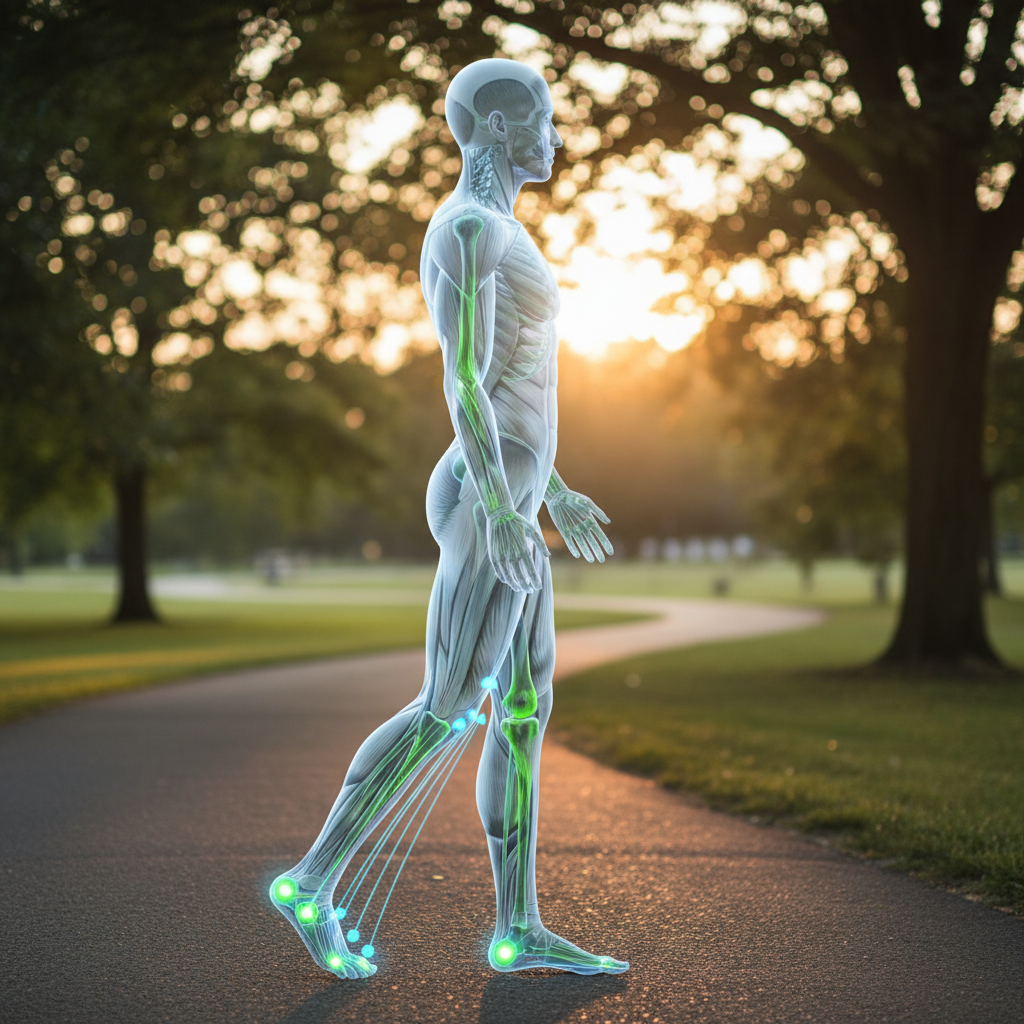
Walking is not automatic locomotion. It is the most complex engineering problem your body solves thousands of times a day — and most modern humans are solving it wrong. Sedentary lifestyles, narrow shoes, and “text neck” have turned the human gait into a sequence of micro-injuries. This guide synthesizes the work of 10 leading biomechanists, physiotherapists, and movement scientists into one unified framework: the Gold Standard of Walking.
Key Takeaways
Most modern walking is biomechanically compromised by sedentary habits and narrow shoes; the fixes are treating the foot as an active tripod, hitting a 170 to 180 step-per-minute cadence, and (optionally) adding poles to engage 90 percent of muscles.
- Optimal cadence: 170-180 steps per minute reduces overstriding and impact.
- Foot adaptation: foot muscles need 8-12 weeks to adapt to a more natural, wider platform.
- Active tripod: load the heel, big-toe and little-toe joints to stabilise each step.
- Nordic upgrade: adding poles engages 90% of muscles (vs ~45%) while protecting joints.
- Engine: pelvis and glutes drive efficient gait, not the lower legs alone.
Module 1: The Foundation — Your Foot as a Biological Sensor
The Active Tripod Concept
Your foot has three load-bearing contact points — the heel, the base of the big toe, and the base of the little toe. These three points form a tripod. When all three maintain ground contact, the arch functions as a dynamic spring. Lose contact at any point (common in over-pronation), and the entire kinetic chain collapses upward — the knee drifts inward, the hip drops, the lower back compensates.
| Tripod Point | What It Does | What Happens When Lost |
|---|---|---|
| Heel | Initial ground contact, shock absorption | Forefoot overload, Achilles strain |
| Big toe base (1st metatarsal) | Final push-off power, medial arch anchor | Bunions, arch collapse, knee valgus |
| Little toe base (5th metatarsal) | Lateral stability, balance on uneven ground | Ankle sprains, lateral chain weakness |
The Shoe Prison
Modern shoes with narrow toe boxes and thick cushioned soles “blind” your brain. Your foot has over 200,000 nerve endings — more per square centimeter than almost any other body part. These sensors tell your brain about surface type, slope, and impact force. When encased in rigid shoes, this feedback disappears. Stabilizer muscles atrophy. Balance deteriorates. Injury risk climbs.
The fix: Transition to shoes with a wide toe box (your toes should spread naturally) and minimal heel-to-toe drop (zero drop is ideal). This is not about going barefoot — it is about letting your foot work.
Vivobarefoot Primus Trail III
Zero drop · Wide toe box · 4mm sole · Puncture-resistant · Barefoot feel on real terrain
Altra Olympus 6
Zero drop · FootShape toe box · Max cushion · Vibram Megagrip · Best of both worlds
Merrell Vapor Glove 5
Zero drop · Barefoot construction · 6.5mm stack · Vibram outsole · Minimalist classic
Transition to minimal/barefoot shoes gradually — 10-15 minutes per day for the first week, increasing by 10 minutes weekly. Your foot muscles need 8-12 weeks to adapt. Jumping straight to barefoot shoes from traditional cushioned shoes risks plantar fasciitis and stress fractures.
Module 2: Gait Dynamics — The Controlled Fall
Biomechanically, walking is a process of controlled falling forward, where one leg constantly “rescues” the body from hitting the ground. Every joint must move through three planes of motion during a single step.
The Two Phases
| Phase | What Happens | Foot State | Common Error |
|---|---|---|---|
| Stance (60% of cycle) | Heel strikes, weight transfers, body passes over foot | Soft and mobile — absorbs shock via controlled pronation | Rigid foot at contact = impact shoots to knee |
| Push-off (40% of cycle) | Foot becomes rigid lever, big toe drives forward propulsion | Stiff and powerful — supination locks the arch | Soft foot at push-off = energy leak, Achilles overload |
Optimal Cadence: 170-180 Steps Per Minute
Research shows that a cadence of 170-180 steps per minute optimizes the elastic energy return from tendons. Below 160 spm, you rely primarily on muscular force (inefficient, fatiguing). Above 180, you over-recruit hip flexors. The sweet spot uses your Achilles tendon as a spring — storing energy at foot strike and releasing it at push-off.
How to check: Count your steps for 30 seconds and multiply by 2. If you are below 160, shorten your stride (do not speed up — just take more frequent, smaller steps).
Module 3: The Engine — Pelvis and Glutes
External Rotation and Torque
Your feet should point straight forward — parallel, not turned out. To stabilize the pelvis during single-leg stance (which is what every step is), you need to generate slight external rotation at the hips. Think of it as trying to “spread the floor apart” with your feet without actually moving them. This activates the gluteus medius — the muscle that prevents your pelvis from dropping on the unsupported side.
| Muscle | Role in Walking | What Happens When Weak | How to Strengthen |
|---|---|---|---|
| Gluteus Maximus | Hip extension — drives you forward | Lower back takes over, lumbar pain | Hip thrusts, step-ups, lunges |
| Gluteus Medius | Pelvic stability — prevents hip drop | Trendelenburg gait, IT band syndrome, knee pain | Clamshells, side-lying hip abduction, single-leg stands |
| Deep Hip Rotators | Joint centering — keeps femur in socket | Hip impingement, groin pain | 90/90 stretches, pigeon pose, banded walks |
Spinal Decompression Through Walking
Walking should feel like your spine is growing taller — not compressing. When your glutes fire correctly, they pull the pelvis into a neutral position, creating space between vertebrae. When glutes are inactive, the lower back flexes and compresses. Proper walking is a continuous spinal decompression exercise.
Module 4: Stabilization — Spine and Arm Swing
Arm Swing as a Disc Pump
Walking with arms still (or in pockets) is poison for your spine. Your arms must swing in opposition to the legs — right arm with left leg, left arm with right leg. The swing originates from the shoulder joint, not the elbow.
This creates rotational movement in the thoracic spine. Spinal discs have no blood supply — they feed through diffusion, absorbing nutrients during movement. Active arm swing literally feeds your spine.
This is exactly why Nordic walking is biomechanically superior to regular walking. The poles force proper arm swing amplitude, counter-rotation of the thoracic spine, and anterior-posterior stabilization. Every expert in this article would approve of well-executed Nordic walking technique.
The Overstriding Problem
| Gait Pattern | Foot Strike | Braking Force | Knee Load | Efficiency |
|---|---|---|---|---|
| Overstriding (common) | Heel far ahead of body | High — you “brake” with every step | High — impact travels straight up | Low — wasted energy |
| Optimal stride | Foot lands under center of mass | Minimal — smooth forward flow | Low — cushioned by elastic recoil | High — tendon springs engaged |
The silent test: Your walking should be nearly soundless. Loud footfalls mean your tendons are not functioning as springs — you are “crashing” into the ground instead of rolling over it.
Module 5: Neurology — The Body-Brain Connection
Text Neck and Gait Collapse
When you look at your phone, your head shifts forward. This changes your center of gravity. Your nervous system, trying to prevent a fall, locks up the calf and hip muscles. Result: you stop using your glutes and start “dragging” your legs forward with hip flexors. This leads to chronic groin and lower back pain.
The fix: Eyes on the horizon while walking. Always. Your peripheral vision handles the ground in front of you — your head stays balanced over your spine.
Walking as Cognitive Training
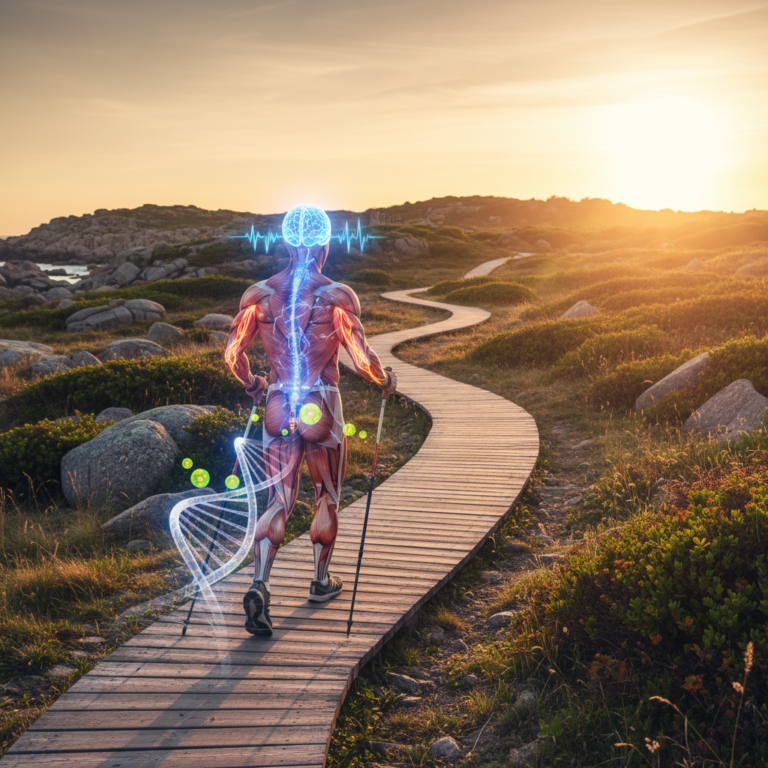
Walking on varied terrain develops the cerebellum and proprioceptive system. This is proven prevention against dementia and age-related cognitive decline. Trail walking, uneven surfaces, and Nordic walking with poles all challenge the brain’s motor planning in ways that treadmill walking cannot.
Module 6: Nordic Walking — The Biomechanical Upgrade
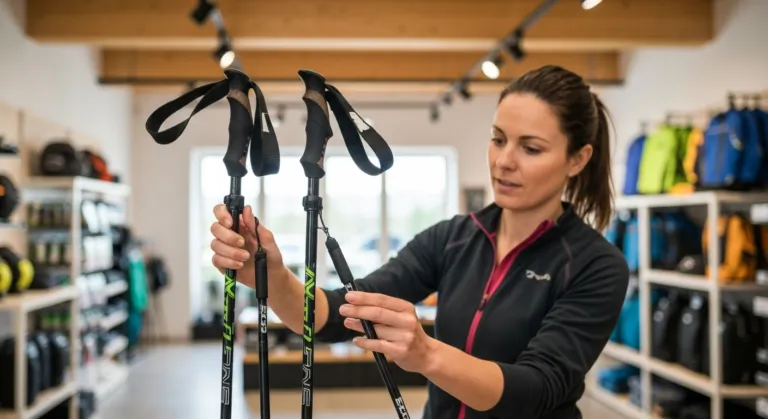
Nordic walking activates 90% of the body’s muscles (vs 45% for regular walking). From a biomechanics perspective, poles serve two critical functions:
| Function | Mechanism | Benefit |
|---|---|---|
| Off-loading | Poles transfer 15-20% of body weight from lower joints to upper body | Knee/hip preservation, pain-free walking for arthritis and post-surgical patients |
| Activation | Poles force proper arm swing and thoracic rotation | Disc nutrition, core engagement, 20-25% more calories burned |
| Stabilization | 4 points of contact vs 2 | 40% fall reduction, confidence on uneven terrain |
| Pacing | Poles set natural cadence rhythm | Optimal 170-180 spm maintained automatically |
Properly sized poles (use our Pole Length Calculator) maintain the vertical spinal axis that all 10 experts emphasize, preventing the forward lean that destroys gait mechanics.
Leki Micro Flash Carbon
Carbon (max piezoelectric signal) · Shark strap (optimized hand-release) · 7.4 oz · Folds to 15″
TrailBuddy Adjustable Poles
Aluminum · Cork grip · Adjustable length · Budget-friendly · 9.6 oz
The Gold Standard Checklist
Print this. Tape it to your wall. Check yourself against it weekly until it becomes automatic:
| # | Checkpoint | Test | Fix |
|---|---|---|---|
| 1 | Feet parallel | Look down — toes pointing straight ahead, not out | Consciously rotate feet inward until parallel |
| 2 | Tripod contact | Feel heel + big toe base + little toe base on ground | Foot exercises: towel scrunches, marble pickups |
| 3 | Eyes on horizon | Head balanced over spine, chin level | Tape a reminder on your phone: “Look up” |
| 4 | Arm pendulum | Arms swing freely from shoulders, opposite to legs | Nordic walking poles force correct pattern |
| 5 | Nose breathing | Inhale/exhale through nose, rhythmic, synced to steps | Practice 4-step inhale, 4-step exhale |
| 6 | Silent footfalls | Walking is nearly soundless | Shorten stride, increase cadence to 170+ spm |
| 7 | Glute activation | Feel glutes engage at push-off, not lower back | Pre-walk glute activation: 20 clamshells per side |
| 8 | Spinal length | Feel taller at end of walk than at start | Imagine a string pulling crown of head upward |
Tools for Gait Analysis and Correction
Garmin Forerunner 965
Cadence tracking · Stride length · Ground contact time · Running dynamics · GPS
Currex RunPro Insoles
Dynamic arch support · 3 profiles (low/med/high) · Improves tripod contact · Fits any shoe
TriggerPoint GRID Foam Roller
Release tight calves, IT band, hip flexors · Pre/post-walk · Restores tissue mobility
Fit Simplify Resistance Bands (Set of 5)
Glute activation · Clamshells · Monster walks · Pre-walk warm-up essential
Yes4All Wooden Wobble Board
Proprioception training · Ankle stability · 360° tilt · Builds foot sensor awareness
The 4-Week Gait Correction Protocol
| Week | Focus | Daily Practice | Walk Cue |
|---|---|---|---|
| Week 1 | Foot awareness | 5 min barefoot on grass. Towel scrunches 3×20. Tripod stance 3x30s. | “Feel all three points” |
| Week 2 | Glute activation | Clamshells 3×15. Single-leg stand 3x30s. Glute bridges 3×12. | “Push the ground away with your glute” |
| Week 3 | Arm swing + posture | Wall angels 3×10. Shoulder circles 3×20. Thoracic rotations 3×10/side. | “Swing from the shoulder, eyes on horizon” |
| Week 4 | Integration | All exercises combined. 30-min walk focusing on all 8 checkpoints. | “Silent feet, tall spine, free arms” |
Bottom Line
Walking biomechanics is not academic theory — it is the difference between a body that heals with every step and one that deteriorates. The Gold Standard is simple: feet parallel, tripod active, eyes forward, arms swinging, glutes firing, spine lengthening. Add Nordic walking poles and you engage 90% of your muscles while protecting your joints.
Your body was designed to walk 20,000 steps a day. Make each one count.
Our Top Pick
📚 See also:
- running biomechanics companion guide — Running Biomechanics Expert Guide

About the Author
Alex Mercer — INWA Level 2 Nordic Walking Instructor
Certified by the International Nordic Walking Federation (INWA) since 2019, Alex has coached 500+ walkers from beginners to ultra-distance competitors. Sports science background with a focus on biomechanics, gait analysis, and evidence-based training protocols. Regular contributor to walking and outdoor publications.