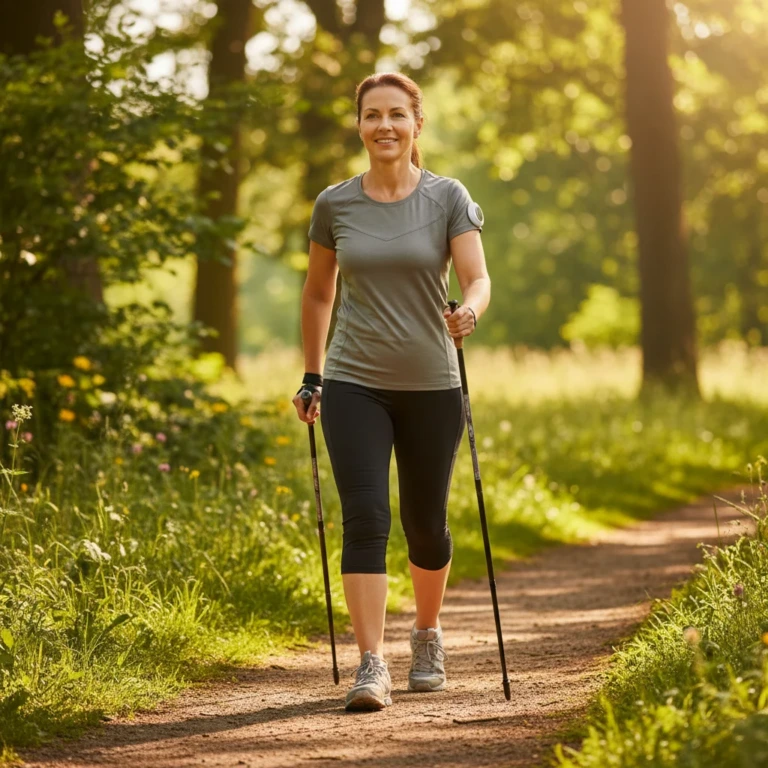
Walking Benefits for Joints and Spine

Walking is one of the most underrated forms of exercise for musculoskeletal health. While high-impact activities like running place heavy loads on cartilage and vertebral discs, walking strengthens the support structures around your joints without the wear-and-tear risks.
Nordic walking is particularly beneficial because the poles transfer 25-30% of impact forces away from the lower body. This makes it one of the safest exercises for people with knee osteoarthritis, hip issues, or lower back pain.
Key Takeaways
Walking strengthens the muscles that support your joints and spine without the cartilage wear of high-impact exercise, and Nordic walking poles transfer 25 to 30 percent of impact forces away from the lower body.
- Joint offloading: poles divert 25 to 30% of impact force from knees, hips and ankles.
- Normal response: morning stiffness that clears within 15 to 20 minutes of walking is expected.
- Starter program: walk 20 minutes daily at a pace that keeps joint pain at or below 2/10.
- Progression: add 5 minutes per session while monitoring the 24-hour post-walk response.
- Spine benefit: upright pole-supported walking eases compressive load on the lumbar discs.
How Walking Protects Your Joints
Cartilage has no blood supply — it gets nutrients through compression and release during movement. Regular walking pumps synovial fluid through the cartilage, keeping it nourished and resilient. Research shows that moderate walkers have thicker, healthier knee cartilage than sedentary individuals.
Spinal Health Benefits
Walking engages the deep stabilizer muscles of the spine — the multifidus and transversus abdominis. Nordic walking amplifies this effect because the arm-pole interaction creates gentle rotational forces that activate the obliques and paraspinal muscles, building a natural “corset” of support.
Walking vs. Other Exercises for Joint Health
Pros
- Zero equipment cost for basic walking
- Can be done anywhere, anytime
- Low injury risk
- Improves joint lubrication
- Strengthens supporting muscles
Cons
- Less effective for bone density than weight training
- May not be enough for advanced joint conditions
- Progress is gradual
Recommended Walking Program for Joint Health
Frequency: 5 days per week minimum
Duration: 30-45 minutes per session
Intensity: Moderate — able to hold a conversation
Surface: Grass or packed earth is gentler than concrete
Poles: Strongly recommended for anyone with existing joint issues
If you have joint pain, walk through stiffness but never through sharp pain. Morning stiffness that resolves within 15-20 minutes of walking is normal. Pain that increases during the walk is a signal to stop and consult your doctor.
Shop Supportive Walking Shoes on Amazon →
Browse Nordic Walking Poles on Amazon →
Brooks Ghost — Cushioned Walking Shoes →
Nordic Walking for Joint Health: Mechanics Explained
Standard walking generates ground reaction forces of 1.0-1.5× bodyweight through the knee joint with each step. Running increases this to 3.0-3.5×. Nordic walking reduces it to 0.7-1.0× because poles absorb approximately 20-30% of the vertical impact force at each step — not just on the pole-plant side, but through the diagonal loading pattern that distributes force across the entire upper body kinetic chain.
The spinal benefit is equally significant. Intervertebral discs receive nutrients through cyclic compression and decompression — standing still actually starves discs of nutrition. The rhythmic, low-impact walking motion in Nordic walking creates ideal disc nutrition cycles: compression during pole-plant loading, decompression during swing phase. This is why people with degenerative disc disease consistently report symptom reduction from regular Nordic walking.
The Role of Muscle in Joint Protection
Joints do not protect themselves — muscles do. The quadriceps, hamstrings, and gluteus medius form the primary protective system for the knee. When these muscles are weak or fatigued, the joint bears forces directly. Nordic walking builds these muscles through consistent loaded activity, while simultaneously reducing the impact that would damage the joint during the strengthening process.
This is the clinical reason Nordic walking outperforms both rest and high-impact exercise for most joint conditions: it strengthens the protective muscles while staying below the impact threshold that causes further damage. After 6-8 weeks of consistent Nordic walking, many people with knee OA report they can tolerate activities they previously could not — stairs, light hiking, carrying loads — because the supporting muscles have strengthened around the joint.
The Joint-Protection Walking Program: A 4-Week Protocol
For people with diagnosed joint conditions — osteoarthritis, patellofemoral syndrome, or recovering from joint surgery — walking is often recommended but rarely prescribed with the specificity that makes it genuinely therapeutic rather than merely “better than nothing.” The following protocol is based on load management principles used in physiotherapy.
Week 1: Baseline establishment. Walk 20 minutes daily at a pace that produces no joint pain above 2/10 during or within 24 hours of the session. If pain exceeds 2/10, reduce pace or duration until it does not. This is your training threshold — never exceed it. Establish the surface that causes least joint stress (typically grass or compacted earth, not asphalt).
Week 2: Volume increase. Add 5 minutes per session. Monitor 24-hour post-walk response carefully. If joints feel stiffer the morning after walking than the morning before you began the program, you are loading too aggressively. Step back to Week 1 volumes for 3 days before progressing again.
Week 3: Surface variety. Introduce slight inclines (not steep hills). Walking uphill reduces knee impact compared to flat walking due to altered loading mechanics. Walking downhill increases quad demand and can aggravate patellofemoral issues in susceptible people — introduce it gradually and monitor response.
Week 4: Duration target. Achieve 35-45 minute sessions without triggering the 2/10 pain threshold. This is the functional maintenance volume that research shows produces synovial fluid circulation benefits and cartilage nutrition without exceeding adaptive capacity.
Footwear as a Joint-Protection Tool
For joint-compromised walkers, footwear is not a comfort preference — it is a clinical variable. A shoe with excessive cushioning can actually increase knee compressive load compared to a more responsive, lower-stack shoe by altering heel-strike mechanics. Consult a physiotherapist or podiatrist for footwear recommendation before investing in expensive shoes, particularly if you have been given conflicting advice about cushioned vs minimalist designs.
Nordic Walking vs Regular Walking for Joint Health: The Evidence
The comparison between Nordic walking and regular walking for joint health outcomes has been examined in multiple clinical studies since 2005. The consistent finding: Nordic walking produces equivalent or superior joint health outcomes to regular walking at the same duration, with the addition of measurable upper-body conditioning that regular walking does not provide.
The key joint-health mechanism specific to Nordic walking is pole-assisted load transfer. At moderate Nordic walking intensity with correct technique, 20-30% of body weight is transmitted through the arms and poles rather than through the lower limb joints. For a 90kg person, this reduces per-step compressive load on the knee by approximately 15-25kg compared to regular walking at the same speed. Over a 45-minute session at 110 steps per minute, this represents roughly 55,000-75,000 fewer Newtons of compressive load on each knee joint — a clinically meaningful reduction for people with established joint pathology.
Studies in specific populations: A 2010 study of knee osteoarthritis patients found Nordic walking produced significantly greater pain reduction than regular walking after 12 weeks. A 2015 study of post-hip replacement patients showed safe return to activity 3-4 weeks earlier with Nordic walking (supervised) versus regular walking. These findings are consistent with the load-transfer mechanism — poles reduce joint stress while maintaining cardiovascular and muscular training stimulus.
Important qualification: These benefits depend entirely on correct technique. Incorrect technique — gripping poles too tightly, planting poles too far forward, using poles that are too long — can reverse the load benefit and potentially increase joint stress. Joint-compromised walkers should seek certified instruction before beginning an independent program.
Frequently Asked Questions
Does walking help with back pain?
Yes. Regular walking strengthens the muscles supporting the spine, improves blood flow to spinal discs, and releases endorphins that reduce pain perception. Nordic walking is particularly effective due to core engagement.
How long should I walk for joint health?
30 minutes of moderate walking most days of the week provides measurable joint health benefits. Start with 15 minutes if you have existing joint issues and build gradually.