
Birdwatching on the Trail: Binoculars, Field Guides, and the Art of Hiking Slowly
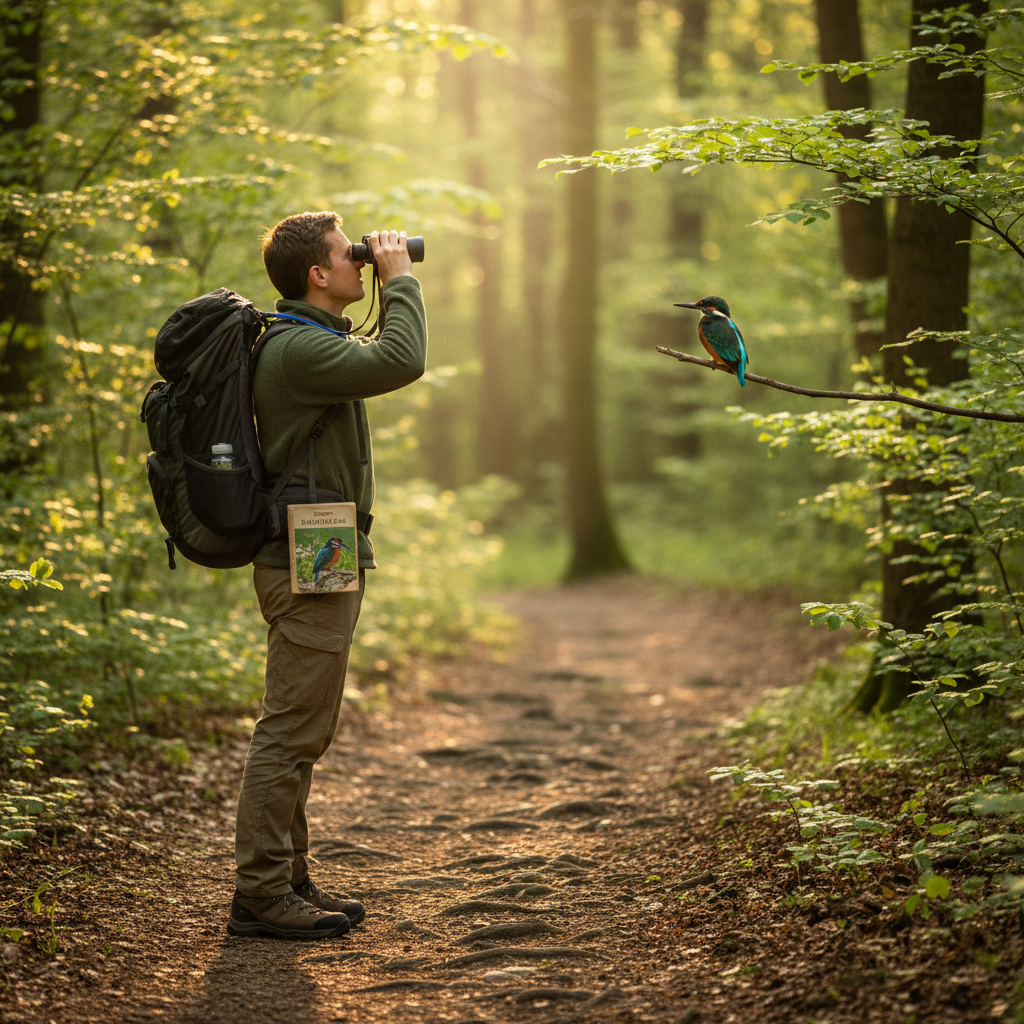
You have walked this trail a hundred times. You know every switchback, every stream crossing, every view. But you have never truly seen it — because you have never stopped, raised binoculars, and watched a peregrine falcon dive at 240 mph through the canyon below you. Birdwatching transforms any hike from exercise into exploration. There are 900+ bird species in North America alone, and the backcountry is where the rare ones live. All you need is a pair of binoculars, a field guide, and the patience to stand still.
Key Takeaways
Combining birdwatching with hiking transforms a familiar trail; the right kit is 8×42 binoculars and a field guide, and the first two hours after sunrise are peak time, with about 80 percent of identification done by ear.
- Optics: 8×42 binoculars balance magnification, brightness and weight (around 24.6 oz).
- Prime time: the first 2 hours after sunrise are best for birdsong and trail quality.
- By ear: roughly 80% of bird identification happens by sound, not sight.
- Carry system: a binocular harness beats a neck strap, which destroys your neck after a full day.
- Field guide: a regional guide turns sightings into confident identifications.
Why Birding + Hiking Is the Perfect Combination
- Backcountry = rare species. Many birds avoid developed areas. Hikers access habitats that car-birders never reach — alpine meadows, old-growth forest, remote wetlands.
- Elevation = migration highways. Mountain ridges are raptor migration corridors. Spring and fall, hawks, eagles, and falcons ride thermals along ridgelines by the thousands.
- Dawn starts. Birding and hiking share the same golden rule: start early. The first 2 hours after sunrise are peak for both birdsong and trail quality.
- Forced slowness. Birding makes you stop, look, and listen — the exact skills that make hiking safer and more enjoyable.
- Mental health. Studies show birdwatching reduces anxiety and increases mindfulness. Combined with Nordic walking’s mental health benefits, it is a powerful natural antidepressant.
Choosing Binoculars for the Trail
Binoculars are the single most important birdwatching purchase. The wrong pair ruins the experience; the right pair makes it magical. Here is what matters:
| Spec | What It Means | For Hiking Birders |
|---|---|---|
| Magnification | How close the bird appears (8x, 10x, 12x) | 8x is best — wider field of view, easier to find birds, less shake |
| Objective lens (mm) | Light gathering (32, 42, 50mm) | 42mm is ideal — bright enough for dawn/dusk, not too heavy |
| Weight | Total binocular weight | Under 26 oz for hiking. Over 30 oz = neck fatigue |
| Close focus | Nearest distance you can focus | Under 6 feet — warblers are sometimes 3 feet away |
| Waterproof | Rain, fog, stream splash | Non-negotiable for trail use |
| Eye relief | Comfort for eyeglass wearers | 15mm+ if you wear glasses |
The #1 mistake: buying 10x or 12x binoculars for hiking. Higher magnification means narrower field of view (harder to find the bird), more hand shake (blurrier image), and heavier weight. 8×42 is the universal sweet spot for birding on the trail. Save 10x for stationary birding from a blind.
Best Binoculars for Hiking Birders
Vortex Diamondback HD 8×42
HD glass · Phase-corrected · 24.6 oz · Waterproof/fogproof · VIP lifetime warranty
Nikon Monarch M5 8×42
ED glass · Extra-low dispersion · 21.5 oz · Locking diopter · Multilayer coating
Celestron Nature DX ED 8×42
ED glass · 22 oz · Close focus 6.5 ft · Phase-corrected · Best under $150
Field Guides: Your Trail Companion
A field guide turns “I saw a bird” into “I saw a Cedar Waxwing.” Carry one in your pack — the act of leafing through pages while sitting on a rock, matching what you just saw to an illustration, is one of birding’s deepest pleasures.
The Sibley Guide to Birds (2nd Edition)
The birding bible · 6,600+ illustrations · Range maps · All 923 NA species · 14 oz
National Geographic Field Guide to Birds (8th Ed)
Photographic guide · Compact · 480 pages · Seasonal plumage · Easy for beginners
Digital option: The Merlin Bird ID app (by Cornell Lab, free) identifies birds by photo or sound recording. It works offline with downloaded regional packs. Use it alongside a physical guide — the app IDs the bird, the book teaches you why.
Carrying Your Binoculars: Harness vs Strap
A neck strap works for 30 minutes. After an 8-hour hike, your neck is destroyed. A binocular harness distributes the weight across your shoulders and chest — no bounce, no neck strain, instant access.
Vortex Optics Binocular Harness Strap
Elastic suspension · Padded · Quick-disconnect · Binoculars sit on chest · 4 oz
Digiscoping: Phone + Binoculars = Photos
You do not need a $2,000 telephoto lens to photograph birds. A smartphone adapter clips your phone to your binoculars or spotting scope eyepiece — instant 8x-60x zoom with autofocus and auto-exposure. The results will not win National Geographic, but they are perfect for your birding journal and social media.
Celestron NexYZ 3-Axis Phone Adapter
Universal fit · 3-axis alignment · Fits any binocular/scope · Spring-loaded clamp · 6.4 oz
Birding Notebook
A life list — a record of every species you have ever seen — is the birder’s ultimate achievement tracker. Start one on your first hike and it becomes a lifelong project. All-weather notebooks survive rain, sweat, and dropped-in-stream incidents.
Rite in the Rain All-Weather Notebook
Waterproof paper · Write in rain, snow, mud · Pocket size · 4.6 x 7″ · Field notes classic
Trail Birding Technique
The 5 Senses Protocol
- Stop every 15-20 minutes. Stand still for 60 seconds. Birds reveal themselves to patient observers, not moving ones.
- Listen first, look second. 80% of bird identification happens by ear. Learn 10 common songs and you will “see” birds you never could visually.
- Scan edges. Birds concentrate at habitat transitions — forest meets meadow, water meets shore, canopy meets understory.
- Watch the canopy. Tilt your head up. Most hikers never look higher than eye level. Warblers, vireos, and tanagers live above you.
- Follow the mob. Alarm calls (chickadees, jays) mean a predator is near. Follow the mobbing calls to find owls, hawks, or snakes.
Best Times for Trail Birding
| Time | Activity Level | What You Will See |
|---|---|---|
| Dawn chorus (30 min before sunrise) | ⭐⭐⭐⭐⭐ | Peak singing. Every species calling at once. Overwhelming and magical. |
| First 2 hours after sunrise | ⭐⭐⭐⭐ | Active feeding. Birds visible and vocal. Best for identification. |
| Midday (10 AM – 3 PM) | ⭐⭐ | Quiet. Raptors soaring on thermals. Woodpeckers drumming. |
| Late afternoon (4-6 PM) | ⭐⭐⭐ | Second feeding burst. Shorebirds, waterfowl active. |
| Dusk | ⭐⭐⭐ | Owls calling. Nightjars. Woodcocks displaying. A different world. |
Seasonal Calendar
| Season | Highlight | Target Species |
|---|---|---|
| Spring (Apr-May) | Migration peak — warblers, tanagers, orioles returning | 30+ warbler species pass through in 4 weeks |
| Summer (Jun-Jul) | Nesting — territorial singing, fledglings | Resident species, alpine specialists, hummingbirds |
| Fall (Sep-Oct) | Raptor migration — hawks, eagles on ridgelines | Broad-winged Hawk kettles (thousands in a day) |
| Winter (Dec-Feb) | Wintering flocks, irruptive species | Owls, finches, crossbills, Snowy Owl (irruptive) |
Nordic Walking + Birdwatching
Nordic walking is the ideal birding locomotion. The poles provide stability for sudden stops (bird spotted!), the upright posture opens your field of vision to the canopy, and the rhythmic pace covers ground efficiently between birding hotspots. Plant your poles, raise your binoculars, glass the tree line, and continue.
Binocular harness + Nordic walking poles = hands always free, binoculars always accessible, pace always efficient.
Clothing for Birding Hikes
Birds have excellent color vision. Bright colors scare them. Wear muted earth tones — olive, tan, brown, dark green. Avoid white, red, and bright blue. Quiet fabrics (no swooshy nylon) let you approach closer.
Frogg Toggs Ultra-Lite2 Rain Suit
Quiet fabric · Waterproof · 12 oz · Non-woven polypropylene · Olive/khaki · Under $25
The Trail Birder’s Kit
| Item | Weight | Why |
|---|---|---|
| Binoculars 8×42 (Vortex or Nikon) | 22-25 oz | Your eyes. Non-negotiable. |
| Binocular harness | 4 oz | Saves your neck on long hikes |
| Field guide (Sibley or NatGeo) | 14 oz | Identify and learn what you see |
| Waterproof notebook + pencil | 3 oz | Record sightings, start your life list |
| Phone with Merlin app (offline) | 0 oz (already carrying) | Sound ID and photo ID in seconds |
| NexYZ phone adapter (optional) | 6.4 oz | Digiscoping — photos through binoculars |
| TOTAL | ~3 lbs |
Bottom Line
You are already on the trail. You are already in the habitat. The birds are already there — 200+ species in most North American hiking regions. All you need is a pair of Vortex Diamondback HD 8×42 binoculars, a Sibley guide, and the willingness to stand still for 60 seconds at a time.
The trail will never look the same again.
Our Top Pick

About the Author
Alex Mercer — INWA Level 2 Nordic Walking Instructor
Certified by the International Nordic Walking Federation (INWA) since 2019, Alex has coached 500+ walkers from beginners to ultra-distance competitors. Sports science background with a focus on biomechanics, gait analysis, and evidence-based training protocols. Regular contributor to walking and outdoor publications.