
Nordic Walking Poles: Complete Buying Guide for Every Budget

The pole is the defining piece of Nordic walking equipment — and choosing incorrectly affects technique, joint health, and enjoyment. This guide covers every factor that matters: materials, grip systems, tip design, sizing, and how to get the best value at any price point.
Key Takeaways
The pole is the defining Nordic walking purchase; spend at least $55 to $65 on a quality aluminum pair, prioritise glove-style straps, and avoid sub-$30 department-store poles, which are an inferior product category.
- Minimum spend: about $55-65 buys a reliable aluminum pair (Komperdell, Black Diamond grade).
- Avoid: $30 store poles are not cheaper versions of good poles, but a different, inferior class.
- Straps: glove-style straps are the single most important feature for technique.
- Materials: aluminum, carbon, and carbon-aluminum composite each trade weight, damping and price.
- Lock strength: telescopic locks must withstand repeated push loads of 15-25 kg.
The Three Core Materials
Pros
- Carbon fiber poles: lightest (130-160g), best vibration damping
- Aluminum poles: affordable, durable, repairable in field
- Glove-strap system: drives full upper body engagement
- Telescopic poles: one pair for all terrain and user heights
- Carbide tips: grip on all surfaces including ice
- Blade/basket attachments: available for soft ground and snow
Cons
- Carbon poles crack rather than bend — not field-repairable
- Budget poles use low-quality straps that restrict blood flow
- Telescopic poles are 15-30g heavier than equivalent fixed
- No universal standard for pole length across brands
Aluminum
The most common material for entry-level and mid-range poles. Advantages: durable, repairable, affordable. Disadvantages: heavier (200–280g per pole), transmits more vibration to hands. Best for: beginners, budget-conscious buyers, rough terrain where poles might take impact.
Carbon Fiber
Premium material used in high-end poles. Advantages: extremely lightweight (130–180g per pole), superior vibration damping, responsive feel. Disadvantages: brittle — can shatter rather than bend under lateral impact; expensive. Best for: experienced walkers, long-distance sessions, those with upper limb sensitivity.
Carbon-Aluminum Composite
Middle ground offering durability improvements over pure carbon with better vibration damping than aluminum. Increasingly popular in the €80–150 price range. Often constructed with aluminum lower section (takes ground impact) and carbon upper section (main shaft).
Fixed vs. Adjustable Length
| Type | Pros | Cons | Best for |
|---|---|---|---|
| Fixed length | Strongest structure, lightest weight, most consistent feel | Cannot adjust for terrain or sharing | Experienced walkers who know their size |
| 2-section adjustable | Pack shorter, share with others | Slightly heavier, locking mechanism can fail | Beginners, travelers, families |
| 3-section folding | Pack to 40cm for travel | More complex, potential failure points | Travelers, occasional users |
Grip Systems: The Most Important Feature for Technique
Nordic walking technique relies on the strap/glove system, not the grip itself. This is the most misunderstood aspect of pole selection.
Glove-Style Straps (Preferred)
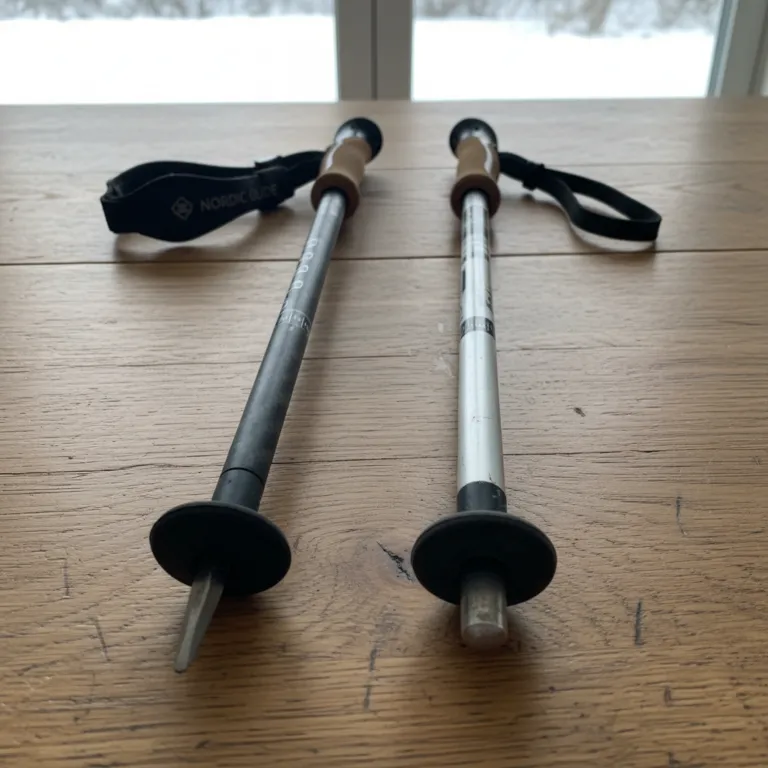
Used by INWA-certified Nordic walking systems (LEKI Trigger, Exel, Swix). The strap wraps around the hand like a fingerless glove. When pushing, you push against the strap rather than squeezing the grip. This allows you to open your hand completely on the forward swing — the hallmark of proper technique. Essential for maximizing upper body engagement and minimizing hand fatigue.
Loop Straps
Common on budget poles and trekking poles. The wrist loop prevents dropping but doesn’t allow the open-hand technique. For pure Nordic walking, these limit performance significantly.
Grip Materials
- Cork: Warm, absorbs moisture, molds to hand shape over time. Premium choice
- Foam: Lightweight, comfortable, good in cold weather, less durable
- Rubber: Durable, good in cold/wet, can cause blisters in long sessions
Tip Systems
- Carbide tip: Standard for most poles; penetrates soft ground and provides grip on hard surfaces. Replace when worn to a flat point
- Rubber boot (paw): Fits over carbide tip for urban use; increases traction on pavement, protects surfaces. Most poles include these
- Baskets: Snow baskets for winter; mud baskets for soft terrain. Most poles have removable systems
Price Tiers and What You Get
| Price Range | Material | Strap System | Representative Models |
|---|---|---|---|
| Under €40 | Aluminum | Basic loop | Generic brands, supermarket poles |
| €40–80 | Aluminum | Improved glove | Leki Response Shark, Exel Nordic Walker |
| €80–150 | Aluminum/composite | Good glove strap | Swix CT4, Leki Cressida Shark, Exel Premium |
| €150–250 | Carbon | Premium glove | Leki MCT Nordic Walking, Swix Nordic |
| Over €250 | High-mod carbon | Best available | Exel World Cup, specialist brands |
Calculating the Right Length
Standard formula: height (cm) × 0.68 = pole length. For beginners or those seeking more support, use × 0.70. For faster-paced walking or experienced users, × 0.66. Always verify by standing with the pole tip at your foot: elbow should be at approximately 90 degrees.
Maintenance and Longevity
- Rinse poles with fresh water after muddy or coastal walks
- Check locking mechanisms (adjustable poles) before each use
- Replace rubber boot tips when worn (typically every 300–500 km)
- Store hanging or lying flat — not compressed in closed position for extended periods
- Carbon poles: inspect for hairline cracks after any significant impact
The best Nordic walking poles are the ones matched to your budget and walking style. A good entry-level aluminum pole with a proper glove strap system will give you significantly better results than an expensive carbon pole with a basic loop strap. Prioritize the strap system and correct length over material and price point.
Explore More
Related tools: Calculate Your Pole Length
Recommended reading: Best Nordic Walking Poles 2026 | How to Choose Poles
Never buy Nordic walking poles based on weight alone. A 30g difference is irrelevant; a poor strap system that does not engage your triceps negates the entire upper-body benefit. The strap is the most important component — test it in the shop by pushing through it with an open hand.
Pole Length Guide for Different Use Cases
The standard formula (height × 0.68) applies to flat Nordic walking. Different disciplines and terrains require adjustments that pole guides rarely mention:
- Flat Nordic walking: height × 0.68 (elbow at 90 degrees with tip on ground)
- Hilly terrain: telescopic poles, shorten 5cm for steep climbs, lengthen 5cm for steep descents
- Trail running with poles: height × 0.65 (shorter for more aggressive planting rhythm)
- Post-surgical walking: slightly longer than formula (adds offloading leverage), consult physiotherapist
- Beginners: start 2cm shorter than formula — common mistake is too-long poles
The Hidden Cost of Cheap Poles
Budget poles under $30 share a common failure mode: the locking mechanism fails under load after 3-6 months. The pole collapses mid-walk — a safety issue, not just an inconvenience. Telescopic poles require locking mechanisms that can withstand repeated push loads of 15-25kg. Cheap mechanisms use thin plastic teeth that wear within months.
The minimum viable investment for reliable Nordic walking poles is approximately $55-65 for a quality aluminum pair (Komperdell, Black Diamond, or better-grade TrailBuddy). Anything below this price point uses locking mechanisms that will fail. The $30 poles at department stores are not cheaper versions of good poles — they are a different, inferior product category.
Frequently Asked Questions
What is the best Nordic walking pole brand?
Leki dominates the performance segment with the best strap systems in the industry. Swix and Exel are preferred by competitive Nordic walkers for their lightweight carbon shafts. For budget buyers, TrailBuddy and Black Diamond offer reliable and affordable aluminum options that work well for beginners. Brand matters less than strap quality and correct sizing.
How much should I spend on Nordic walking poles?
Beginners should start with a quality aluminum telescopic pair. Intermediate walkers doing 3+ sessions per week benefit from carbon or carbon-blend models. Serious and competitive walkers should invest in premium carbon with top-tier strap systems. Browse Nordic Walking Poles on Amazon to compare current prices across all tiers.
Can I use trekking poles for Nordic walking?
Technically yes, but it is not recommended. Trekking poles lack the glove-style open-hand strap system that enables proper Nordic walking technique. You end up gripping rather than pushing, losing 30-40% of the cardiovascular and muscular benefit. If you are serious about Nordic walking, dedicated Nordic walking poles are worth the investment.