Summit Training at Home: 12-Week Program to Prepare for Any Mountain
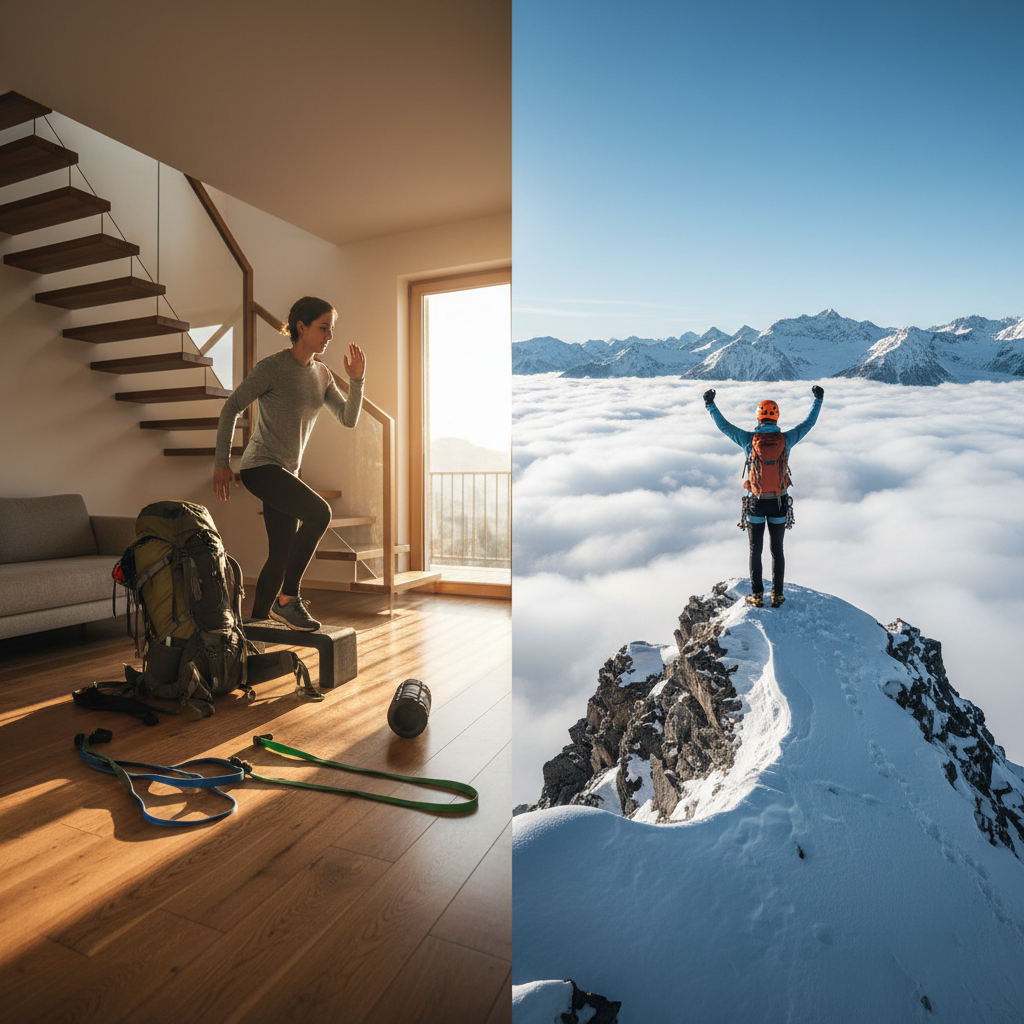
The summit does not care where you trained. It does not care if you have a gym membership or a home gym or a staircase and a loaded backpack. It only cares whether your legs can push for 8 hours, whether your lungs can work at 60% oxygen, and whether your mind can override the voice that says “turn around.” Every great mountaineer prepares the same way: specificity. You train the exact movements, energy systems, and mental patterns that the mountain will demand. And you can do all of it from your living room.
Key Takeaways
Summit fitness can be built entirely at home in 12 weeks across three phases; the benchmark of readiness is completing 1,000 weighted step-ups in a single session.
- Readiness test: 1,000 weighted step-ups in one session means you can summit most peaks.
- Three phases: Foundation (weeks 1-4), Building (weeks 5-8) and Peak (weeks 9-12).
- Peak phase: 2+ hours of continuous stair climbing or step-ups to simulate summit days.
- Key gear: a weighted vest progressed from bodyweight to 30+ lb, plus a stair stepper.
- The demand: summits require legs that push for 8 hours and lungs that work at ~60% oxygen.
What the Mountain Demands
Before we discuss gear, understand what climbing actually requires of your body:
| Physical Demand | What It Means | How to Train It |
|---|---|---|
| Aerobic endurance | Walking 6-12 hours at 60-70% max HR | Long stair sessions, weighted walks, Zone 2 cardio |
| Leg strength | Thousands of weighted step-ups per day | Squats, lunges, step-ups, single-leg work |
| Core stability | Balancing on uneven terrain with 30+ lb pack | Planks, pallof press, anti-rotation exercises |
| Ankle/knee resilience | Constant downhill impact, lateral slopes | Balance boards, wobble pads, eccentric squats |
| Respiratory capacity | Breathing at altitude (40-60% less oxygen) | Respiratory trainers, high-intensity intervals |
| Load carrying | 20-40 lb pack for 8+ hours | Weighted vest training, loaded carries |
| Mental toughness | Pushing through fatigue, cold, fear | Deliberate discomfort, long monotonous sessions |
The 12-Week Summit Prep Program
This program assumes you are starting from a moderate fitness base (can walk 60 minutes without stopping). Adjust intensity down if you are less fit, or up if you are already athletic.
Phase 1: Foundation (Weeks 1-4)
Goal: Build aerobic base + leg strength + movement patterns
| Day | Session | Duration | Details |
|---|---|---|---|
| Mon | Stair Climbing | 30 min | Continuous stair climbing or step-ups at home. HR Zone 2. Add 5 min each week. |
| Tue | Strength A | 40 min | Squats 3×12, Lunges 3×10/side, Step-ups 3×12/side, Planks 3x45s, Glute bridges 3×15 |
| Wed | Active Recovery | 30 min | Easy walk or Nordic walking. Foam rolling. Stretching. |
| Thu | Strength B | 40 min | Single-leg deadlift 3×10, Wall sit 3x60s, Calf raises 3×20, Side plank 3x30s, TRX rows 3×12 |
| Fri | Long Cardio | 45-60 min | Brisk walk or Nordic walking with light pack. Build duration weekly. |
| Sat | Balance + Core | 30 min | BOSU squats, wobble board, yoga balance poses, dead bugs, bird dogs |
| Sun | Rest | — | Full rest. Sleep 8+ hours. |
Phase 2: Building (Weeks 5-8)
Goal: Add load, increase duration, introduce altitude simulation
| Day | Session | Duration | Details |
|---|---|---|---|
| Mon | Weighted Stairs | 45 min | Add 10-15 lb weighted vest or loaded pack. Continuous climb. HR Zone 2-3. |
| Tue | Strength A (heavy) | 50 min | Goblet squat 4×10 (kettlebell), Bulgarian split squat 3×8/side, Step-ups with weight 4×10, Pallof press 3×10 |
| Wed | Respiratory Training | 20 min | PowerBreathe or Training Mask intervals: 5×3 min hard / 2 min rest. Then 20 min easy walk. |
| Thu | Strength B (heavy) | 50 min | Weighted lunges 4×8, Pistol squat progressions 3×5, Calf raises (single leg) 3×15, TRX pike 3×10 |
| Fri | Long Session | 90 min | Weighted walk (20 lb) with Nordic poles. Simulate trail pace. Hill repeats if available. |
| Sat | Intervals | 40 min | Step-up intervals: 4×5 min fast / 2 min rest. Or stair sprint intervals. |
| Sun | Recovery | 30 min | Foam rolling, stretching, gentle yoga. Theragun on quads and calves. |
Phase 3: Peak (Weeks 9-12)
Goal: Maximum specificity — simulate summit conditions at home
| Day | Session | Duration | Details |
|---|---|---|---|
| Mon | Summit Simulation | 2-3 hours | 30+ lb vest. Stair climbing or step-ups for 2+ hours continuous. This is your “mountain day.” |
| Tue | Recovery | 30 min | Easy walk. Full recovery protocol: foam roll, stretch, Theragun. |
| Wed | Strength (maintenance) | 40 min | Reduce volume, maintain intensity. Heavy goblet squats, split squats, core work. |
| Thu | Respiratory + Intervals | 45 min | Training Mask intervals on stairs: 6×4 min hard / 2 min easy. Simulates altitude stress. |
| Fri | Long Weighted Walk | 3-4 hours | Full pack weight. Walk for as long as possible. This is your dress rehearsal. |
| Sat | Taper (Week 12) | 30 min | Easy movement only. Reduce volume 50%. Maintain some intensity. Sleep and eat well. |
| Sun | Rest | — | Week 12: full taper. You are ready. |
The single best exercise for mountain preparation is the weighted step-up. It replicates the exact movement of ascending — one leg pushing your body weight plus pack weight up a vertical distance. Do them on a sturdy chair, bench, or staircase. Start with bodyweight, progress to 30+ lbs. If you can do 1,000 weighted step-ups in a session, you can summit most peaks.
Essential Home Training Gear
Cardio and Endurance
Yes4All Adjustable Weighted Vest 20lb
Adjustable 1-20 lbs · Secure fit · Mesh ventilation · Pockets for weight plates
Sunny Health Mini Stair Stepper
Hydraulic resistance · LCD counter · Resistance bands included · Compact · Under-desk fit
Strength Training
TRX All-in-One Suspension Trainer
Door anchor · 300+ exercises · Full body · 1.5 lbs · Travel-friendly · Used by military
Yes4All Vinyl Coated Kettlebell 35lb
Cast iron · Vinyl coat protects floors · Wide handle · Goblet squats, swings, Turkish get-ups
Fit Simplify Resistance Loop Bands (Set of 5)
5 resistance levels · Latex · Portable · Glute activation, clamshells, monster walks
Balance and Stability
Mountain terrain is never flat. Training on unstable surfaces builds ankle proprioception and knee stability — the two things that prevent falls and injuries on uneven ground.
BOSU Balance Trainer Pro
Half-ball + platform · Squats, lunges, push-ups on unstable surface · Pump included · 65 cm
AIREX Balance Pad
Closed-cell foam · Single-leg stands, squats · Physical therapy grade · 16×20 inches
Altitude Simulation
You cannot replicate 14,000 feet in your living room. But you can train your respiratory muscles to work harder with less oxygen — so when you do reach altitude, your breathing system is pre-adapted.
PowerBreathe Plus Respiratory Trainer
Adjustable inspiratory resistance · 30 breaths 2x/day · Strengthens diaphragm and intercostals
Training Mask 3.0
6 resistance levels · Restricts airflow · Forces harder breathing · Not true altitude but builds respiratory endurance
Training masks do NOT simulate true altitude (they restrict airflow, not oxygen percentage). However, they do strengthen respiratory muscles and increase breathing efficiency — which is genuinely useful at altitude. Think of it as weight training for your lungs, not altitude acclimatization.
Recovery
Recovery is where adaptation happens. Hard training tears muscle fibers; rest rebuilds them stronger. Skimp on recovery and you arrive at the mountain pre-injured.
TriggerPoint GRID Foam Roller
Multi-density surface · Hollow core · 500 lb weight limit · Quads, IT band, calves, back
Theragun Mini
3 speeds · 3 attachments · 150 min battery · Portable · Targeted deep-tissue percussion
The “No Stairs” Problem — Solutions
If you live in a single-story home with no stairs, here are alternatives:
- Step-ups on a sturdy box or chair — 12-18 inch height, alternating legs, weighted vest
- Mini stepper machine — compact, fits under a desk, simulates stair climbing
- Parking garage stairs — free, tall, and usually empty at off-hours
- Stadium bleachers — high school or college stadiums are often open to the public
- Treadmill at max incline (15%) — set to 15% grade, 2-3 mph, weighted vest
Nutrition for Summit Prep
| Phase | Calories | Protein | Focus |
|---|---|---|---|
| Building (Weeks 1-8) | Maintenance or slight surplus | 1.6-2.0 g/kg body weight | Fuel training, build muscle, recover |
| Peak (Weeks 9-11) | Slight surplus | 1.6 g/kg | Glycogen loading, maximal recovery |
| Taper (Week 12) | Maintenance | 1.4 g/kg | Carb loading final 3 days, hydration |
| Summit Day | 200-300 cal/hour on the move | Minimal (digestion is slow at altitude) | Simple carbs, gels, electrolytes, constant sipping |
For a complete nutrition guide, see our Nordic Walking Nutrition Guide — the principles apply directly to mountain preparation.
Mental Training: The Forgotten 50%
Physical fitness gets you to the mountain. Mental fitness gets you to the top. Train your mind as deliberately as you train your legs:
- Visualization. Close your eyes for 5 minutes daily. Visualize yourself on the summit — the cold, the wind, the view, the fatigue in your legs, and the choice to keep moving. Make it vivid. Your brain cannot tell the difference between vivid imagination and reality — it builds the same neural pathways.
- Embrace boredom. Do your stair sessions without music, without podcasts. Just the sound of your breathing and your footsteps. The mountain will not have entertainment. Learn to be comfortable in the silence of effort.
- “One more step” mantra. When your legs burn on the last set of step-ups, do not think about the remaining reps. Think only about the next single step. This exact skill will save you above 12,000 feet.
- Cold exposure. End your shower with 30-60 seconds of cold water. Progress to 2-3 minutes over weeks. This builds tolerance for discomfort — the core skill of mountaineering.
When to Start Training
| Your Mountain | Elevation | Prep Time Needed | Fitness Baseline Required |
|---|---|---|---|
| Day hike (5,000-8,000 ft) | Low-moderate | 4-6 weeks | Can walk 60 min |
| 14er (Colorado, etc.) | 14,000+ ft | 8-12 weeks | Can walk 2 hours with pack |
| Mt. Kilimanjaro | 19,341 ft | 12-16 weeks | Can walk 4+ hours with pack |
| Mont Blanc | 15,774 ft | 16-20 weeks | Strong hiker, some climbing experience |
| Mt. Rainier | 14,411 ft | 16-24 weeks | Technical — glacier travel, crampon skills |
The Complete Home Summit Training Kit
| Priority | Item | Why |
|---|---|---|
| 🔴 Must | Weighted vest (20 lb) | Simulates pack weight for stairs and walks |
| 🔴 Must | Sturdy step/box (12-18 in) | Step-ups are the #1 mountain exercise |
| 🔴 Must | Foam roller | Daily recovery prevents overuse injuries |
| 🟡 High | TRX suspension trainer | Full-body strength with zero floor space |
| 🟡 High | Kettlebell (35 lb) | Goblet squats, swings, loaded carries |
| 🟡 High | Resistance bands (set) | Glute activation, warm-ups, rehab |
| 🟢 Nice | BOSU or balance pad | Ankle stability for uneven terrain |
| 🟢 Nice | PowerBreathe respiratory trainer | Breathing efficiency at altitude |
| 🟢 Nice | Mini stepper machine | Stair climbing without stairs |
| 🟢 Nice | Theragun Mini | Targeted muscle recovery |
Bottom Line
The mountain does not require a gym. It requires specificity. Step-ups, squats, weighted walks, and long sessions on the stairs — done consistently for 12 weeks — will prepare your body for almost any peak. Add a weighted vest, a TRX, and a foam roller to your living room and you have everything you need.
The summit is earned at home. One step-up at a time.
Our Top Pick
📚 See also:
- fastpacking training protocols — Fastpacking Guide

About the Author
Alex Mercer — INWA Level 2 Nordic Walking Instructor
Certified by the International Nordic Walking Federation (INWA) since 2019, Alex has coached 500+ walkers from beginners to ultra-distance competitors. Sports science background with a focus on biomechanics, gait analysis, and evidence-based training protocols. Regular contributor to walking and outdoor publications.