Hammock Camping: The Complete Guide to Sleeping Between Trees
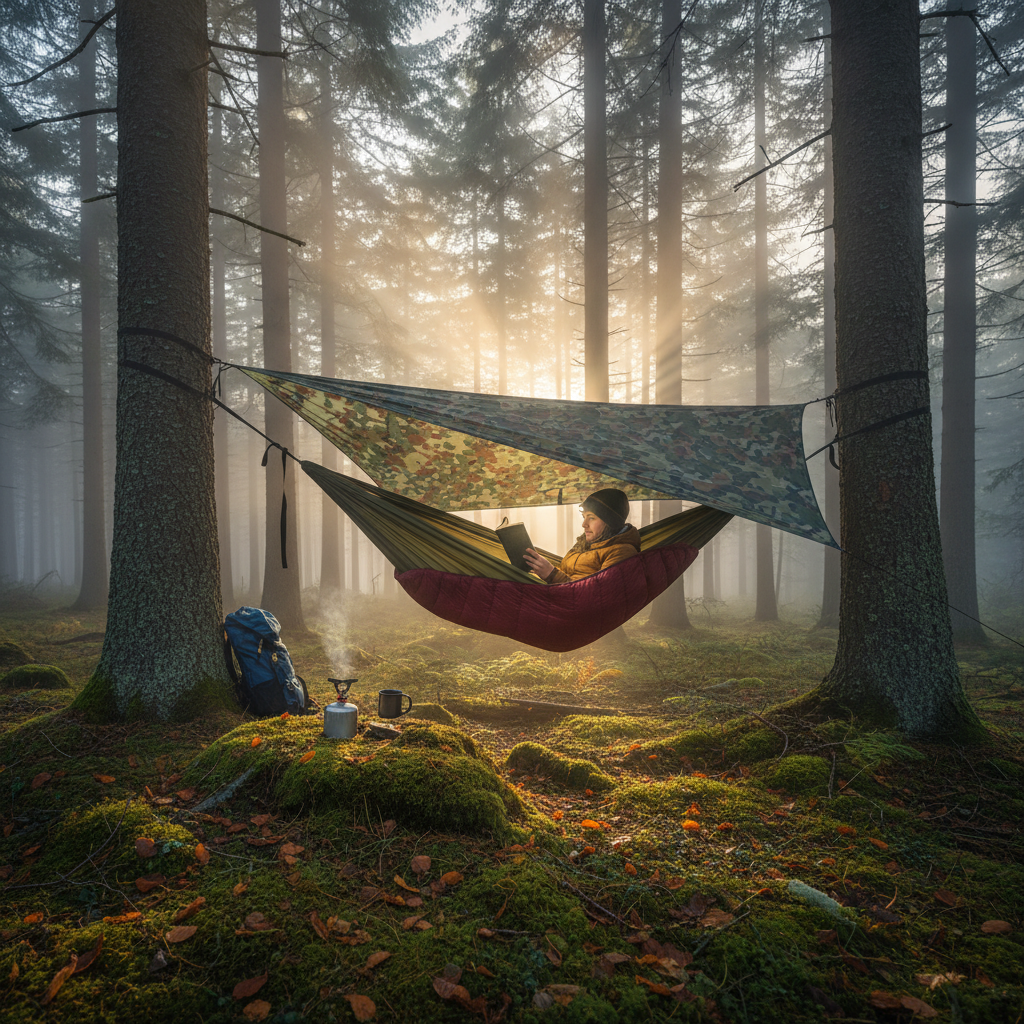
Imagine sleeping suspended between two pines, swaying gently in the breeze, looking up at stars through a mesh canopy while the forest floor — with its rocks, roots, and puddles — is 3 feet below you. No flat ground required. No clearing needed. No rock-in-your-back at 2 AM. Hammock camping is not just an alternative to tent camping — for many hikers, it is a permanent upgrade. Here is everything you need to go from ground-dweller to tree-sleeper.
Key Takeaways
Hammock camping needs no flat ground and sets up in under two minutes; comfort comes from a diagonal lay at a 15 to 30 degree angle and a 30-degree strap sag.
- Setup speed: a quality system pitches in under 2 minutes between two trees.
- Diagonal lay: lie at a 15-30 degree angle across the hammock for a flat, comfortable position.
- Correct sag: hang with a gentle 30-degree curve, not stretched flat like a bridge.
- Five components: hammock, suspension, bug net, rain tarp and underquilt or pad.
- Tree care: use flat straps at least 1 inch wide to protect the bark.
Why Hammock Camping Wins
| Factor | Hammock | Tent |
|---|---|---|
| Setup surface | Any two trees 12-15 ft apart | Flat, clear ground (rare in forests) |
| Comfort | Suspended — no rocks, roots, slopes | Ground contact — depends on pad |
| Weight (full system) | 2-4 lbs (hammock + tarp + suspension) | 3-5 lbs (tent + poles + stakes) |
| Pack size | Softball-sized | Large cylinder |
| Setup time | 2-5 minutes | 5-10 minutes |
| Rain | Tarp above, off the ground | Ground sheet + seam sealing needed |
| Bugs | Enclosed net from all sides | Similar protection if sealed |
| Cold weather | Needs underquilt (air below = cold) | Pad handles insulation |
| Wind | More exposed (no windbreak walls) | Better wind protection |
| Above treeline | No trees = no hammock | Works anywhere with stakes |
The #1 mistake new hammock campers make: lying straight like in a bed. The correct position is a diagonal lay — position yourself at a 15-30° angle across the hammock. This flattens the curve, eliminates shoulder squeeze, and gives you a perfectly flat sleeping surface. It is the difference between “this is terrible” and “I am never going back to a tent.”
The Hammock Camping System — 5 Components
Unlike a tent (one purchase = done), a hammock system has modular layers. Think of it like clothing layers — each one serves a purpose:
- Hammock — the bed itself
- Suspension — straps that connect to trees (tree-friendly, no damage)
- Rain tarp — protection from rain and wind
- Insulation — underquilt (below) and top quilt (above)
- Bug net — mesh protection from insects (some hammocks have this built in)
Best Hammocks
Hennessy Hammock Explorer Deluxe
Asymmetric design · Integrated bug net + fly · Bottom entry · 2 lbs 7 oz · 200 lb capacity
ENO DoubleNest Hammock
2-person · 400 lb capacity · 19 oz · 9’4″ x 6’2″ · Triple-stitch · 30+ colors
Wise Owl Outfitters Hammock
2-person · 500 lb capacity · 16 oz · 10′ x 6’6″ · Nautical-grade carabiners · Budget king
Suspension Systems
Rope damages trees and slips. Proper hammock straps are flat, wide (1″+ webbing), and distribute pressure across the bark surface without harming the tree. Non-negotiable — most parks require tree-friendly straps.
ENO Atlas Suspension Straps
30 adjustment points · 400 lb capacity · 1″ polyester · No knots needed · 11 oz per set
Wise Owl Outfitters Hammock Straps
36 loops · 500 lb capacity · 10 ft each · No-stretch polyester · 8 oz · Budget pick
Rain Tarps
A tarp above your hammock is the difference between sleeping dry and sleeping miserable. Even on clear nights, dew and morning drizzle can soak you without a tarp. Set it up every night — even if the forecast says clear.
ENO ProFly Rain Tarp
70D ripstop nylon · DWR coating · 10’6″ x 6’5″ · 22 oz · 6 guy-out points · Full coverage
Kelty Noah’s Tarp 12
12′ x 12′ square · 40D polyester · Multiple pitch configs · 1 lb 15 oz · Works for tents too
Insulation: The Cold-Below Problem
In a tent, your sleeping pad insulates you from the cold ground. In a hammock, there is nothing below you but air — and compressed insulation (your sleeping bag) provides zero warmth on the bottom. Below 60°F, you will feel cold from underneath. The solution is an underquilt — a insulated blanket that hangs under the hammock outside, trapping warm air.
ENO Vulcan Underquilt
Synthetic insulation · Adjustable · 35°F comfort · 25 oz · Shock cord attachment · Stuffs small
OneTigris Hammock Underquilt
40°F comfort · Synthetic fill · 22 oz · Adjustable · Budget-friendly · Good 3-season option
Snugpak Hammock Quilt
Top quilt + under quilt combo · Synthetic · 40°F · 2 lbs 7 oz · Full sleep system
Bug Nets
If your hammock does not have a built-in bug net (Hennessy does, ENO does not), a separate net is essential in mosquito season. A single mosquito inside your hammock at midnight will ruin your sleep more effectively than any thunderstorm.
ENO Guardian SL Bug Net
Full enclosure · 19 oz · No-see-um mesh · Fits all ENO hammocks · Shock cord hem
How to Set Up a Hammock Camp
- Find two trees — 12-15 feet apart, alive, at least 6″ diameter. Avoid dead trees (widow-makers).
- Wrap straps at shoulder height — the hammock will sag to hip height once loaded.
- Clip hammock — attach carabiners to strap loops. Aim for a 30° hang angle (not taut like a bridge).
- Test sit — sit in the middle. Your butt should be about 18″ off the ground.
- Adjust for diagonal lay — move your head to one side, feet to the other. You should feel flat.
- Hang tarp above — use a ridgeline between the same trees, higher than the hammock. Tarp extends 12″ past each end.
- Attach underquilt — hangs under the hammock, outside the fabric. Adjust until it covers your torso area.
- Enter and enjoy — sleep diagonally, head slightly elevated.
Hammock Camping by Season
| Season | Hammock | Tarp | Insulation | Bug Net |
|---|---|---|---|---|
| Summer (70°F+) | Any hammock | Optional (rain only) | None or light top sheet | Essential |
| Spring/Fall (40-65°F) | Any hammock | Always | Underquilt (40°F) + top quilt | Optional (fewer bugs) |
| Cold (20-40°F) | Double-layer preferred | Always, with doors | Down underquilt (20°F) + sleeping bag | Not needed |
| Winter (below 20°F) | Winter-rated system | Full coverage with doors | Down UQ + winter bag + top quilt | Not needed |
Complete Hammock Camping Kits
| Budget | Hammock | Straps | Tarp | Insulation | Total Weight |
|---|---|---|---|---|---|
| Budget ($80-130) | Wise Owl | Wise Owl Straps | Generic tarp | Sleeping bag liner | ~3 lbs |
| Mid ($200-350) | ENO DoubleNest | ENO Atlas | ENO ProFly | OneTigris UQ | ~4.5 lbs |
| Premium ($400-600) | Hennessy Explorer | Included | Included | ENO Vulcan UQ | ~4 lbs |
Hammock Camping + Nordic Walking
The combination of Nordic walking poles and hammock camping is a thru-hiker’s dream: poles provide stability and upper-body engagement on the trail, then double as tarp ridgeline supports at camp. Thread your tarp ridgeline between two poles planted in the ground for a quick shelter setup without needing trees for the tarp (though you still need trees for the hammock).
For more overnight gear tips, see our Multi-Day Trekking Gear Checklist.
Common Mistakes
- Hanging too tight. A hammock should have a gentle curve (30° sag), not be stretched flat like a bridge. Flat = uncomfortable and hard on stitching.
- Forgetting insulation below 60°F. Your sleeping bag compresses under your weight and provides zero insulation underneath. You will be cold. Bring an underquilt.
- Lying straight. Diagonal lay at 15-30° is how hammock sleeping works. Go diagonal or go uncomfortable.
- Skipping the tarp. Even on clear nights, dew can soak you. Tarp goes up every night.
- Using rope on trees. Rope damages bark and is illegal in many parks. Use 1″+ flat webbing straps.
- Hanging too high. Your hammock should be ~18″ off the ground when you sit in it. Higher = harder entry + further to fall.
Bottom Line
Hammock camping is not for everyone — if you hike above treeline or in desert environments, a tent wins. But for forest trails, thru-hikes through wooded terrain, and anyone tired of sleeping on roots and rocks, a hammock system is lighter, more comfortable, and faster to set up than any tent at the same price point.
Start with a Wise Owl and straps for under $40. Try one night in your backyard. If you wake up wondering why you ever slept on the ground — welcome to the tribe.
Our Top Pick

About the Author
Alex Mercer — INWA Level 2 Nordic Walking Instructor
Certified by the International Nordic Walking Federation (INWA) since 2019, Alex has coached 500+ walkers from beginners to ultra-distance competitors. Sports science background with a focus on biomechanics, gait analysis, and evidence-based training protocols. Regular contributor to walking and outdoor publications.