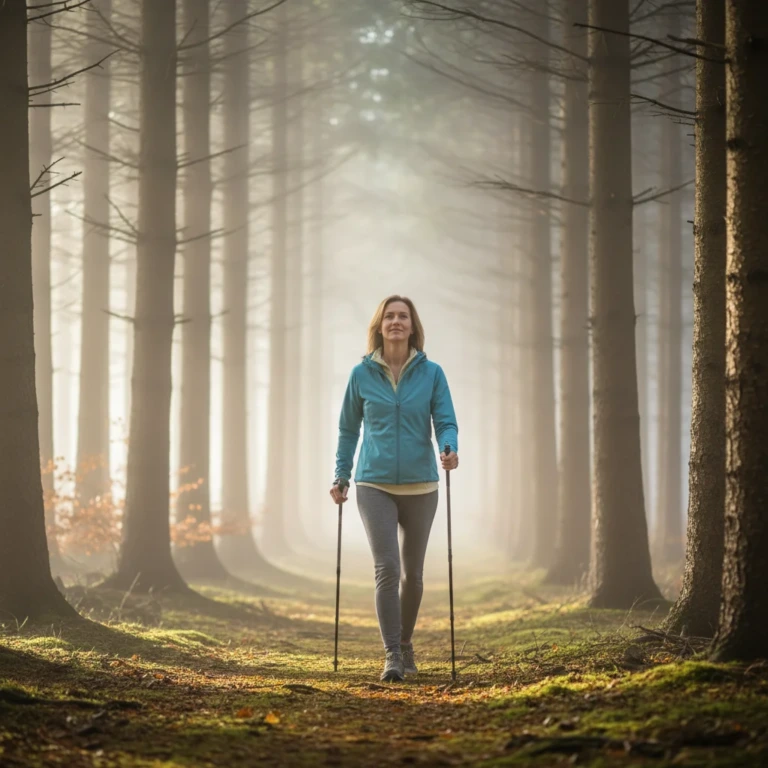
Nordic Walking for Stroke Recovery: Rebuilding Gait, Balance & Independence

In 2019 there were about 12 million new strokes worldwide (Global Burden of Disease Study 2019), and many survivors are left with lasting disability. The standard rehab prescription — “walk more” — ignores a critical problem: most stroke survivors walk asymmetrically, loading one side of the body while the other atrophies. Nordic walking may help. The poles encourage both arms to work, give a steady rhythm, and add support, which can involve the paretic (weakened) side more than walking without poles. The evidence is promising but early: a small randomised trial in adults after stroke found greater gains in balance and gait with Nordic-pole treadmill training than with treadmill training alone, and a trial in children with hemiparesis found better gait symmetry. Larger studies are still needed.
Key Takeaways
Nordic walking may support stroke recovery by encouraging both sides of the body to work and giving rhythm and support while walking. Early trials are small but encouraging: 6 weeks of Nordic-pole treadmill training improved balance, gait and daily activities more than treadmill training alone in 30 stroke patients.
- Balance and mobility: a 2016 RCT (Kang et al.) found greater improvements in Berg Balance, Timed Up & Go and walking tests with Nordic treadmill training than with treadmill training alone.
- Walking speed: about 0.8 m/s is the classic threshold between limited and full community walking (Perry et al., 1995); how far Nordic walking moves people toward it is not yet known.
- Gait symmetry: a 2026 RCT in children with hemiparesis found better gait symmetry and affected-side step length with Nordic walking.
- Bilateral activation: poles encourage both sides to work, countering the one-sided loading common after stroke.
- Reconditioning: peak fitness after stroke is often only 26-87% of that of healthy peers; walking-based aerobic training is recommended to rebuild it.
The Evidence: What Clinical Research Shows
| Study | Year | Key Finding |
|---|---|---|
| RCT — Nordic Treadmill Training vs Treadmill Training (Kang et al., J Stroke Cerebrovasc Dis) | 2016 | 30 stroke patients, 30 min a day, 5 days a week for 6 weeks. Both groups improved; the Nordic-pole group improved more in balance (Berg, Timed Up & Go), gait (10-meter and 6-minute walk tests) and daily activities. |
| Systematic Review — Walking Training with Poles (Ono et al., PM&R) | 2023 | 13 RCTs, 750 participants. Pooled results were possible only for Parkinson’s disease and older adults: moderate-quality evidence that pole walking improves walking speed in Parkinson’s, no significant effect on walking speed in older adults. |
| RCT — Children with Hemiparesis (Nashed et al., Physiother Res Int) | 2026 | 40 children aged 6-10. Replacing 20 minutes of gait training with Nordic walking for 3 months gave a lower gait symmetry index, longer affected-side steps and higher cadence than conventional therapy alone. |
| Walking Aids Comparison — Early Rehab (Allet et al., Arch Phys Med Rehabil) | 2009 | 25 inpatients with hemiparesis tried three aids. A simple cane gave the longest walking distance and highest speed; the Nordic stick did not improve step-length symmetry. Poles are not automatically better than a cane early in rehab. |
| Cochrane Review — Fitness Training After Stroke (Saunders et al.) | 2020 | 75 trials, 3,017 participants. Walking-based cardiorespiratory and mixed training improve fitness, balance and walking speed and capacity; too little data to judge effects on quality of life. |
For stroke survivors, the key advantage of Nordic walking over regular walking is forced bilateral engagement. The poles create a rhythmic, alternating arm-swing pattern that may help engage the paretic side through the coupling of upper and lower limbs. This cross-body activation — left arm with right leg, right arm with left leg — is the same contralateral pattern that stroke disrupts. Nordic walking practises this pattern with every step, although how much it speeds recovery is still being studied.
6 Mechanisms: How Nordic Walking Aids Stroke Recovery
1. Forced Bilateral Activation
Stroke typically weakens one side of the body (hemiparesis). During regular walking, the strong side compensates — the weak side “goes along for the ride.” Nordic poles change this equation: both hands must grip and push. The paretic arm is recruited into every stride cycle, giving it repeated practice — and repetitive practice is a core principle of motor recovery after stroke. The idea is related to forced use, the concept behind constraint-induced movement therapy, though Nordic walking has not been tested as a substitute for it.
2. Gait Symmetry Restoration
Hemiplegic gait is characterized by asymmetric step length, swing time, and stance duration. The poles create external timing cues — each pole plant sets the rhythm for the contralateral leg. With practice, this may help the gait pattern become more symmetrical. A 2026 randomised trial in children with hemiparesis found a lower gait symmetry index and longer affected-side steps with Nordic walking training (Nashed et al.); comparable trials in adult stroke survivors are still lacking.
3. Balance and Fall Prevention
Stroke survivors fall much more often than people of the same age who have not had a stroke. Nordic walking provides four points of ground contact instead of two, widening the base of support, and the poles can help you catch your balance. In the Kang et al. (2016) trial, Berg Balance Scale scores improved more with Nordic-pole treadmill training than with treadmill training alone; whether this lowers fall rates has not been tested.
4. Walking Speed and Endurance
Walking speed after stroke is one of the strongest predictors of community reintegration and independence. Speeds of about 0.4-0.8 m/s are classified as “limited community ambulators” (Perry et al., 1995, Stroke). Poles may help speed through two mechanisms: the poles generate propulsive force (pushing you forward) and the rhythmic pattern increases cadence. Kang et al. (2016) found greater improvement on the 10-meter walk test with Nordic-pole treadmill training than with treadmill training alone, but how large and lasting the speed gains are is not yet clear.
5. Cardiovascular Reconditioning
Post-stroke deconditioning is common: a systematic review found peak oxygen uptake in stroke survivors was 26-87% of that of healthy people of the same age and sex (Smith et al., 2012, International Journal of Stroke). Nordic walking adds arm and trunk work to the leg work of walking and raises oxygen use at the same speed (by about 20% in healthy adults), which helps bring heart rate into training zones. In healthy adults the extra work did not raise perceived effort; whether stroke survivors can walk longer before fatigue with poles has not been tested.
6. Neuroplasticity Through Rhythmic Movement
Repetitive, rhythmic practice is thought to support the brain’s reorganization after stroke. Each Nordic walking session delivers thousands of coordinated arm-leg cycles of this kind of practice. The idea is related to rhythmic auditory stimulation (RAS) used in gait rehab, where a beat paces the steps, but Nordic walking itself has not been studied for this effect.
Who Can Benefit? (Stroke Phase Guide)
| Phase | Timeframe | Nordic Walking Suitability | Notes |
|---|---|---|---|
| Acute | 0-7 days | Not appropriate | Medical stabilization priority. Bed rest or supervised mobilization only. |
| Subacute (early) | 1-4 weeks | Not yet — focus on standing tolerance | Begin standing balance, weight-shifting exercises with physiotherapist. |
| Subacute (late) | 1-3 months | Possible with therapist supervision | If able to walk 10+ meters with or without assistive device. Poles provide stability. |
| Chronic (mild impairment) | 3+ months | Excellent candidate | Can walk independently. Nordic walking adds challenge + symmetry training. |
| Chronic (moderate impairment) | 3+ months | Good candidate with modifications | May need wrist strap adaptation for paretic hand. Supervision recommended initially. |
| Chronic (severe impairment) | 3+ months | Limited — consider pole-assisted standing | If unable to walk 10 meters independently, Nordic walking may not be feasible yet. |
The 8-Week Stroke Recovery Walking Protocol
| Week | Sessions | Duration | Focus |
|---|---|---|---|
| 1-2 | 3x/week | 10-15 min | Pole familiarization. Focus on grip with paretic hand (use wrist strap). Flat, smooth surface only. Walking with therapist or trained companion. |
| 3-4 | 3-4x/week | 15-25 min | Rhythmic pole planting. Count “left-right-left-right” aloud. Focus on equal step length both sides. |
| 5-6 | 4x/week | 25-35 min | Increase speed gradually. Add gentle turns (practice turning toward AND away from paretic side). Begin outdoor walking on level paths. |
| 7-8 | 4-5x/week | 30-45 min | Introduce gentle inclines. Practice obstacle negotiation (curbs, uneven surfaces). Build toward independent community walking. |
The grip challenge: Many stroke survivors struggle to grip a pole with their affected hand. Solution: use poles with wrist straps (glove-style straps are best). The strap transfers force even with a weak grip. Some patients begin with the affected hand simply resting inside the strap — as strength returns, active gripping follows. Never force grip strength — let it develop naturally through repetition.
Adapting Technique for Stroke Survivors
| Challenge | Adaptation |
|---|---|
| Weak grip (paretic hand) | Use glove-style wrist straps. Velcro closure allows independent donning. Start with strap support only, progress to active grip. |
| Spasticity in affected arm | Use adjustable poles set slightly shorter on the affected side. Reduced pole length accommodates limited elbow extension. |
| Foot drop | Use an ankle-foot orthosis (AFO) with Nordic walking shoes. The poles provide stability during swing phase when foot drop causes tripping risk. |
| Visual field cut (hemianopia) | Walk with companion on affected side. Poles provide tactile feedback about ground surface, compensating for reduced visual field. |
| Balance anxiety | Start with 4-point contact pattern (both poles + both feet always in contact with ground). Progress to normal alternating pattern as confidence builds. |
| Fatigue | Use the “talk test” — if you can’t hold a conversation, slow down. Post-stroke fatigue is neurological, not just physical. Shorter, more frequent sessions are better than one long session. |
Gear for Stroke Recovery Walking
TrailBuddy Adjustable Poles
Adjustable length (critical for asymmetric setup) · Cork grip · Budget-friendly · Wrist straps included
Buy on AmazonOpens the product page on Amazon, where you can see the current price and delivery options.
New Balance 928v3 Walking Shoe
ROLLBAR stability · Extra Wide available · Medicare approved (A5500) · Firm heel counter prevents rollover
Buy on AmazonOpens the product page on Amazon, where you can see the current price and delivery options.
Hoka Bondi 9
Maximum cushion · Meta-Rocker promotes heel-to-toe transition · Reduces impact on affected joints
Buy on AmazonOpens the product page on Amazon, where you can see the current price and delivery options.
Garmin Venu 3
Heart rate monitoring · Body Battery energy tracking · GPS · Share progress data with rehab team
Buy on AmazonOpens the product page on Amazon, where you can see the current price and delivery options.
Safety for Stroke Survivors
- Get medical clearance. Always consult your neurologist or rehabilitation physician before starting Nordic walking. Ensure blood pressure is controlled and cardiac status is stable.
- Walk with a companion for the first 4-6 weeks, especially outdoors. Falls during the learning phase can cause serious injury and setback recovery.
- Choose smooth, flat surfaces initially. Uneven terrain, gravel, and wet surfaces increase fall risk. Progress to natural terrain only after 6+ weeks of confident walking.
- Monitor fatigue carefully. Post-stroke fatigue is neurological — it can onset suddenly. Stop before exhaustion. Use the Rating of Perceived Exertion (RPE) scale: stay at 3-4 out of 10.
- Watch for warning signs. Stop immediately and seek medical attention if you experience: sudden headache, vision changes, new weakness, difficulty speaking, or chest pain.
- Protect the affected side. Ensure the paretic hand is securely in the wrist strap. Check the affected foot for skin breakdown after every walk (reduced sensation may mask blisters).
- Stay hydrated. Many stroke medications (diuretics, antihypertensives) increase dehydration risk. Carry water on all walks.
Disclaimer: This article is educational and does not replace medical advice. Always consult your neurologist, rehabilitation physician, or physiotherapist before starting or modifying your exercise program after stroke. Nordic walking should complement, not replace, your prescribed rehabilitation.
References & Scientific Sources
All claims about Stroke Recovery on this page are supported by peer-reviewed clinical research. Below are the primary sources cited:
- Saunders DH, Sanderson M, Hayes S, et al. (2020). Physical fitness training for stroke patients. Cochrane Database Syst Rev. [PubMed]
- Tschentscher M, Niederseer D, Niebauer J. (2013). Health benefits of Nordic walking: a systematic review. Am J Prev Med. [PubMed]
- Billinger SA, Arena R, Bernhardt J, et al. (2014). Physical activity and exercise recommendations for stroke survivors. Stroke. [PubMed]
Citations follow APA-style format. Full-text access varies by source. This article is for informational purposes only and does not replace medical advice — consult your healthcare provider before starting any exercise program for Stroke Recovery.