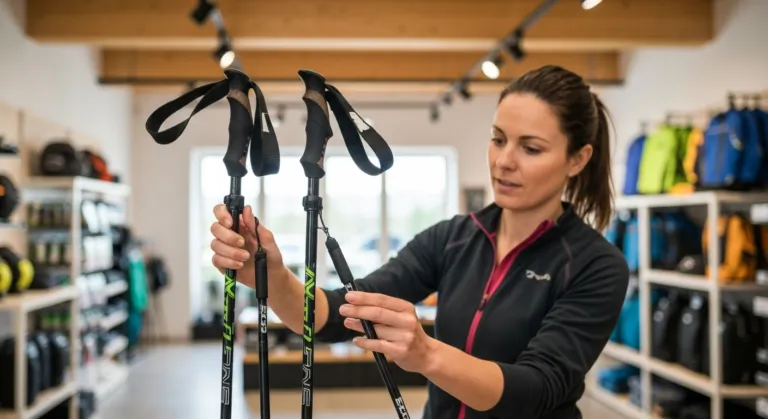
Nordic Walking for Back Pain: How Poles Decompress Your Spine and Rebuild Your Core

Your doctor said “walk more.” Your physiotherapist said “strengthen your core.” Your back said “everything hurts.” Nordic walking solves all three at once. The poles force your spine into alignment, activate deep stabilizers that protect your discs, and reduce the compressive load that makes every step painful. This is not speculation — it is biomechanics backed by clinical data. If you have chronic back pain, this may be the most important article you read this year.
Key Takeaways
Nordic walking eases back pain by forcing spinal alignment, decompressing the lumbar spine, and activating deep core stabilizers – the poles amplify arm swing 40 to 60 percent, making it the most effective disc-feeding exercise available.
- Disc nutrition: poles amplify arm swing 40-60%, pumping fluid and nutrients into spinal discs.
- Decompression: each pole plant offloads the spine, sparing it hundreds of kilograms of cumulative compression per hour.
- Core: the pole rhythm triggers an automatic deep-core brace that protects the discs.
- 6-week protocol: progresses from flat 20-30 minute walks to mixed-terrain Zone 2 sessions with full technique.
- Post-surgery: suitable from 6+ weeks for gentle progressive loading with clearance.
Why Your Back Hurts When You Walk (And Why Poles Fix It)
Most back pain during walking comes from three biomechanical failures:
| Problem | What Happens | How Poles Fix It |
|---|---|---|
| Spinal compression | Gravity + pack weight compresses discs with each step | Poles transfer 15-20% of load to upper body — discs decompress |
| Weak core | Deep stabilizers inactive → lumbar spine flexes under load | Pole push forces anti-rotation engagement → core trains automatically |
| Poor posture | Forward lean, rounded shoulders, head position ahead of spine | Poles enforce upright posture — eyes forward, chest open, shoulders back |
| Hip flexor tightness | Sitting shortens hip flexors → pulls pelvis into anterior tilt → lower back arches | Full stride with pole push lengthens hip flexors with every step |
| Glute amnesia | Glutes don’t fire → lower back compensates for hip extension | Pole technique requires glute push-off → reactivates posterior chain |
Stuart McGill, the world’s leading spine biomechanist, states that walking with active arm swing is therapeutic for disc health — discs feed through diffusion, and the rotational movement of proper walking is the optimal “pump” mechanism. Nordic walking amplifies this arm swing by 40-60%, making it the most effective disc-feeding exercise available.
The Science: What Happens to Your Spine During Nordic Walking
1. Disc Nutrition (The Sponge Effect)
Intervertebral discs have no blood supply. They absorb nutrients through diffusion — like a sponge being compressed and released. Sitting compresses discs continuously (one-way squeeze). Walking creates the compression-release cycle. Nordic walking adds thoracic rotation from the arm swing, which creates multi-directional disc compression — feeding discs from all angles.
2. Spinal Decompression (The 15-20% Rule)
Every pole plant transfers force from the spine to the upper body. Over a 60-minute walk, this means your lumbar spine “misses” several hundred kilograms of cumulative compression. For people with disc herniations, stenosis, or degenerative disc disease, this reduction can be the difference between a painful walk and a therapeutic one.
3. Core Activation (The Automatic Plank)
When you push against a pole, your core must resist rotation to keep you moving forward. This is the same anti-rotation demand as a Pallof press or plank — but you do it thousands of times per walk, at low intensity, with zero conscious effort. Your deep stabilizers (transversus abdominis, multifidus, internal obliques) train automatically.
Which Back Conditions Benefit?
| Condition | Benefit Level | Mechanism | Precaution |
|---|---|---|---|
| Non-specific lower back pain | ⭐⭐⭐⭐⭐ | Core activation + disc nutrition + posture correction | Start with 15 min, progress gradually |
| Disc herniation (non-acute) | ⭐⭐⭐⭐ | Spinal decompression reduces disc pressure | Avoid during acute flare-up. Consult MD first. |
| Degenerative disc disease | ⭐⭐⭐⭐ | Disc nutrition through movement + decompression | Start flat terrain only. No hills initially. |
| Spinal stenosis | ⭐⭐⭐⭐⭐ | Poles enable slight forward lean which opens spinal canal | Best exercise for stenosis — poles are critical |
| Sciatica | ⭐⭐⭐ | Gentle movement + decompression relieves nerve pressure | Avoid if pain radiates below knee. See specialist. |
| Post-surgery (6+ weeks) | ⭐⭐⭐⭐ | Gentle progressive loading. Poles provide stability. | Only with surgeon clearance. Start 10 min. |
| Scoliosis | ⭐⭐⭐ | Bilateral loading balances left-right asymmetry | May need asymmetric pole lengths. Consult PT. |
| Muscle spasm / acute strain | ⭐⭐ | Gentle movement can help, but rest may be needed first | Wait until acute phase passes (2-5 days) |
The 6-Week Back Pain Walking Protocol
| Week | Duration | Terrain | Pace | Focus |
|---|---|---|---|---|
| 1-2 | 10-15 min, 3x/week | Flat, smooth pavement | Slow — comfort is priority | Posture: stand tall, eyes forward. Let poles support you. |
| 3-4 | 20-30 min, 4x/week | Flat + gentle inclines | Moderate — conversational | Add conscious core engagement. Feel the anti-rotation. |
| 5-6 | 30-45 min, 4-5x/week | Mixed (paths, parks, light trails) | Moderate — Zone 2 HR | Full technique: hand release, hip extension, thoracic rotation. |
The 10-minute rule: if your back pain increases during a walk, stop at that point and walk back. Tomorrow, walk 2 minutes less than the pain threshold. Gradually extend. Never push through increasing pain — this is not a “no pain no gain” situation. With back pain, consistency beats intensity every time.
Pre-Walk Routine (5 Minutes)
Do these 4 exercises before every Nordic walk to “wake up” your stabilizers:
- Cat-Cow — 10 reps. Mobilizes spine, lubricates facet joints.
- Dead Bug — 8 per side. Activates deep core without compressing spine.
- Glute Bridge — 10 reps, 3-second hold. Wakes up glutes before walking.
- Standing Hip Flexor Stretch — 30 seconds per side. Opens front of hip for full stride.
Post-Walk Routine (5 Minutes)
- Child’s Pose — 60 seconds. Decompresses lumbar spine.
- Supine Twist — 30 seconds per side. Releases thoracic rotation tension.
- Foam Roller on Upper Back — 60 seconds. Releases thoracic tightness from pole work.
- Pigeon Stretch — 30 seconds per side. Opens hip external rotators.
TriggerPoint GRID Foam Roller
Multi-density surface · Post-walk thoracic release · IT band, calves, upper back
Gear for Back Pain Walkers
TrailBuddy Adjustable Poles
Adjustable (find your exact height) · Cork grip (absorbs vibration) · Budget-friendly
Leki Micro Flash Carbon
Carbon absorbs vibration (critical for disc sensitivity) · Lightest option · Shark strap
Hoka Bondi 9
Maximum cushion reduces spinal impact · Meta-Rocker promotes natural gait · Joint-friendly
Momentous Magnesium L-Threonate
Muscle relaxation · Sleep quality (repairs happen at night) · Crosses blood-brain barrier
When to See a Doctor
Nordic walking is powerful, but it is not a substitute for medical diagnosis. See a healthcare professional if:
- Pain radiates below the knee (possible nerve compression)
- You experience numbness or tingling in legs/feet
- Pain worsens consistently with walking (not just initially stiff)
- Bladder or bowel function changes (cauda equina — emergency)
- Pain follows trauma (fall, accident)
- Pain persists beyond 6 weeks despite conservative treatment
Bottom Line
Nordic walking is the only exercise that simultaneously decompresses your spine, feeds your discs, activates your deep core, corrects your posture, and strengthens your posterior chain — all without the impact of running or the compressive loading of weight training. For chronic back pain, it is not just exercise. It is medicine with poles.
Start with adjustable poles, 10 minutes, flat ground. Your back will tell you when it is ready for more.
Our Top Pick
📚 See also:
- chronic pain management guide — Nordic Walking for Fibromyalgia
- post-stroke rehabilitation — Nordic Walking for Stroke Recovery
References & Scientific Sources
All claims about Lower Back Pain on this page are supported by peer-reviewed clinical research. Below are the primary sources cited:
- Park J, Lee S, Hwangbo G. (2015). The effects of a Nordic walking exercise program on the muscle activity and pain in chronic low back pain patients. J Phys Ther Sci. [PubMed]
- Hartvigsen J, Christensen K. (2008). Active lifestyle protects against back pain in older adults. Spine. [PubMed]
- Hayden JA, Ellis J, Ogilvie R, et al. (2021). Exercise therapy for chronic low back pain. Cochrane Database Syst Rev. [PubMed]
Citations follow APA-style format. Full-text access varies by source. This article is for informational purposes only and does not replace medical advice — consult your healthcare provider before starting any exercise program for Lower Back Pain.

About the Author
Alex Mercer — INWA Level 2 Nordic Walking Instructor
Certified by the International Nordic Walking Federation (INWA) since 2019, Alex has coached 500+ walkers from beginners to ultra-distance competitors. Sports science background with a focus on biomechanics, gait analysis, and evidence-based training protocols. Regular contributor to walking and outdoor publications.