Nordic Walking: Complete Beginner’s Guide
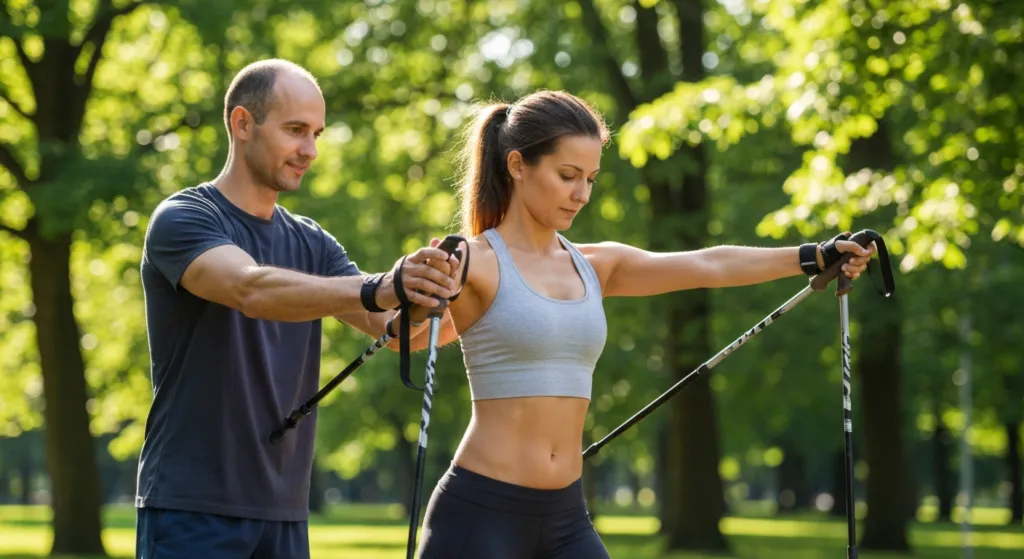
Nordic walking has rapidly grown from a summer training method for Finnish cross-country skiers into one of the most accessible full-body workouts available today. Whether you are twenty-five or seventy-five, this low-impact activity can transform your fitness, posture, and mental well-being.
Nordic walking engages up to 90% of your skeletal muscles — more than almost any other aerobic exercise. It was developed in Finland in the 1930s and is now practiced by over 10 million people worldwide.
Key Takeaways
Nordic walking is a full-body, low-impact workout that engages up to 90% of your skeletal muscles and burns 20 to 46 percent more calories than ordinary walking at the same pace.
- Muscle engagement: poles recruit roughly 90% of skeletal muscles versus about 40% in regular walking.
- Calorie burn: 20 to 46 percent more calories than normal walking at the same speed.
- First 4 weeks: build from three 20-minute sessions in week 1 to 40-minute walks with intervals by week 4.
- Who it suits: all ages 25 to 75+ thanks to its low joint impact.
- Core skill: push through the strap rather than gripping the pole to unlock the full-body benefit.
What Is Nordic Walking?
Nordic walking is a form of brisk walking performed with specially designed poles. Unlike hiking poles used primarily for balance, Nordic walking poles are actively pushed against the ground with each stride, engaging your arms, shoulders, chest, and core. The technique originated in Finland and has since spread across every continent.
Key Benefits of Nordic Walking
Research consistently shows that Nordic walking burns 20 to 46 percent more calories than ordinary walking at the same pace. Because the poles transfer load away from the knees and hips, the activity is gentler on joints while still delivering a vigorous workout.
Pros
- Burns 20-46% more calories than walking
- Engages 90% of muscles
- Low impact on joints
- Improves posture and balance
- Suitable for all ages and fitness levels
Cons
- Requires learning proper technique
- Need to invest in poles
- May feel awkward at first
- Not ideal in very crowded areas
Essential Gear for Beginners
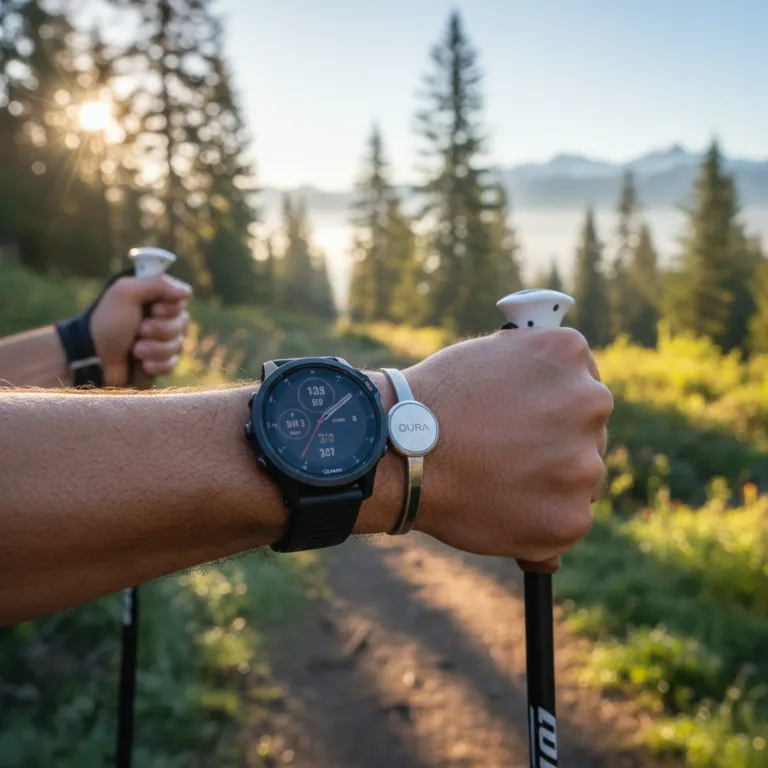
You do not need much equipment to start. The most important item is a pair of purpose-built Nordic walking poles with ergonomic grips and detachable wrist straps. Choose poles whose height places your elbow at roughly a 90-degree angle when the tip touches the ground beside your foot.
Not sure what pole length you need? Use our free Pole Length Calculator — just enter your height and experience level to get a personalized recommendation.
Learning the Basic Technique
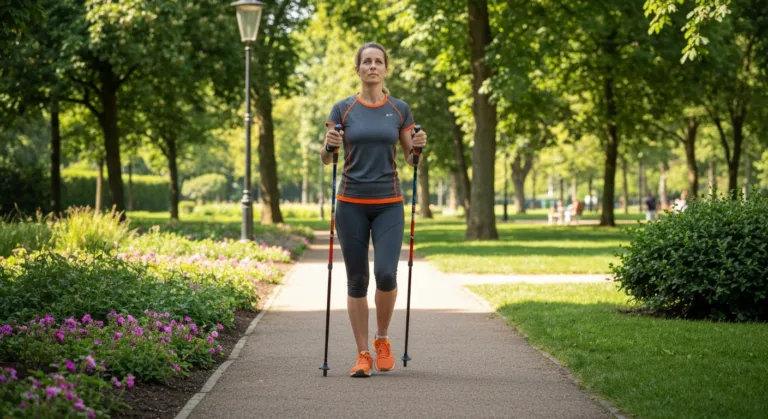
The fundamental movement mirrors a natural walking pattern. As your left foot steps forward, your right arm swings forward and plants the pole at an angle behind your body’s centre of gravity. Push down and back through the pole, then release the grip at the end of the stroke. Keep your shoulders relaxed, your torso upright, and your gaze ahead.
Your First Four Weeks
Week 1: Three 20-minute sessions at a conversational pace.
Week 2: Extend each session to 30 minutes and introduce gentle slopes.
Week 3-4: Increase duration to 40 minutes and experiment with tempo intervals — alternating two minutes of brisk walking with two minutes at an easy pace.
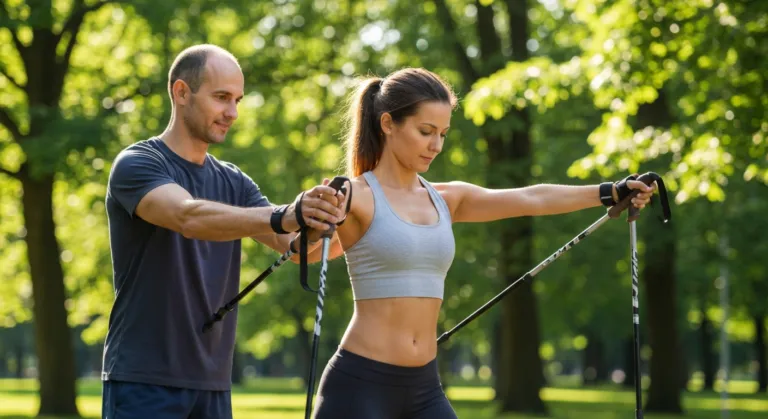
Mild muscle soreness in the upper back and triceps is normal during the first two weeks. Sharp pain in the wrists or shoulders suggests a technique issue — consider a session with a certified instructor.
Common Mistakes to Avoid
- Gripping the poles too tightly, causing forearm fatigue
- Planting the pole in front of the body instead of beside or behind it
- Using hiking or ski poles rather than purpose-built Nordic walking poles
- Taking steps that are too long, straining the hip flexors
- Forgetting to open the hand on the back-swing phase
Want to learn more about these mistakes? Read our detailed guide: 7 Common Nordic Walking Technique Mistakes.
📚 See also:
- world champion athletes and their gear — Nordic Walking Champions
The Health Benefits of Nordic Walking: What Science Says
Nordic walking is not just walking with sticks. A landmark study by Rodney Grieve and colleagues found that 12 weeks of Nordic walking produced significantly greater improvements in cardiovascular fitness, upper body strength, and quality of life compared to regular walking at matched duration. The mechanism is straightforward: adding poles transforms a lower-body activity into a full-body cardiovascular and muscular workout.
Cardiologists at the Cooper Institute measured oxygen consumption in Nordic walkers vs. regular walkers at the same self-reported effort level. Nordic walking consumed 20% more oxygen — equivalent to moving up a full training zone without feeling harder. This means you can train your cardiovascular system more intensely while perceiving the effort as comfortable.
Five Benefits You Will Notice Within 4 Weeks
- Upper body strength: triceps, lats, and shoulder stabilizers strengthen noticeably within 3-4 weeks of consistent practice
- Better posture: the cross-lateral diagonal loading pattern counteracts the forward-head, rounded-shoulder pattern from desk work
- Reduced knee pain: poles shift 20-30% of impact load from knees to arms — most people with mild knee pain report relief within 2 weeks
- Improved sleep: 45+ minutes of Zone 2 exercise is one of the strongest natural sleep quality interventions studied
- Mental clarity: cross-lateral movement (opposite arm and leg working together) activates both hemispheres, with measurable BDNF increase after 30+ minutes
The most common feedback from new Nordic walkers: “I thought it would be easy, but I was out of breath and my arms were sore the next day.” That soreness is your triceps and lats waking up after years of dormancy. Within 3 sessions, it disappears — replaced by a sense of whole-body engagement that regular walking simply cannot produce.
Starting Your Nordic Walking Journey: The First 30 Days
The first month of Nordic walking is where most beginners either build a lasting habit or give up. The difference almost always comes down to expectation management and progressive loading. Your body needs time to adapt — particularly the triceps, lats, and core stabilizers that regular walking barely recruits.
Week 1-2: Technique over distance. Limit sessions to 20-30 minutes. Focus entirely on the push-and-release cycle — pole plant, push, open hand. Do not worry about speed or heart rate. Walking slowly with correct technique builds the neurological patterns that will carry you for years. Walking fast with poor technique builds bad habits that are painful to unlearn.
Week 3-4: Add distance, not intensity. Extend sessions to 35-45 minutes at a comfortable conversational pace. You should be able to maintain a full sentence without gasping. If you cannot, slow down. This is Zone 2 training — fat-burning range — and it is exactly where you want to be as a beginner.
By the end of week 4, most beginners report noticeably improved posture, reduced lower back tension after long sitting days, and a genuine enjoyment of the activity. Those outcomes are not anecdotal — they are the direct result of the upper-body activation Nordic walking provides that regular walking cannot.
Common Beginner Mistakes (and the Fixes)
The most damaging mistake is walking with poles held vertically, planting them directly beside the foot. This turns Nordic walking poles into crutches rather than propulsion tools. The pole must plant at an angle behind the foot, not beside it, so the push drives forward momentum rather than just supporting bodyweight.
The second most common mistake is looking at the ground. Nordic walking demands an upright posture — eyes forward, chin level, shoulders back and down. Looking at your feet compresses the cervical spine and eliminates the postural benefit that makes Nordic walking uniquely therapeutic for desk workers and people with chronic neck tension.
Frequently Asked Questions
Is Nordic walking suitable for seniors?
Absolutely. The poles provide extra stability, and the low-impact nature makes it ideal for older adults. Many physiotherapists recommend it for people recovering from joint replacement surgery or managing arthritis.
How many calories does Nordic walking burn per hour?
On average, a person weighing 70 kg burns approximately 400 to 530 calories per hour. Use our Calorie Calculator for a personalized estimate based on your weight and duration.
What poles should I buy as a beginner?
Start with adjustable aluminum poles in the $30-60 range. They are forgiving, durable, and easy to share. Take our Gear Quiz for a personalized recommendation.
Shop Beginner Nordic Walking Poles