Nordic Walking Elbow Pain: 6 Technique Causes and Fixes
Nordic walking elbow pain often comes from how the poles are used, not from the poles themselves. The most common culprits are pushing down on the pole instead of back, bending and straightening the elbow like a piston, squeezing the grip the whole time, poles that are too long, a strap worn the wrong way, and doing too much too soon. Fixing them may ease the load on your elbows, wrists and shoulders. Pain that is new, severe, swollen or comes with numbness or tingling is a reason to see a professional, not to change technique.
Quick Answer
If your elbows, wrists or shoulders hurt after Nordic walking, check six things: where the pole lands, whether your arm swings from the shoulder, how hard you grip, pole length, how the strap is fitted and how fast you increased your distance. Technique changes can reduce strain, but they do not cure an injury. Stop and get checked if you have swelling, numbness, tingling or pain at rest.
- Push back, not down: the pole should be angled backward, with the tip landing between your feet.
- Swing from the shoulder: keep a long arm with a soft elbow instead of pumping the forearm.
- Loosen the grip: close the hand in front, open it behind the hip, and let the strap carry the force.
- Check length: if your shoulders shrug on each push, the poles are probably too long.
- Build up slowly: sore arms after a sudden jump in distance often come from load, not bad luck.
Why Do My Elbows Hurt After Nordic Walking?
Nordic walking asks your arms to do real work. INWA (the International Nordic Walking Federation) describes the poles as used “diagonally behind the body” to create propulsion, with a strap that lets the hand open naturally. When the poles are used that way, the push travels backward through the strap into the triceps, shoulder and upper back. When they are used like a walking stick, the force goes down through a bent elbow and a clenched hand, and the small tendons of the forearm and elbow take more of the load.
Nordic walkers often describe this pattern in online forums. One walker asked for more shock-absorbing poles because of elbow pain and numb arms. Instructors in the thread replied that the fix was mostly technique: very little downward force, and a push backward through the strap.
Six Technique Causes of Elbow, Wrist and Shoulder Pain
Treat this as a checklist, not a diagnosis.
| Where it hurts | Common technique factor | First thing to try |
|---|---|---|
| Outer elbow, forearm | Pushing down; pumping elbow; death grip | Plant behind, long arm, open hand |
| Wrist, thumb | Loop or trekking strap; hand gripping instead of strap | Glove-style strap, push with heel of hand |
| Hands (aching, blisters) | Squeezing the handle all walk | “Grip in front, release behind” |
| Top of shoulder, neck | Poles too long; tense shoulders | Shorten poles, drop the shoulders |
| Everything, all at once | Too much, too soon | Cut distance, rebuild gradually |
1. Pushing down instead of back (pole planted in front)
What it looks like: the pole tip lands ahead of your front foot and the shaft is vertical, like a cane. Each plant acts as a brake, and your arm absorbs a jolt instead of pushing you forward.
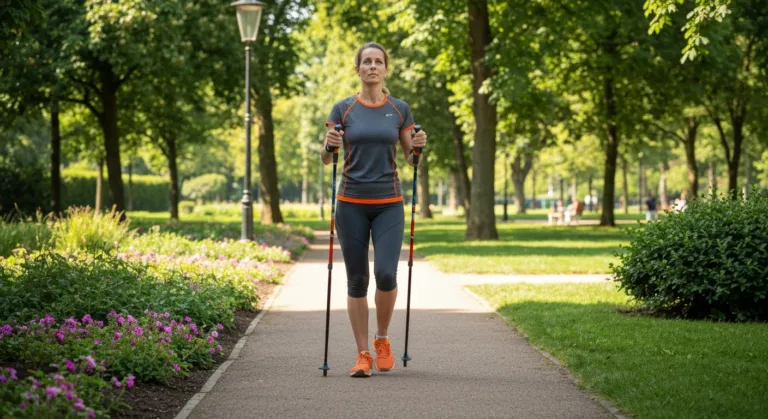
The fix: angle the shaft backward so the tip lands between your feet, no further forward than the heel of your front foot. LEKI describes the poles as angled “towards the back, not vertically.” Instructors often cite a rough 45° angle as a teaching cue, not a measured ideal.
Drill: walk 20 steps dragging the poles lightly behind you, hands relaxed. Then start pressing gently into the strap as each tip touches down behind you.
2. Hinging at the elbow (“chicken wing”)
What it looks like: the upper arm stays close to your side while the forearm pumps back and forth. Your hand never passes behind your hip.
The fix: swing the whole arm from the shoulder, like a pendulum, with a soft bend at the elbow. At the end of the push, your hand passes behind your hip. In a lab study by Pellegrini and colleagues (PLoS One, 2018), elbow-only poling produced less triceps activity and shorter steps than the standard INWA technique. The same study also found that a rigid, locked-straight arm was worse, so aim for relaxed and long, not stiff.
Drill: “handshakes.” Swing your arm forward as if offering a handshake at hip height, then let it travel back past your pocket.
3. The death grip
What it looks like: white knuckles all the way through the stride, with the fingers still wrapped around the handle at the back of the push.
The fix: close your hand lightly as the pole plants, then open it as your arm finishes behind your hip. The strap keeps the pole with you. INWA, LEKI, SportMedBC and many instructors teach this grasp-and-release pattern. Constant squeezing keeps the forearm muscles, which attach at the elbow, working all the time.
Drill: say “grip, release” out loud with each plant for one minute. Then press the heel of your hand into the strap instead of squeezing the handle.
4. Poles that are too long
What it looks like: your shoulder hikes up on every plant, and the tip tends to land in front of you.
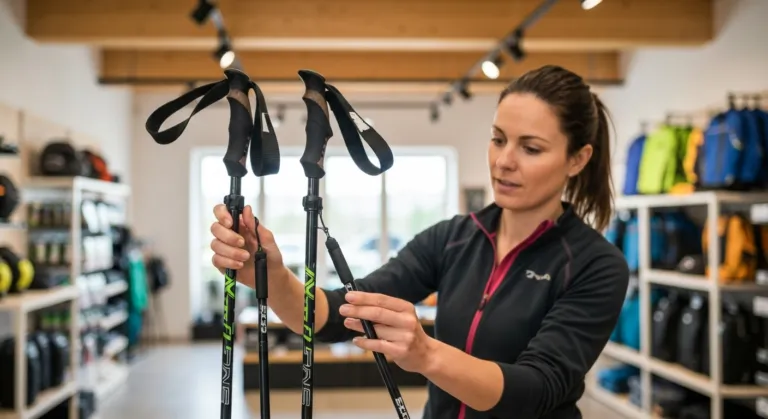
The fix: a common starting point is your height in cm × 0.68, rounded to the nearest 5 cm, then checked with the elbow test. With the tip on the ground beside you, your forearm should be roughly level. If your shoulders rise during the push, shorten the poles by about 2 cm at a time. Our pole length calculator does the math.
5. Strap on wrong, or the wrong kind of strap
What it looks like: your hand drops down onto the top of the strap, or you use simple trekking loops that make you grip hard. One forum walker reported thumb and wrist pain with trekking-style straps that went away after switching to glove straps.
The fix: slide your hand up through the loop from below, the way cross-country skiers do, so the strap sits across the back of your hand. Glove-style Nordic straps let you push through the strap with an open hand.
Drill: stand still, put the straps on, and let go of both handles completely. The poles should hang from your hands without slipping off.
6. Ramping up too fast
What it looks like: everything felt fine until you doubled your distance, added hills or walked every day in your first week.
The fix: go back to a distance that felt comfortable, then add a little each week. Your arms and shoulders need time to get used to poling, just as your legs do.
To see the two most common arm faults in motion, open the lab below and switch on Pumping elbow (chicken wing), then Gripping too tight, and watch which joint lights up.
Explore every fault in the full GaitLab Motion Lab, or read our Nordic walking technique mistakes guide.
Why Do My Hands Hurt When I Walk?
With poles, sore hands usually come back to grip. Squeezing the handle for an hour tires the hand and can cause blisters. One forum walker said they barely hold the grip and let the strap take the force. If the pain is in only one hand, check whether you grip harder on that side or whether one strap fits differently.
Without poles, many people notice puffy, tight-feeling hands on long walks, especially in warm weather. It usually settles after the walk, and loosening rings or watch straps helps many walkers. But one-sided hand pain, numbness or tingling in the fingers, or weakness is worth mentioning to your doctor. Left or right arm pain that comes with chest pressure, shortness of breath, sweating or nausea is an emergency: stop and call for help.
Hand pain from a walking stick or cane
A single walking stick carries weight straight down, so the hand and wrist take more pressure than with Nordic poles. People commonly hold a cane in the hand opposite the painful leg, with the handle at about wrist height when your arm hangs relaxed. A physiotherapist can set the height for you. Our seniors’ guide has more on walking comfortably as you get older.
Can Walking Cause Tennis Elbow?
Ordinary walking is unlikely to cause tennis elbow on its own. Tennis elbow is an overuse problem of the tendons on the outer elbow, and it is usually linked to repeated gripping and wrist effort. Nordic walking or trekking with a constant tight grip, heavy downward pushing or a sudden jump in distance adds that kind of repetitive load. If you have outer-elbow pain that lingers, gets worse when you grip or does not settle with rest, have a doctor or physiotherapist look at it. Do not self-diagnose from an article.
Why Do My Shoulders Hurt When I Walk?
With poles: the usual suspects are poles that are too long (the shoulder shrugs on each plant), tense shoulders pulled up toward the ears, and a forward plant that jolts the arm. Drop your shoulders, shorten the poles if needed and let the arm swing back past the hip.
Without poles: a hunched posture with the head forward and stiff, held arms can leave the neck and shoulders tired. Harvard Health’s walking advice (2020) is to stand tall, look ahead and swing the arms from the shoulders, not the elbows. Collins, Adamczyk and Kuo (Proceedings of the Royal Society B, 2009) found that walking with the arms held still cost about 12% more energy.
Shoulder pain that wakes you at night, stops you lifting your arm or follows a fall needs a professional check. The same applies to back pain from Nordic walking that does not settle.
When to Stop and See a Doctor or Physio
Technique tweaks are for mild, activity-related soreness that eases within a day or two. Stop walking with poles and get checked if you notice:
- Swelling, warmth or visible bruising around the elbow, wrist or shoulder
- Numbness, tingling or pins and needles in the hand or fingers
- Pain at rest or at night, or pain that is getting worse week by week
- Weakness, such as dropping things or trouble gripping a cup
- Pain after a fall, especially if you landed on an outstretched hand with the strap on
- Sudden, severe pain, or arm pain with chest pain or breathlessness (call emergency services)
If you have arthritis, osteoporosis or a recent injury or surgery, check with your doctor or physiotherapist before starting, and consider a lesson with a qualified instructor. See also walking with arthritis.
Can Different Poles Help With Elbow Pain?
Gear is secondary to technique, but the strap matters most. Our pole buying guide explains why a glove-style strap that lets you open your hand fully is a bigger upgrade than a lighter shaft. Carbon or carbon-blend shafts transmit less vibration than aluminum on pavement, and rubber asphalt paws soften the tap on hard surfaces. If you are choosing poles mainly to manage joint pain, ask your doctor first.
From our best Nordic walking poles review, these three stand out for their straps or vibration-damping shafts:
- Leki Micro Flash Carbon: the Aergon thermo strap spreads push force across the whole hand rather than the wrist.
- Swix CT5 Carbon: cross-country-ski heritage with the EasyCross strap.
- Exel Nordic Walker Carbon: a carbon blend shaft with 65 mm rubber asphalt paws included.
Frequently Asked Questions
Is it normal for my arms to ache after my first Nordic walks?
Mild muscle tiredness in the triceps, shoulders or upper back after the first few sessions is common, because your arms are doing work they are not used to. It should ease within a day or two. Sharp pain at the elbow or wrist, pain that lasts, or pain with swelling or tingling is different: stop and have it checked by a doctor or physiotherapist.
Should I use shock-absorbing poles for elbow pain?
They may soften the jolt on hard surfaces, but instructors generally point to technique first: little downward force, the pole angled back and a push through the strap. Rubber asphalt paws also reduce the tap on pavement. If you are choosing anti-shock poles specifically to manage a joint problem, ask your doctor or physiotherapist whether they suit your situation.
Why does only my right (or left) elbow hurt?
Often one side does more work: a tighter grip, a strap fitted differently, a forward plant on that side or an older injury. If one-sided pain comes with numbness, weakness or swelling, see a professional. Left arm pain with chest pressure or breathlessness needs emergency help, not a technique check.
Can I keep walking with poles while my elbow is sore?
For mild soreness, many people walk without poles or with a very light, relaxed arm action for a while, then reintroduce the poles gradually. If poling makes the pain worse during or after the walk, stop using the poles and get advice. Do not push through pain that is increasing, and check with your doctor or physiotherapist before returning to full distance.
Do trekking poles cause more wrist pain than Nordic poles?
Some walkers report that they do on flat ground. Trekking poles usually have simple loop straps, so the hand has to grip constantly, and they are made for planting in front on rough terrain. Nordic poles use glove-style straps that let you push with an open hand. One forum walker described thumb and wrist pain that went away after switching to glove straps.