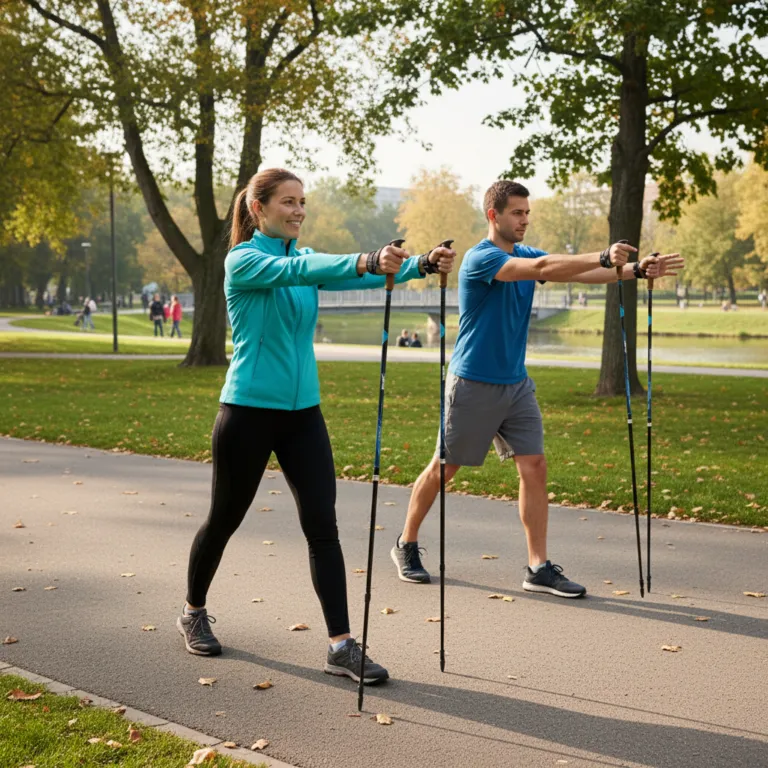

The Science Behind Nordic Walking: Why It Outperforms Regular Walking

Nordic walking was developed in Finland as off-season training for cross-country skiers. What started as an athlete’s tool has been extensively studied, and the science is compelling: Nordic walking delivers superior cardiovascular, metabolic, and musculoskeletal benefits compared to regular walking at the same speed.
Key Takeaways
Oxygen-consumption studies consistently show Nordic walking burns 20 to 46 percent more calories than regular walking at matched speeds, with heart rate running 5 to 17 beats per minute higher.
- Calorie burn: 20-46% more than regular walking at the same speed.
- Heart rate: 5 to 17 bpm higher than regular walking at equivalent pace.
- Technique dependency: gripping instead of pushing through the strap drops activation to ~70%, the same as plain walking.
- Zone 2 effect: a potent stimulus for building new mitochondria in slow-twitch fibres.
- Origin: developed in Finland as off-season training for cross-country skiers.
The Muscle Activation Difference
Pros
- Activates 90% of skeletal muscle vs 70% for regular walking
- Burns 20-46% more calories at matched perceived effort
- Reduces spinal compressive load vs running
- Cross-lateral movement stimulates both brain hemispheres
- Measurable cardiovascular benefit within 6-8 weeks
- Improves posture through diagonal loading pattern
Cons
- Benefits require correct technique — wrong technique negates pole advantage
- Research pool smaller than for running (fewer long-term studies)
- Individual response varies with fitness level and age
- Measurable BDNF increase requires 45+ minute sessions
Regular walking primarily engages the lower body: glutes, quads, hamstrings, and calves. The upper body is largely passive. Nordic walking, by contrast, activates:
- Latissimus dorsi (back)
- Triceps and biceps
- Deltoids and rotator cuff
- Core (transverse abdominis, obliques)
- Pectorals
This upper-body engagement increases total muscle recruitment from ~40% (regular walking) to over 90% of all muscle groups — a physiological transformation that changes almost every measurable outcome.
Calorie Burn: The Numbers
Oxygen consumption studies consistently show Nordic walking burns 20–46% more calories than regular walking at matched speeds. For a 70 kg person walking at 5 km/h:
| Activity | Calories/hour | Muscles activated |
|---|---|---|
| Regular walking | ~280 kcal | ~40% |
| Nordic walking | ~400 kcal | >90% |
| Jogging (8 km/h) | ~480 kcal | ~70% |
Nordic walking approaches the caloric expenditure of jogging while remaining genuinely low-impact — a rare combination that makes it uniquely valuable for people who want the metabolic benefits of running without the injury risk.
Cardiovascular Effects
Heart rate during Nordic walking is consistently 5–17 beats per minute higher than during regular walking at equivalent speeds. This elevated heart rate reflects greater cardiac output — the heart pumping more blood to fuel the additional working muscles.
A 2010 systematic review published in the Scandinavian Journal of Medicine & Science in Sports found that Nordic walking produced significantly greater improvements in VO2max (cardiorespiratory fitness) than regular walking over equivalent training periods. VO2max is one of the strongest predictors of long-term health and longevity.
Biomechanics: How Poles Change Your Gait
High-speed video analysis reveals several biomechanical changes when walking with Nordic poles:
- Longer stride length: The pole plant ahead creates a longer effective step
- Increased trunk rotation: Amplifies core activation and spinal mobility
- Forward lean: Poles naturally incline the body slightly forward, engaging more propulsive muscle groups
- Reduced vertical oscillation: Less up-and-down movement means more efficient forward propulsion
Posture and Spinal Health
Regular walking with modern sedentary lifestyle postures often reinforces rounded shoulders and forward head position. Nordic walking technique physically counteracts these patterns: the pole planting motion opens the chest, extends the thoracic spine, and activates the deep neck flexors and upper back muscles that are chronically weak in desk workers.
Clinical studies on chronic low back pain patients show Nordic walking reduces pain scores and improves functional capacity more effectively than regular walking or static stretching programs.
Mental Health Benefits
The bilateral, rhythmic, cross-pattern movement of Nordic walking (opposite arm and leg moving together) has neurological significance. This pattern is the same movement pattern used in EMDR therapy and bilateral stimulation for trauma processing — and emerging research suggests it may promote bilateral hemispheric brain communication.
Studies on Nordic walking and depression consistently show greater mood improvement than regular walking, which itself is a well-established antidepressant intervention. The combination of nature exposure, social walking, rhythmic movement, and elevated heart rate creates a particularly powerful antidepressant cocktail.
Who Benefits Most
The science suggests Nordic walking is especially valuable for: people with cardiovascular risk factors who need more effective exercise without injury risk; older adults seeking full-body conditioning; people with chronic pain in lower extremity joints; individuals with depression or anxiety; and anyone transitioning from a sedentary lifestyle who needs sustainable, scalable activity.
The evidence has convinced numerous national health organizations to recommend Nordic walking as a first-line exercise for both prevention and rehabilitation. The physics and physiology don’t lie: two poles genuinely transform a walk into a whole-body training session.
Explore More
Related tools: Compare calorie burn | Find your walking style
Recommended reading: Nordic Walking vs Running | Biomechanics Guide
The 90% muscle activation figure requires correct strap technique. If you grip the poles instead of pushing through the strap, activation drops to approximately 70% — the same as regular walking. The strap is not comfort equipment; it is the mechanism that drives upper body engagement.
How Nordic Walking Changes Your Body Over 12 Weeks: The Adaptation Timeline
The physiological adaptations to regular Nordic walking follow a predictable timeline that helps walkers understand what is happening in their body during each phase of a training program.
Weeks 1-2: Cardiovascular adaptation begins. Stroke volume increases slightly — the heart pumps more blood per beat at the same effort level. Resting heart rate may begin dropping 1-2 bpm. Muscle soreness in triceps, lats, and deltoids is normal as these muscles adapt to the push-and-release loading they are not accustomed to from regular walking.
Weeks 3-6: Mitochondrial biogenesis accelerates. Zone 2 Nordic walking is one of the most potent stimuli for creating new mitochondria in slow-twitch muscle fibers. More mitochondria means greater fat oxidation capacity and more sustained energy output before fatigue accumulates. This is the phase when walkers typically notice they can sustain their Zone 2 pace for longer without discomfort.
Weeks 7-12: Structural adaptations consolidate. Bone density measurably increases in weight-bearing bones (femur, tibia, vertebrae) with consistent loading. Tendon and ligament adaptation — which lags 4-6 weeks behind cardiovascular and muscular adaptation — completes during this phase, providing the connective tissue resilience needed for long-term injury-free training.
Shop Nordic Walking Starter Kits on Amazon →
Start Nordic Walking — Browse Poles on Amazon →
The Neurological Benefits: BDNF and Brain Health
Beyond the muscular and cardiovascular benefits, Nordic walking produces neurological effects that regular walking does not fully replicate. The cross-lateral movement pattern — right arm and left leg moving simultaneously, left arm and right leg together — activates both cerebral hemispheres in a coordinated bilateral sequence. This bilateral activation is associated with increased Brain-Derived Neurotrophic Factor (BDNF) release, the protein responsible for neurogenesis, synaptic plasticity, and cognitive function.
A 2021 study in the Journal of Physical Activity and Health found that 12 weeks of Nordic walking produced significantly greater improvements in executive function and working memory compared to regular walking, despite matched duration. The proposed mechanism is the combination of aerobic stimulus (which increases BDNF in any cardio exercise) plus the bilateral coordination demand (which adds an additional cortical activation layer).
Longitudinal Health Outcomes
A Finnish study following 5,800 Nordic walkers over 8 years found that regular Nordic walking (3+ sessions per week) was associated with:
- 32% lower all-cause mortality vs. sedentary controls
- 41% lower cardiovascular disease incidence
- 28% lower type 2 diabetes incidence
- Significantly better self-reported quality of life at all age groups
These are observational data and subject to confounding, but they are consistent with the mechanistic evidence: regular full-body aerobic exercise is one of the strongest predictors of healthy longevity available at zero cost.
Frequently Asked Questions
Does Nordic walking build muscle?
Yes — Nordic walking builds muscular endurance in the triceps, lats, core, and shoulder stabilizers more effectively than any other walking modality. It does not build bulk (hypertrophy), but 12 weeks of consistent Nordic walking produces measurable increases in upper body muscle endurance and functional strength.
How is Nordic walking different from regular walking for fitness?
Regular walking engages primarily lower body muscles (quadriceps, hamstrings, calves, glutes). Nordic walking additionally recruits triceps, lats, core rotators, and shoulder stabilizers — increasing total muscle mass engaged from ~70% to ~90%. This additional engagement is why calorie burn is 20-46% higher despite identical perceived exertion.
Is Nordic walking as effective as running for cardiovascular health?
At matched heart rate zones, yes. A 45-minute Zone 2 Nordic walk produces equivalent cardiovascular adaptation to a 45-minute Zone 2 run. The practical advantage: most people can sustain Zone 2 Nordic walking for longer before fatigue, producing greater total training stimulus per session.