Recovery Biohacking 2026: Best Massage Guns, Compression Boots & Red Light Tools
GaitLab is reader-supported. When you buy through links on our site, we may earn an affiliate commission at no extra cost to you.
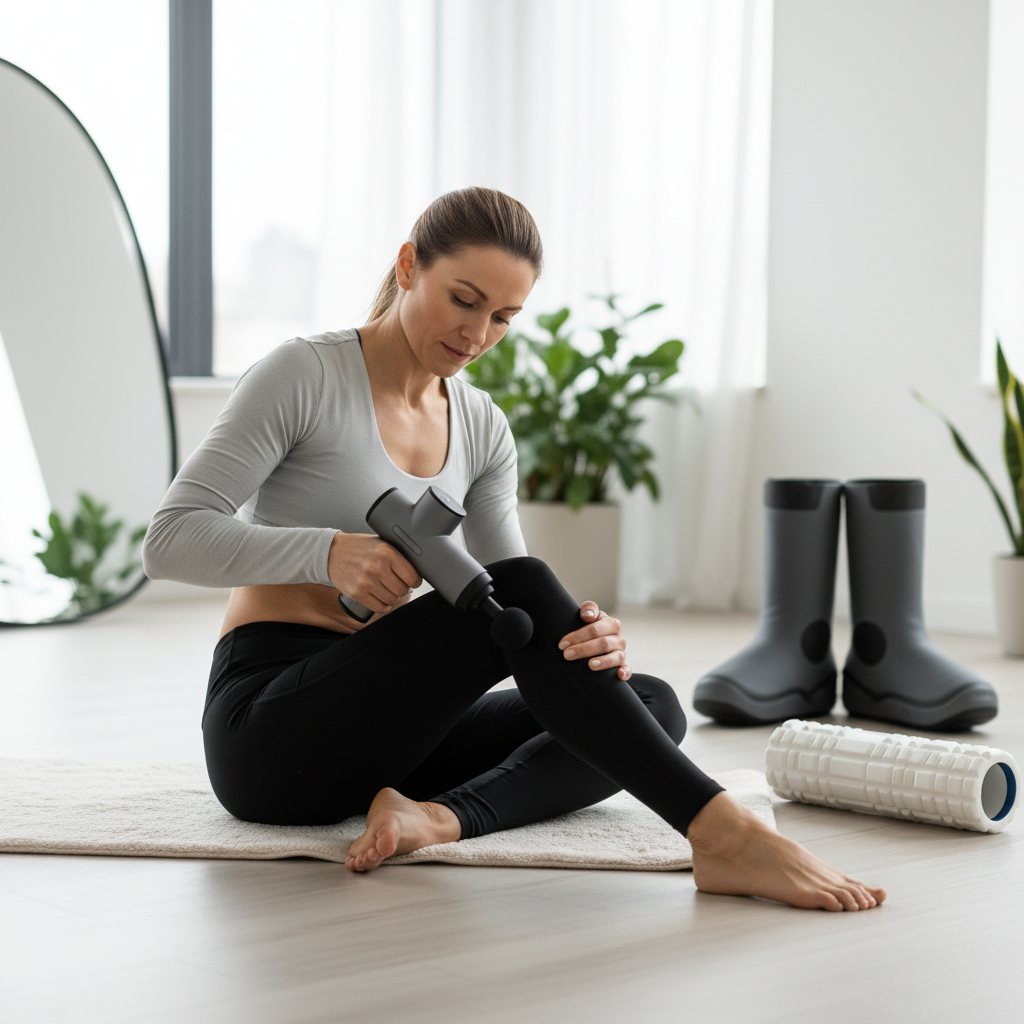
Recovery used to mean a foam roller in the garage and hoping the soreness faded by Thursday. In 2026, the same percussion, pneumatic, and light-based tech once reserved for pro locker rooms sits comfortably on a home shelf at consumer prices. This guide breaks down the four recovery categories that actually matter for active adults—percussion massage guns, pneumatic compression boots, red and near-infrared light, and old-reliable foam rolling—explains how each one works, and ranks seven tools we’d genuinely recommend across every budget.
Key Takeaways
- Top pick overall: the Theragun Prime—quiet, app-guided, and the best blend of power and usability for most people.
- Best budget: the RENPHO Active Massage Gun delivers 80% of the experience for a fraction of the price.
- Percussion guns target localized soreness and circulation; compression boots flush the whole leg; red light may support cellular recovery; rollers handle daily fascia work.
- You don’t need all four. Most people get the biggest return from one good massage gun plus a foam roller.
- Recovery tech complements—not replaces—sleep, protein, and easy movement on rest days.
How We Picked—And What Actually Matters
Recovery gadgets are easy to over-buy. We evaluated each tool on the criteria that change your day-to-day experience, not spec-sheet bragging rights:
- Effectiveness for the job: does the mechanism match the claim? Percussion for muscle soreness and blood flow, compression for venous return, light for photobiomodulation, rolling for tissue mobility.
- Noise: a loud massage gun gets used less. Quiet brushless motors are worth paying for.
- Battery and convenience: tools that charge fast and travel well actually get used.
- Comfort and ergonomics: grip angle, weight, amplitude, and intuitive controls.
- Value for money: we weighted real-world benefit against price tier, because a great $90 tool often beats a marginal $500 one.
Below, every product links to a live Amazon search so you can compare current pricing and reviews yourself.
| Product | Best for | Standout | Price tier |
|---|---|---|---|
| Theragun Prime | Most people, overall | App-guided routines + deep amplitude | $$ |
| Hypervolt 2 | Quiet, premium feel | Whisper-quiet Bluetooth gun | $$ |
| RENPHO Active Massage Gun | Budget buyers | Best value percussion | $ |
| Hyperice Normatec 3 Legs | Runners & heavy leg days | Pro-grade pneumatic flush | $$$ |
| Bestqool Red Light Panel | Whole-body light therapy | Red + near-infrared at mid-price | $$ |
| TriggerPoint GRID Foam Roller | Daily fascia work | Durable, do-everything roller | $ |
| Theragun Mini | Travel & gym bag | Pocketable percussion | $$ |
The Best Recovery Tools of 2026, Ranked
Theragun Prime (Therabody)
The Prime is the sweet spot in Therabody’s lineup: it carries the brand’s signature 16mm amplitude—the deep, thudding stroke that reaches muscle better than the shallow buzz of cheaper guns—without the four-figure price of the Pro models. The ergonomic triangle handle lets you hit your own back and hamstrings without wrenching your wrist, and the companion app can walk you through guided routines that take the guesswork out of “where do I put this thing.”
It’s the right call for the widest range of users: weekend hikers, lifters, and runners who want one capable tool that won’t intimidate them. Trade-offs are modest—it has fewer speed presets than the pricier Pro, and at full power it’s audible (though far quieter than older percussion guns). For most readers, this is the one to buy and stop overthinking.
- Deep 16mm amplitude reaches muscle, not just skin
- App-guided routines remove the guesswork
- Comfortable multi-grip handle for self-treatment
- Pricier than budget guns
- Fewer presets than the Pro tier
Price tier: $$ (mid-range)
Hypervolt 2 (Hyperice)
If silence is your priority, the Hypervolt 2 is hard to beat. Hyperice built its reputation on quiet brushless motors, and this gen is genuinely living-room-friendly—you can use it on the couch without drowning out the TV. It’s lighter and slimmer than many rivals, with a clean cylindrical handle and Bluetooth connectivity to Hyperice’s app for guided sessions.
It’s a premium pick for people who value a refined, low-vibration feel over maximum brute force. The flip side: its amplitude is slightly shallower than the Theragun’s deep stroke, so true “dig into a knot” users may prefer the Prime. But for daily maintenance, pre-workout priming, and quiet evening use, the Hypervolt 2 is a polished, satisfying tool.
- Exceptionally quiet motor
- Lightweight, comfortable to hold for long sessions
- Bluetooth app integration
- Slightly less deep-tissue punch than Theragun
- Premium price for the feature set
Price tier: $$ (mid-range)
RENPHO Active Massage Gun
The RENPHO is the tool we point friends to when they say “I’m curious but I don’t want to spend $300.” It covers the fundamentals well: multiple speed settings, a handful of swappable heads, a quiet-enough motor, and battery life that easily survives a week of short sessions. For the money, the value is genuinely excellent.
It’s the obvious choice for first-time buyers, casual users, or anyone outfitting a household where the gun gets shared. You give up the deepest amplitude and the polished app ecosystem of premium brands, and the build feels a touch less refined—but for relieving general post-walk and post-workout soreness, most people won’t feel shortchanged. This is how you start recovery biohacking without overcommitting your wallet.
- Outstanding price-to-performance
- Solid battery life and multiple heads
- Quiet enough for everyday use
- Shallower amplitude than premium guns
- No guided app ecosystem
Price tier: $ (budget)
Hyperice Normatec 3 Legs
Compression boots work differently from percussion. Instead of targeting a single spot, the Normatec 3 wraps your legs and inflates in sequential pulses from foot to hip, mechanically encouraging venous return and helping flush the legs after long efforts. Runners, cyclists, and anyone who racks up serious mileage tend to describe the after-feeling as “fresh, drained-out legs,” and it’s a uniquely passive recovery you can do while reading or watching a show.
This is a premium, category-defining product, and the price reflects it—plus the boots take up storage space and need a power source. It’s overkill for someone who walks a few miles a week. But for high-volume athletes who treat recovery as part of training, the Normatec 3 is the gold-standard pneumatic flush you can own at home. As with any new recovery stimulus, talk to your doctor first if you have circulatory issues, blood clots, or other vascular conditions.
- Sequential compression flushes the entire leg
- Completely passive—use while resting
- Pro-grade, durable system
- Premium price
- Bulky to store; not for casual walkers
Price tier: $$$ (premium)
Bestqool Red Light Therapy Panel
Red light therapy—formally photobiomodulation—uses red and near-infrared wavelengths that research suggests may support cellular energy production and tissue recovery. The Bestqool panel delivers both red (around 660nm) and near-infrared (around 850nm) light, which is the combination most home users look for, at a price that sits below boutique competitors while still feeling substantial.
It suits the experimenter who wants to add light to their recovery stack without a four-figure outlay, and the mid-size panel is enough for targeted areas like a sore back, knees, or shoulders. Be realistic about expectations: evidence here is promising but still developing, and panels require consistent, regular sessions to evaluate any benefit. Treat it as a low-effort addition to a solid routine, not a magic bullet—and check with your doctor if you have light-sensitivity conditions or take photosensitizing medications.
- Combines red and near-infrared wavelengths
- More affordable than boutique panels
- Hands-free, passive sessions
- Evidence still developing; manage expectations
- Requires consistent use to assess benefit
Price tier: $$ (mid-range)
TriggerPoint GRID Foam Roller
No recovery kit is complete without a roller, and the TriggerPoint GRID has earned its status as the default. Its hollow core with a multi-density “grid” surface mimics the feel of a massage therapist’s hands—firmer ridges and softer channels—so you can target fascia and tight muscle without the roller collapsing or going dead-flat after a few months. It’s the cheapest tool here and arguably the highest-frequency one you’ll use.
This is the daily workhorse for everyone, from beginners learning to roll out a tight calf to seasoned athletes prepping for a session. The only real trade-off is that rolling takes effort and technique—it won’t do the work for you the way a massage gun or boots will. But as a value-per-dollar recovery tool, nothing on this list beats it.
- Durable multi-density surface holds its shape
- Versatile for legs, back, glutes, and more
- Excellent value
- Requires effort and some technique
- Less targeted than percussion for deep knots
Price tier: $ (budget)
Theragun Mini (Portable)
The Mini takes Therabody’s percussion into a palm-sized package that disappears into a gym bag or carry-on. It won’t match the amplitude or run-time of full-size guns, but for travelers, commuters, and anyone who wants relief on the road, it’s a smart, genuinely portable option with the brand’s reliable build and quiet operation.
It’s best thought of as a complement rather than a primary tool—ideal as a second gun for the office or suitcase if you already own a larger one. If you only buy a single device, choose the Prime instead. But for keeping a sore neck or tight quad in check while you’re away from home, the Mini punches well above its size.
- Truly pocketable and lightweight
- Quiet, dependable Therabody build
- Great second/backup gun
- Less power and shorter battery than full-size
- Not ideal as your only device
Price tier: $$ (mid-range)
Expert tip — Stack timing, not just tools. Sequence your recovery for the biggest payoff: use a massage gun or foam roller before activity for 30–60 seconds per muscle to prime tissue and boost blood flow, and save the longer, slower flushing work—compression boots or unhurried rolling—for after a hard effort or in the evening. Light, gentle percussion before bed can also help you wind down. The tool matters less than putting it at the right point in your day.
Expert tip — Less pressure, more often. The most common mistake is grinding a massage gun hard into a painful spot. Percussion and rolling work best as a light-to-moderate, consistent habit—glide slowly, breathe, and stop short of sharp pain. Two minutes a day beats one brutal 20-minute session a week, and it’s far kinder to your nervous system, which is half the recovery equation.
How to Use Recovery Tech: A Simple Starter Routine
You don’t need a complicated protocol. Here’s a realistic framework most active adults can follow:
- Pre-walk or pre-workout (2–3 min): Quick massage-gun passes or light rolling on the muscles you’re about to use—calves, quads, glutes—to wake up circulation.
- Post-effort (5–10 min): Slower foam rolling on tight areas, then a calm massage-gun session at lower speed. If you have compression boots, this is their moment.
- Evening or rest days: Optional red-light session while you relax, plus gentle mobility. Rest days are when adaptation actually happens.
- Weekly rhythm: Daily rolling, massage gun as needed, boots and light a few times a week. Consistency beats intensity.
A quick safety note: if you’re starting a new recovery stimulus and have any cardiovascular, circulatory, or injury concerns—or you’re pregnant—talk to your doctor before diving in. None of this is medical advice.
Frequently Asked Questions
Do massage guns actually help with sore muscles?
Percussion therapy can increase local blood flow and may reduce the perception of delayed-onset muscle soreness (DOMS), and many people find it relaxing and mobility-enhancing. Research is encouraging but modest—think of a massage gun as a helpful tool for comfort and circulation, not a cure for overtraining.
Are compression boots worth the money?
For high-mileage runners, cyclists, and anyone with frequent heavy leg days, pneumatic boots like the Normatec 3 offer a genuinely pleasant, passive way to flush the legs and feel fresher. For casual walkers or light exercisers, the cost is hard to justify—you’ll likely get more value from a good massage gun and roller.
Does red light therapy really work for recovery?
Red and near-infrared light therapy (photobiomodulation) has a growing body of research suggesting it may support cellular energy and tissue recovery, but the evidence is still developing and results vary. Treat it as a low-risk, consistent add-on to a strong foundation of sleep, nutrition, and movement—not a primary recovery strategy.
If I can only buy one recovery tool, what should it be?
For most people, a quality massage gun like the Theragun Prime offers the broadest, most flexible benefit. On a tighter budget, pair the RENPHO massage gun with a TriggerPoint foam roller—that combination covers the vast majority of everyday recovery needs for under the price of a single premium gadget.
The Bottom Line
If you buy just one tool, make it the Theragun Prime—it’s powerful, guided, and versatile enough for nearly everyone. Budget-focused readers should grab the RENPHO gun and a TriggerPoint roller and call it a day. Whatever you choose, remember that recovery tech amplifies good habits—it never replaces sleep, easy movement, and patience.

About the Author
Alex Mercer — INWA Level 2 Nordic Walking Instructor
Certified by the International Nordic Walking Federation (INWA) since 2019, Alex has coached 500+ walkers from beginners to ultra-distance competitors. Sports science background with a focus on biomechanics, gait analysis, and evidence-based training protocols. Regular contributor to walking and outdoor publications.