Nordic Walking Champions: World Records, Top Athletes & The Gear They Use
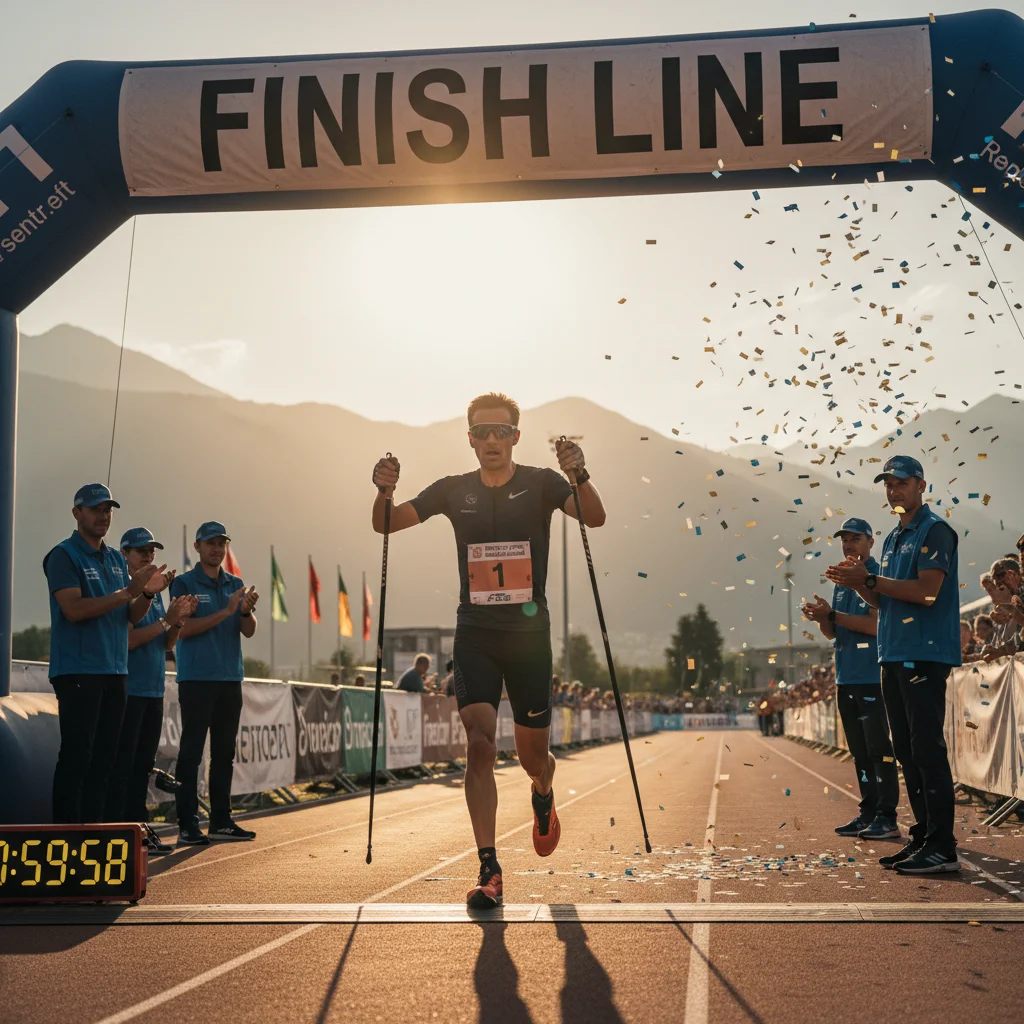
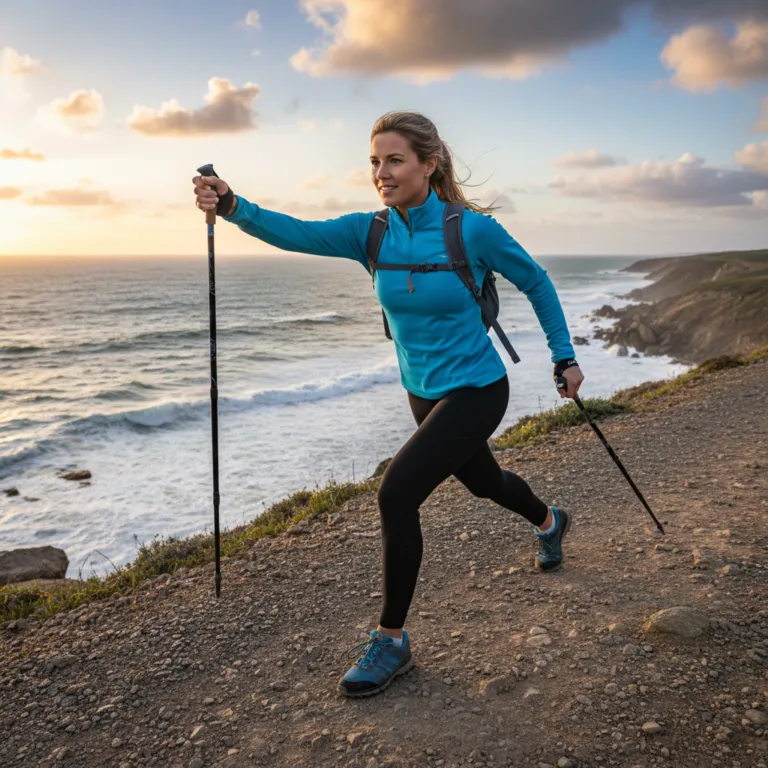
Nordic walking is not just a gentle stroll with poles. At the elite level, it is a fiercely competitive sport with World Championships, World Cup circuits, and athletes pushing the human body past 14 km/h — with walking technique so precise that three yellow cards for lifting both feet simultaneously means disqualification. From a Finnish record-holder who covers 5 km in 21 minutes to a Polish ultra-athlete who Nordic walked 100 km in under 12 hours, these are the champions who define what is possible with two poles and relentless training. Here is their story — and the exact gear they use to win.
Key Takeaways
Competitive Nordic walking is a fiercely contested sport with World Championships and athletes exceeding 14 km/h under strict technique rules; records range from 5 km in 21:09 to 100 km in under 12 hours.
- Top speed: elite athletes sustain over 14 km/h with legal ground contact and precise technique.
- Speed record: Finland’s Jor Hakkinen holds 5 km in 21:09 and 10 km in 44:20.
- Ultra record: a Polish athlete Nordic walked 100 km in under 12 hours.
- Rules: three yellow cards for lifting both feet (loss of contact) means disqualification.
- Dominance: Polish and Finnish athletes lead the World Championship and World Cup circuits.
The Competitive Nordic Walking Landscape
Two international governing bodies run the sport’s championship circuits:
| Organization | Founded | Major Events | Headquarters |
|---|---|---|---|
| INWA (International Nordic Walking Federation) | 2000 | INWA World Championships, INWA World Cup series | Bromarf, Finland |
| ONWF (Original Nordic Walking Federation) | Founded by Marko Kantaneva | World Championships, European Championships, World Cup, World League | Finland / Poland |
Races are held over standard distances — 5 km, 10 km, and 21 km (half marathon) — plus ultra events at marathon (42 km) and 100 km. Categories span age groups from under-17 to 70+, with separate men’s and women’s divisions. Technique is strictly enforced: walkers must maintain ground contact at all times, and referees issue yellow cards for violations — three yellows equals a red card and disqualification.
World Records: The Fastest Nordic Walkers on Earth
Get Your Free 12-Week Training Plan
Join 2,500+ Nordic walkers. Receive a proven training program PDF and weekly technique tips — free.
| Distance | Gender | Athlete | Country | Time | Pace | Location |
|---|---|---|---|---|---|---|
| 5 km | Men | Jor Hakkinen | 🇫🇮 Finland | 21:09 | 4:14/km | Helsinki, 2015 |
| 5 km | Women | Renata Jachimowicz | 🇵🇱 Poland | 30:01 | 6:00/km | Tirano, Italy, 2018 |
| 10 km | Men | Jor Hakkinen | 🇫🇮 Finland | 44:20 | 4:26/km | Helsinki, 2015 |
| 10 km | Women | Elzbieta Wojciechowska | 🇵🇱 Poland | 59:03 | 5:54/km | Pakosc, Poland, 2011 |
| 21 km | Men | Melvin Oluwagbemi | 🇫🇷 France | 1:57:45 | 5:36/km | Qinghai, China, 2018 |
| 21 km | Women | Li Jinglan | 🇨🇳 China | 2:08:15 | 6:06/km | Qinghai, China, 2018 |
| 100 km | Men | Marcin Michalec | 🇵🇱 Poland | 11:52:21 | 7:07/km | Torun, Poland, 2022 |
| 100 km | Women | Agnieszka Mielecka | 🇵🇱 Poland | 13:49:40 | 8:18/km | Torun, Poland, 2022 |
To put these records in perspective: the men’s 5 km record of 21:09 means Nordic walking at 14.2 km/h — faster than most recreational joggers. And this is walking, not running — both feet must maintain ground contact. The technique precision required at this speed is extraordinary.
The Champions: Profiles of the World’s Best
🇫🇮 Jor Hakkinen — The Finnish Speedster
Records: World record holder at 5 km (21:09) and 10 km (44:20), both set on a track in Helsinki in September 2015.
Hakkinen represents the Finnish roots of Nordic walking — the country where the sport was born. His track records remain unbroken after more than a decade, a testament to his extraordinary combination of cardiovascular fitness and technical mastery. Walking at 14.2 km/h with poles while maintaining legal ground contact requires a stride frequency and biomechanical efficiency that few athletes in the world can match.
Training approach: Finnish-style high-volume endurance training with emphasis on VO2max intervals and race-pace technique work on 400m track. Finnish athletes train through harsh Nordic winters, building the aerobic base that powers record-breaking speed.
Gear origin: Finland is home to Exel — the company that produced the first Nordic walking pole in 1997 and coined the term “Nordic Walking” in 1999. Finnish elite athletes typically use one-piece carbon Exel poles for maximum energy transfer.
🇵🇱 Marcin Rosak — The Half-Marathon King
Titles: World Champion 2018 (21 km), World Champion 2022 (21 km), European Champion 2019 (10 km), Polish Champion at 5 km, 21 km, and 42 km distances.
Considered Poland’s first professional Nordic walker, Rosak dominates the long-distance events. His back-to-back World Championship victories in the half-marathon distance demonstrate an ability to maintain race pace over 21 km that no other competitor has matched. He also holds Polish national titles across four different distances — a versatility that speaks to his complete athletic development.
Training approach: Rosak trains 6 days per week, combining Nordic walking sessions (60-90 minutes) with supplementary strength training and cross-country skiing in winter. He emphasizes thoracic rotation and hip extension — the two technical elements that generate forward propulsion at race pace.
🇵🇱 Tomasz Wojtowicz — The Triple European Champion
Titles: Three-time European Champion. Double gold at INWA World Championships in Lahti, Finland (5 km and 10 km, Senior category). INWA World Master 2022. European Championship 5 km gold in Warsaw with a time of 27:30.
Wojtowicz is the most decorated INWA circuit athlete, with titles spanning both European and World Championship events. His 27:30 5 km time at the European Championships in Warsaw represents elite competitive speed — just 5:30/km pace while maintaining legal Nordic walking technique under referee observation.
🇵🇱 Agnieszka Mielecka — The Ultra Queen
Titles: World Champion 2018 (10 km). Women’s 100 km ultra world record holder (13:49:40). 2024 and 2025 Polish National Champion (5 km). Competes for Polipack Team GWE.
Mielecka’s range is extraordinary — she wins 5 km national championships and then Nordic walks 100 km in under 14 hours. Her 2022 ultra record in Torun is a feat of endurance that few athletes in any sport can comprehend: maintaining Nordic walking technique for nearly 14 continuous hours, covering 100 kilometers with poles.
Training insight: Ultra preparation requires training the body to metabolize fat as fuel while maintaining technique integrity under extreme fatigue. Mielecka’s schedule includes back-to-back long sessions (90 min + 60 min) with short recovery between, simulating the metabolic demands of race day.
🇵🇱 Marcin Michalec — The 100 km World Record Holder
Records: Men’s 100 km ultra Nordic walking world record at 11:52:21 (Torun, April 2022), breaking the previous record by nearly one hour. Nordic Walking Biathlon champion. Competes for KKB MOSiR Krosno.
Michalec’s world record is staggering: averaging 8.4 km/h for nearly 12 hours straight, with poles, maintaining legal technique throughout. He broke the previous record — held by an Austrian athlete — by almost 60 minutes, a margin that suggests he was competing against himself more than anyone else.
Gear: Michalec is an ambassador for Gabel, the Italian pole manufacturer. He uses Gabel one-piece carbon poles with ergonomic cork grips designed for all-day comfort during ultra events.
🇫🇷 Melvin Oluwagbemi — The French Record-Breaker
Records: Men’s half-marathon world record (1:57:45), set at the 2018 INWA World Cup in Qinghai, China.
Oluwagbemi’s sub-2-hour half-marathon record — set at altitude on the Tibetan Plateau in Qinghai Province — stands as one of the most impressive performances in competitive Nordic walking history. The thin air at elevation makes maintaining the pace and technique demands even more challenging.
🇨🇳 Li Jinglan — China’s Distance Star
Records: Women’s half-marathon world record (2:08:15), set at the 2018 INWA World Cup in Qinghai, China.
Li’s record demonstrates the growing strength of Chinese athletes in the sport. China has been hosting major INWA World Cup events since 2018, and local athletes have risen rapidly through the competitive ranks, particularly in longer distances where the country’s tradition of endurance sports provides a strong foundation.
🇵🇱 Robert Kowalak & Andzelika Ludwiczak — 2024 World League #1
Rankings: #1 ranked man (24,819 points) and #1 ranked woman (25,137 points) in the 2024 World Nordic Walking League, 5 km division.
The World League ranks athletes across a season of international events. Kowalak (Walka Kostrzyn) and Ludwiczak (Ekspedycja Nordic Team Szczecin) topped the global standings in 2024, with Ludwiczak actually scoring higher than any male or female competitor — a remarkable achievement in a points-based system that rewards consistency across multiple races.
Why Poland Dominates Nordic Walking
The data is clear: Polish athletes hold the majority of world records, world championship titles, and World League top rankings. Several factors explain Poland’s dominance:
- Infrastructure: Poland hosts more international Nordic walking events than any other country — the 2022 and 2024 World Championships, multiple World Cup rounds, and a robust national championship series.
- Organized clubs: Polish cities have dedicated Nordic walking clubs (Walka Kostrzyn, Ekspedycja Nordic Team Szczecin, KS NW Belchatow, Nordic Team Czestochowa) that provide structured training and competition pathways.
- Government support: Nordic walking is recognized as a competitive sport in Poland, with MOSiR (Municipal Sports and Recreation Centers) providing facilities and coaching infrastructure.
- Cultural adoption: Poland embraced Nordic walking as both recreation and competition earlier and more enthusiastically than most countries — creating a pipeline from casual walking to elite competition that does not exist elsewhere.
Race Formats You’ve Never Heard Of
| Format | Description | What Makes It Unique |
|---|---|---|
| Nordic Hill Racing | Uphill sprint with poles on a marked trail, timed | Pure power + technique on steep gradients. Pole push generates propulsion that flat walking doesn’t require. |
| Nordic TechWalking | Judged on both time accuracy per round AND technique quality | You must hit a target pace perfectly — too fast is penalized as much as too slow. Plus referees score your form. |
| Nordic Walking Biathlon | Combined Nordic walking race with shooting elements | Inspired by winter biathlon — heart rate management between walking and shooting is the ultimate challenge. |
| 4×2 km Relay | Team event: 4 athletes each walk 2 km | Men’s, women’s, and mixed categories. Strategy matters — who walks which leg? |
What Champions Actually Use: The Gear
Competitive Nordic walking gear is specialized — lighter, stiffer, and more precisely fitted than recreational equipment. Here are the brands and products that dominate the podium.
Poles: One-Piece Carbon Is Non-Negotiable
At the elite level, every champion uses one-piece, fixed-length carbon fiber poles. No telescoping mechanisms — they add weight, create flex, and can collapse under aggressive push-off. The four brands that dominate competition podiums:
| Brand | Country | Notable Athletes | Key Technology |
|---|---|---|---|
| Exel | 🇫🇮 Finland | Finnish national team athletes | Invented the first NW pole (1997). High-modulus carbon. The original. |
| Gabel | 🇮🇹 Italy | Marcin Michalec (100 km WR holder) | Italian design. Ergonomic cork grips. Ultra-distance specialist poles. |
| KV+ | 🇨🇭 Switzerland | Multiple national teams | Also makes NW-specific racing shoes. Full athlete systems approach. |
| LEKI | 🇩🇪 Germany | National teams, INWA circuit athletes | Shark Frame Strap system. Traveller Carbon and Instructor Lite models. |
Why one-piece poles? Adjustable poles lose 5-15% of energy through joint flex with every push-off. Over a 5 km race with ~5,000 pole plants, that adds up to thousands of watts of lost propulsion. For recreational walkers, adjustable is fine. For competition, it is a measurable disadvantage.
Competition-Level Poles (Available to Buy)
LEKI Traveller Carbon
100% Carbon · Shark Frame Strap · Fixed length options · Competition-ready · Used by INWA circuit athletes
Exel Nordic Walker
Finnish-made · Carbon composite · The brand that invented NW poles · Cork grip · Fixed length
TrailBuddy Adjustable Poles
Adjustable 24.5-54″ · Cork grip · Anti-shock · Best entry point for aspiring competitors on a budget
Shoes: What Champions Wear
KV+ is the only brand making dedicated competitive Nordic walking shoes — purpose-built with Vibram outsoles, low drop, and lightweight construction for race day. Most other competitors use lightweight road racing shoes or trail runners. Here are the best options available:
Altra Torin 7
Zero drop · FootShape wide toe box · EGO MAX cushion · 9.7 oz · Perfect biomechanical alignment for pole technique
Nike Pegasus 41
ReactX foam · 10mm drop · Flywire · 10.2 oz · Lightweight and responsive for race-pace walking
Hoka Speedgoat 6
Vibram Megagrip · 4mm drop · 10.6 oz · Trail races and Nordic Hill Racing · Aggressive grip
Race Day Essentials
Garmin Forerunner 265
AMOLED display · GPS + heart rate · Training status · Race predictor · Pace alerts for TechWalking events
Salomon Active Skin 4 Vest
4L capacity · 2 soft flasks · Fits over race jersey · Essential for 21 km+ races · Bounce-free
Darn Tough Light Hiker Socks
Merino wool · Anti-blister · Lifetime warranty · Moisture-wicking · Race-day essential
Goodr OG Sunglasses
No-slip · No-bounce · Polarized · Lightweight 25g · Budget-friendly · Race-proven
How Champions Train: A Week in the Life
| Day | Session | Focus | Duration |
|---|---|---|---|
| Monday | Easy NW + Technique drills | Pole plant timing, hand release, hip extension. Video review. | 60 min |
| Tuesday | Interval session | 8 × 3 min at race pace / 2 min recovery. Track or flat path. | 50 min |
| Wednesday | Strength training | Core, hip flexors, posterior chain. Single-leg exercises for balance. | 45 min |
| Thursday | Tempo walk | 30 min at 85-90% race pace. Continuous effort. | 45 min |
| Friday | Rest or light yoga | Recovery. Mobility work for thoracic spine and hips. | 30 min |
| Saturday | Long NW session | 75-120 min easy pace. Build aerobic base. Terrain variety. | 90+ min |
| Sunday | Cross-training | Cycling, swimming, or XC skiing. Active recovery. | 60 min |
How to Get Started in Competitive Nordic Walking
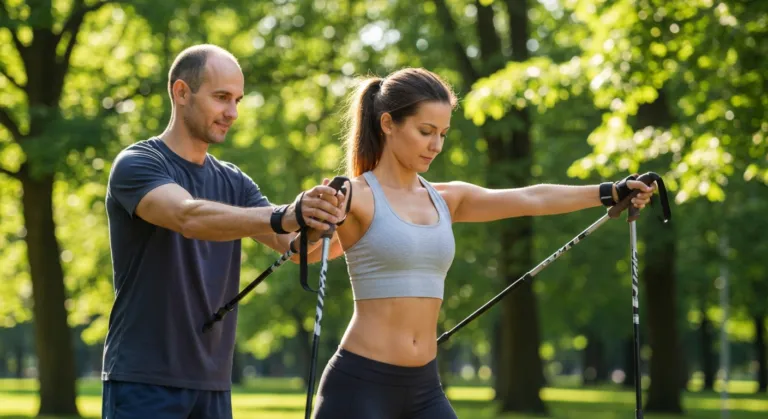
- Master the technique first. Competition referees will disqualify you for poor form. Learn the INWA 10-step technique or the ONWF Original Nordic Walking method. Consider certification courses.
- Find your fixed-length pole size. Height × 0.68 = your race pole length. Round to the nearest 5 cm. One-piece carbon is ideal, but adjustable poles work for your first races.
- Train with a watch. Know your 5 km pace. Aim for under 35 minutes as a competitive entry point for men, under 40 minutes for women.
- Enter a local event. Many countries have regional Nordic walking races. Start with 5 km before attempting longer distances.
- Join the World League. The ONWF Nordic Walking World League ranks athletes globally across a season of events. Register at nordicwalkingworldleague.com.
2025-2026 Competition Calendar
| Event | Date | Location | Distances |
|---|---|---|---|
| ONWF European Championships | June 2025 | Tirano, Italy | 5 km, 10 km, 21 km |
| ONWF World Cup | August 2025 | Belchatow, Poland | 5 km, 10 km |
| Polish National Championships | 2025 | Gorzow Wielkopolski, Poland | 5 km |
| INWA World Cup events | 2025-2026 | Multiple countries | Various |
Bottom Line
Competitive Nordic walking is a real sport with real athletes pushing the limits of what the human body can achieve with two poles and walking technique. Poland dominates the podium, Finland holds the speed records, and France and China have carved out niches in long-distance events. The gear these champions use — one-piece carbon poles from LEKI, Exel, Gabel, and KV+, paired with zero-drop racing shoes like the Altra Torin 7 — is available to anyone willing to train.
You don’t need a world record to start competing. You need a pair of poles, a 5 km race, and 35 minutes of determination.

About the Author
Alex Mercer — INWA Level 2 Nordic Walking Instructor
Certified by the International Nordic Walking Federation (INWA) since 2019, Alex has coached 500+ walkers from beginners to ultra-distance competitors. Sports science background with a focus on biomechanics, gait analysis, and evidence-based training protocols. Regular contributor to walking and outdoor publications.