How to Maintain Your Nordic Walking Poles
Nordic walking poles are a long-term investment, and proper maintenance keeps them performing at their best season after season. Whether you own fixed-length carbon poles or adjustable aluminum ones, these simple care routines will extend their lifespan significantly.
Key Takeaways
Proper maintenance extends Nordic walking pole life from 2 to 3 years up to 5 to 8 years; the key habit is replacing carbide tips every 500 to 800 km, a roughly $25 investment.
- Tip replacement: swap carbide tips every 500 to 800 km, or when point diameter exceeds 3 mm.
- Cost vs payoff: about $25 in spare tips extends pole life from 2-3 years to 5-8 years.
- Winter wear: ice, frozen ground and gravel wear tips 3 to 4 times faster than summer trails.
- After every walk: wipe shafts, clear grit from baskets and check tightness of locks.
- Storage: carbon shafts tolerate -20C to +50C, so normal outdoor storage is fine.
After Every Walk
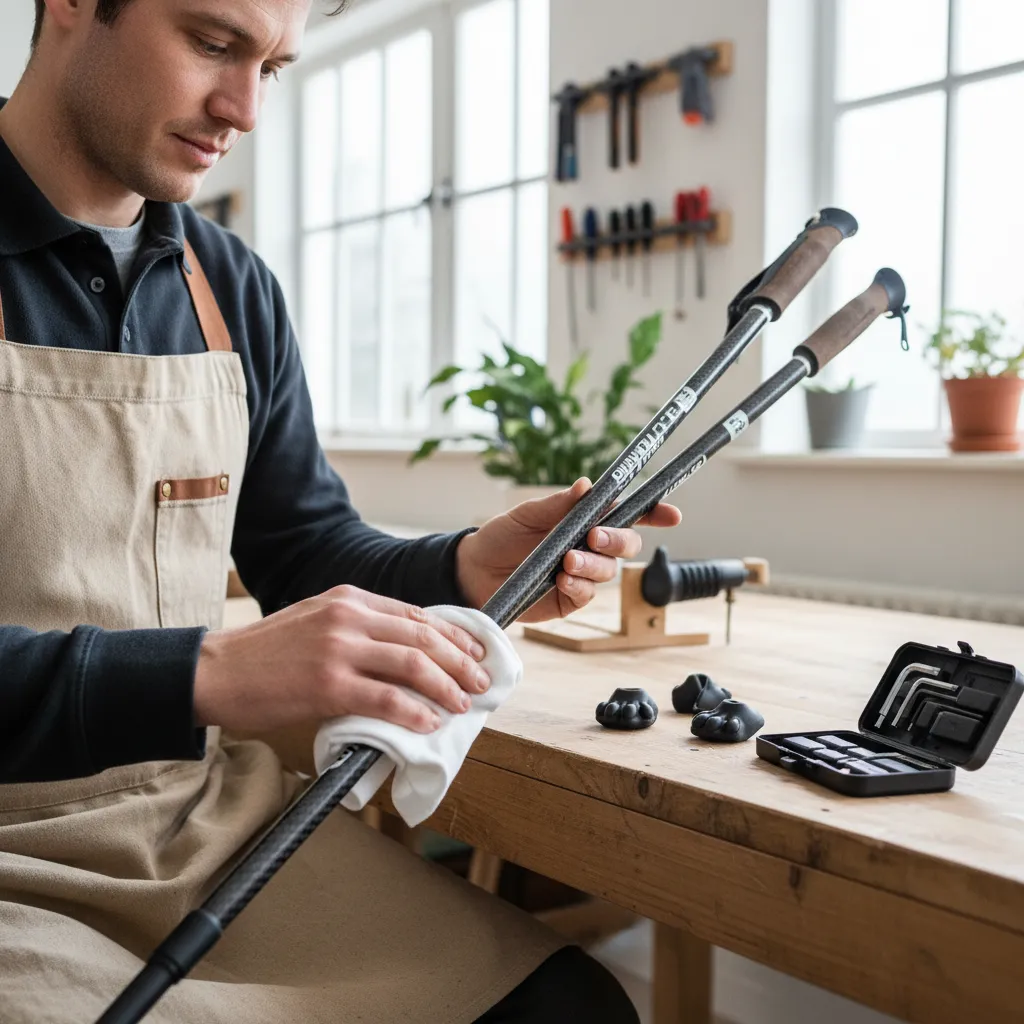
- Wipe down the shaft with a damp cloth to remove dirt and moisture
- Check that rubber paws (asphalt tips) are still firmly attached
- If using telescopic poles, extend them fully to air-dry the inner shaft
- Store poles upright or hanging — never in a damp bag
Never collapse wet telescopic poles and leave them in a closed bag. Moisture trapped inside promotes corrosion on aluminum shafts and can weaken the locking mechanism over time.
Monthly Maintenance
- Inspect carbide tips for wear — replace when the point is flat
- Check rubber paws for cracks or excessive wear
- Test telescopic locks — tighten or replace if slipping
- Clean grip straps with mild soap and water
- Inspect shaft for cracks (especially carbon poles)
When to Replace Parts
Pros
- Rubber paws: cheap and easy to replace ($5-10)
- Carbide tips: last 500-1000 km
- Straps: replacement kits available from most brands
- Baskets: snap-on replacement in seconds
Cons
- Cracked carbon shaft: entire pole must be replaced
- Worn-out lock mechanism: consider new poles
- Bent aluminum shaft: cannot be safely straightened
A worn-out carbide tip reduces grip on all surfaces and forces you to compensate with technique changes that can strain your wrists. Replace tips every 500-800 km of walking — they cost less than a coffee.
Replacement Parts and Maintenance Supplies
Snow Baskets for Winter Walking →
Carbon vs. Aluminum Poles: Maintenance Differences
Aluminum poles fail gradually — they bend under stress, giving visible warning before failure. Carbon poles fail suddenly — a micro-crack from a sharp impact or improper storage becomes a full break mid-session without warning. This difference fundamentally changes the maintenance approach for each material.
For carbon poles, inspect the shaft visually at every maintenance session. Run your fingernail lightly along the entire shaft — any roughness or sound change indicates a crack. Tap gently along the length: a solid sound throughout means intact carbon; a hollow or dull thud indicates internal delamination. Do not use a carbon pole that fails either test.
For aluminum poles, check for bends at the locking section (the most stress-concentrated point) and at the tip junction. A minor bend is safe to continue using; a sharp kink at the locking section should be addressed before the next session — the kink concentrates stress and will cause sudden failure at that point.
The Complete Maintenance Schedule
- After every walk: wipe shaft with damp cloth, check tip for wear, rinse straps, extend telescopic poles fully to dry interior
- Every 10 sessions: inspect shaft for cracks (carbon) or bends (aluminum), test locking mechanism under load, check strap stitching
- Every 25 sessions: replace carbide tips if visibly worn (flat rather than pointed), apply silicone spray to locking mechanism
- Annually: replace wrist straps if webbing shows fraying, inspect handle grip for delamination
The total annual maintenance cost for a quality pair of poles is under $25 (tips + strap replacement). This $25 investment extends pole life from 2-3 years to 5-8 years — a straightforward return on a simple habit.
Full Annual Maintenance Schedule: Month-by-Month
Sporadic pole maintenance catches problems after they develop. A calendar-based maintenance schedule prevents them from developing at all. Here is a month-by-month maintenance calendar for year-round Nordic walkers.
January-February (Winter use): After every session, wipe shafts dry and remove tips to allow shaft interior to air-dry overnight. Check spike points weekly — winter terrain (ice, frozen ground, gravel) wears tips 3-4x faster than summer conditions. Replace tips when point diameter exceeds 3mm (test with a caliper or by feel — a rounded point that no longer bites into hard surfaces needs replacement).
March-April (Spring transition): Full inspection after winter season. Extend telescopic poles fully and check for play at the locking mechanism — any side-to-side movement indicates worn locking collar. Clean locking mechanisms with a dry brush to remove grit accumulated during winter. Check strap stitching for wear, particularly at the wrist bar connection point.
May-August (Peak season): Monthly strap inspection. Replace rubber paw tips if using them for summer trail walking — rubber compounds degrade with UV and ozone exposure over one season and lose grip before they visibly appear worn. Carbon pole users: after any fall or impact, inspect the impact point for hairline cracks by running a finger along the full shaft length. Cracks have a distinct texture compared to the smooth shaft.
September-October (Pre-winter preparation): Full mechanical service on telescopic poles — disassemble, clean all sections, inspect spring mechanisms, lubricate locking mechanisms with a dry PTFE lubricant (not oil-based, which attracts grit). Order replacement tips and straps for the winter season before demand spikes and shipping times increase.
November-December (Early winter): Install ice spike tips. Store rubber paws and summer tips in a dry location away from UV exposure to extend service life. Confirm tip security before first icy session — a tip that separates mid-walk on ice is a fall risk.
Storage Conditions That Determine Long-Term Pole Lifespan
The distinction between poles that last 2-3 years and poles that last 7-10 years typically comes down to storage conditions rather than use intensity. High-quality poles used heavily but stored correctly consistently outlast lower-use poles stored carelessly.
Temperature extremes: Carbon fiber poles are largely immune to temperature cycling within the range of normal outdoor storage (-20°C to +50°C). Aluminum poles in telescopic configurations are more susceptible — the expansion/contraction differential between the aluminum shaft and the internal locking mechanism can cause microscopic wear at the collar over hundreds of thermal cycles. Store telescopic aluminum poles extended (unlocked) during prolonged storage to eliminate this stress.
UV exposure: The primary failure mode for straps stored in sunlight is UV degradation of the webbing and rubber wrist bar. A strap stored in a garage window for one summer ages more than the same strap used daily for two years. Store poles in a bag or case, away from direct sunlight, when not in use for extended periods.
Moisture and damp environments: Aluminum telescopic poles stored in damp conditions (garage corner, car trunk near leaks) develop internal corrosion within the locking mechanism that is invisible from outside and causes the pole to collapse under load without warning. If you store poles in a potentially damp space, store them vertically, tips up, to allow any moisture to drain away from the locking mechanism rather than pooling there.
Transport damage: The most common physical damage to poles occurs during transport — thrown into car trunks, leaned against walls, or packed loosely in luggage. Carbon poles in particular should be transported in a dedicated pole bag or case. Carbon is very strong under axial load (the force direction during walking) but relatively brittle under lateral impact. A sharp blow to the mid-shaft during transit can create a hairline crack that passes unnoticed until the pole fails under walking load.
Frequently Asked Questions
How often should I replace Nordic walking pole tips?
Replace carbide tips when they wear flat (usually every 500-1000km). Replace rubber paw tips every 300-500km or when the tread pattern wears smooth.
Can I repair a bent aluminum pole?
Minor bends can sometimes be straightened, but the metal is weakened at the bend point. For safety, replace significantly bent poles rather than repair them.