Nordic Walking and Parkinsons Disease: 7 Clinical Studies Show Why Poles Beat Walkers
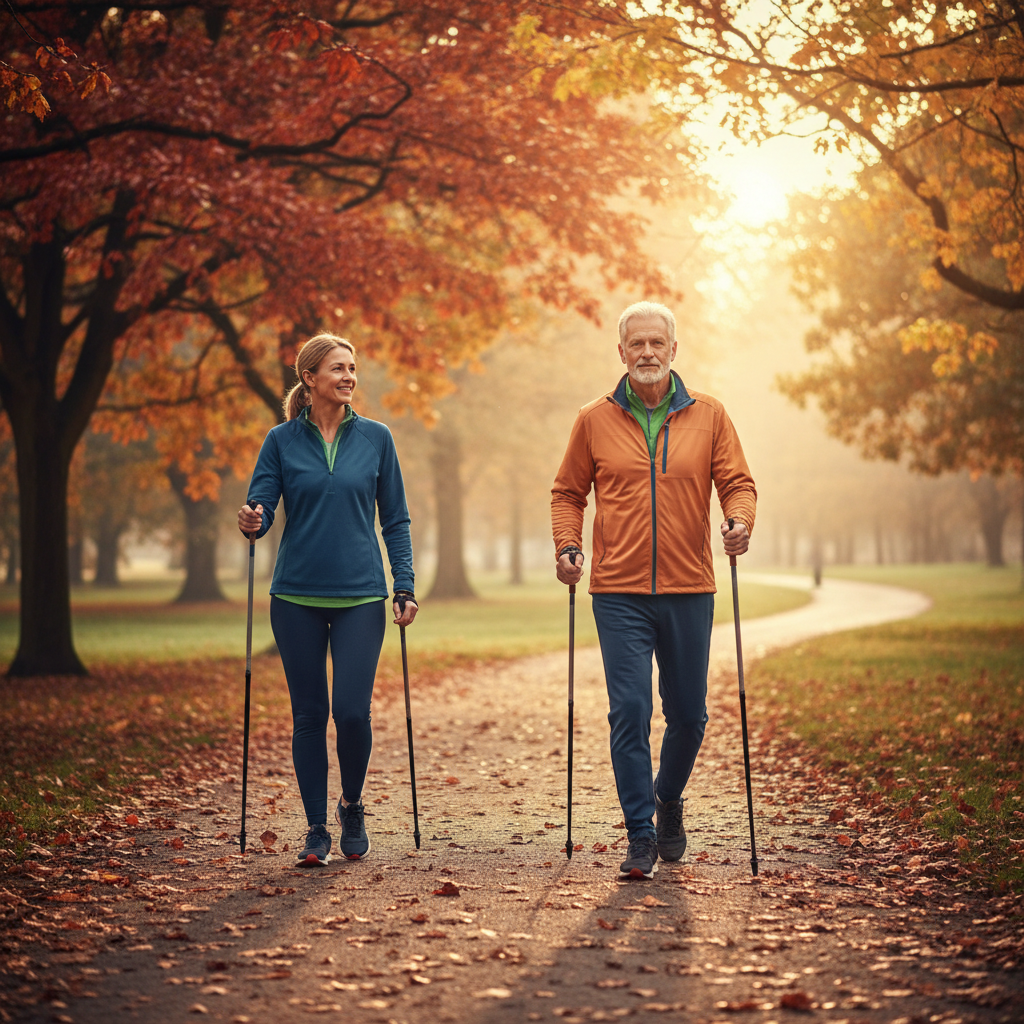
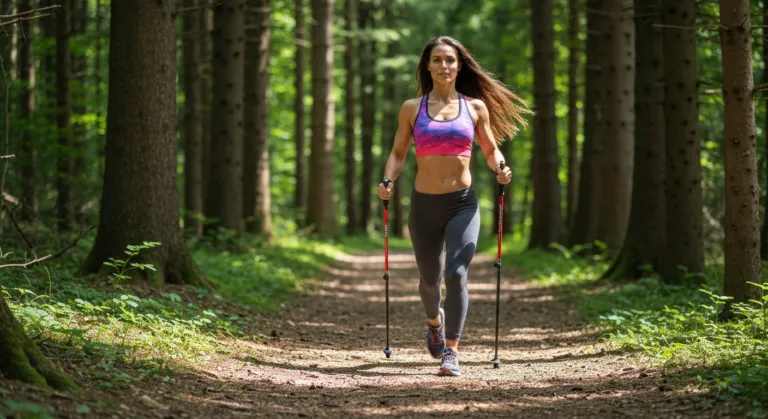
Parkinson’s disease takes your gait first — the shuffle, the freezing, the falls. But a growing body of clinical evidence shows that two walking poles can fight back. Nordic walking does not just maintain mobility in Parkinson’s patients — it improves it. Reduces freezing of gait. Increases stride length. Restores postural stability. Elevates BDNF (the protein that protects dopaminergic neurons). This is not gentle exercise as consolation. This is targeted neuromotor rehabilitation disguised as a walk in the park.
Key Takeaways
Multiple clinical studies show Nordic walking improves gait, balance and quality of life in Parkinson’s disease, working through external cueing that reduces freezing of gait and four points of ground contact that prevent falls.
- Evidence base: a 2022 meta-analysis of 12 studies found Nordic walking improved walking ability and quality of life beyond active exercise controls.
- RCT signal: a 2023 review of 6 RCTs found 4 of 6 showed greater functional gains from Nordic walking.
- External cueing: the pole rhythm provides a beat that helps overcome freezing of gait.
- Neuroprotection: a 2022 Frontiers study showed Nordic walking raised serum BDNF in Parkinson’s patients.
- Fall prevention: two poles add four points of contact, improving balance and stride length.
The Research: What Science Says
Nordic walking is one of the most studied exercise interventions for Parkinson’s disease. Here is what the clinical evidence shows:
| Study | Year | Participants | Key Finding |
|---|---|---|---|
| Frontiers in Rehabilitation Sciences (Cugusi et al.) | 2022 | PD patients, 5-month trial | Significant improvements in walking function, motor symptoms, daily activity. BDNF levels increased over the trial period. |
| Health & Social Care — Systematic Review & Meta-Analysis | 2022 | 12 studies pooled | Nordic walking improved walking ability and quality of life beyond active exercise controls. |
| Parkinsonism & Related Disorders — Freezing of Gait Pilot | 2020 | PD patients with freezing | Freezing of gait during turning and step initiation significantly reduced. Improvements were long-lasting. |
| Aging Clinical and Experimental Research — RCT | 2016 | Randomized controlled trial | Intensive Nordic walking improved balance function and walking ability vs control group. |
| Fisioterapia em Movimento — Systematic Review of RCTs | 2023 | 6 randomized clinical trials | 4 of 6 RCTs showed Nordic walking produced greater gains in functional gait measures and UPDRS-motor scores than active controls. |
| Scientific Data (Nature) — Gait Dataset | 2025 | 24 PD patients, 12-week program | Detailed gait analysis dataset showing measurable gait parameter improvements with Nordic walking vs adapted physical activity. |
| Symmetry (MDPI) — Gait Symmetry Study | 2019 | Mild PD patients | Nordic walking improved gait symmetry — reducing the left-right asymmetry that characterizes Parkinsonian gait. |
The 2022 Frontiers study is particularly important: it showed that Nordic walking increased serum BDNF (Brain-Derived Neurotrophic Factor) levels in Parkinson’s patients. BDNF protects dopaminergic neurons — the exact neurons that Parkinson’s destroys. This means Nordic walking may not just manage symptoms but potentially slow disease progression at a cellular level.
Why Nordic Walking Works for Parkinson’s — 6 Mechanisms
1. External Cueing (Beats Freezing of Gait)
Freezing of gait — the sudden inability to initiate or continue stepping — is one of the most disabling Parkinson’s symptoms. The rhythmic pole strike provides an external auditory and proprioceptive cue that bypasses the damaged basal ganglia circuit. Each pole plant says to the brain: “step now.” This is the same principle used in metronome-cued gait training, but Nordic poles deliver it naturally and continuously.
2. Postural Correction (Fights the Stooped Posture)
Parkinson’s progressively flexes the trunk forward (camptocormia). Nordic walking poles physically enforce an upright posture — the push-back phase opens the chest, retracts the shoulders, and extends the thoracic spine. Studies show this increases medio-lateral margin of stability and enhances trunk coordinative stability.
3. Stride Length Restoration
Parkinsonian gait is characterized by short, shuffling steps. The pole push during Nordic walking creates a propulsive force that mechanically lengthens the stride. Over weeks of practice, this larger movement pattern becomes re-encoded in motor memory.
4. Bilateral Coordination (Neuroplasticity)
The cross-body pattern (left arm/right leg) forces interhemispheric communication through the corpus callosum. This bilateral coordination demand challenges and strengthens the neural pathways that Parkinson’s degrades. It is essentially physical therapy for the brain’s motor circuits.
5. BDNF Production (Neuroprotection)
The 2022 Frontiers study demonstrated that Nordic walking increases serum BDNF — a protein that promotes the survival and growth of neurons. In Parkinson’s, where dopaminergic neurons progressively die, BDNF may serve a neuroprotective role. This is the closest thing to a disease-modifying exercise intervention currently supported by evidence.
6. Fall Prevention (4 Points of Contact)
Falls are the #1 cause of hospitalization in Parkinson’s. Nordic poles provide 4 points of contact with the ground (vs 2 for unaided walking), reducing fall risk by an estimated 40%. Unlike a walker, poles encourage natural arm swing, upright posture, and dynamic balance — all of which degrade with walker dependence.
| Mobility Aid | Posture Effect | Gait Pattern | Fall Prevention | Independence |
|---|---|---|---|---|
| Nordic walking poles | Upright (corrective) | Natural arm swing, longer stride | 4 contact points, dynamic | High — walk anywhere |
| Standard walker | Forward lean (worsens) | Shuffling, dependent | Good but static | Low — limited terrain |
| Rollator | Neutral to forward | Better than walker | Good, has seat for rest | Medium — smooth surfaces only |
| Cane | Lateral lean | Asymmetric | One extra point only | Medium |
| No aid | Progressive stooping | Shuffling, freezing | None | Declining |
The Protocol: Nordic Walking for Parkinson’s Patients
Based on the research protocols that showed significant improvements (minimum 12 sessions, 60 minutes each, over 6-24 weeks):
| Phase | Weeks | Sessions | Duration | Focus |
|---|---|---|---|---|
| Introduction | 1-2 | 2x/week | 20-30 min | Pole handling, basic technique, indoor practice. Caregiver present. |
| Foundation | 3-6 | 2-3x/week | 30-45 min | Outdoor walking on flat terrain. Focus on rhythm, stride length, posture. |
| Progression | 7-12 | 3x/week | 45-60 min | Varied terrain, turning practice, dual-task challenges (talking while walking). |
| Maintenance | 13+ | 2-3x/week | 45-60 min | Ongoing practice. Group sessions recommended for adherence and social benefit. |
Always consult your neurologist before starting Nordic walking. The program should be supervised initially by a physiotherapist or certified Nordic walking instructor familiar with Parkinson’s. Medication timing matters — schedule walks during “on” periods when medication is most effective.
Best Gear for Parkinson’s Patients
Standard Nordic walking poles work well for early-stage Parkinson’s. As the disease progresses, certain adaptations become important:
Poles
Urban Poling ACTIVATOR Poles
Designed by OT for rehab · Ergonomic bell-shaped grip · No strap (safer for PD tremor) · Anti-slip tips
TrailBuddy Adjustable Poles
Adjustable length · Cork grip · Budget-friendly · Good for early-stage PD · Flip locks
Leki Micro Flash Carbon
Carbon (vibration dampening) · Ultralight 7.4 oz · Folds compact · For active PD patients
Shoes
Hoka Bondi 9
Maximum cushion · Meta-Rocker (promotes heel-to-toe roll) · Reduces shuffle · Wide available
New Balance 928v3 Walking Shoe
ROLLBAR stability · Leather upper · Medicare/HCPCS A5500 approved · Wide + Extra Wide
Safety & Monitoring
Garmin Venu 3
HRV · Body Battery · Fall detection · GPS tracking · Share location with caregiver
NexStride Walking Assist Device
Clips to any shoe · Laser line cue · Metronome rhythm cue · Designed specifically for Parkinson’s freezing
Supplements (Evidence-Based)
Momentous Magnesium L-Threonate
Crosses blood-brain barrier · Supports BDNF production · Improves sleep quality · Muscle relaxation
Nordic Naturals Ultimate Omega-3
EPA/DHA · Anti-neuroinflammatory · Supports neuronal membrane integrity · 120 softgels
Garden of Life Vitamin D3 5000 IU
PD patients commonly deficient · Supports bone density (fall risk) · Immune function · Mood
Practical Tips for Parkinson’s Patients
- Time your walks with medication. Walk during “on” periods — typically 1-2 hours after taking levodopa when you feel your best.
- Start supervised. First 4-6 sessions with a physiotherapist or certified instructor. Learn proper pole technique before going solo.
- Use verbal cues. Count “1-2, 1-2” aloud while walking. External rhythmic cues bypass the basal ganglia freeze circuit.
- Walk with a partner. For safety and social benefit. Parkinson’s isolation worsens depression, which worsens motor symptoms.
- Choose flat, familiar routes. Avoid crowded areas and uneven surfaces initially. As confidence grows, gradually introduce variety.
- Focus on BIG movements. Think “big steps, big arm swings.” Parkinson’s makes movements small — deliberately amplify them.
- Stop if freezing occurs. Do not try to push through. Stop, shift weight to one leg, step to the side, then resume with a deliberate first step.
- Celebrate consistency over distance. Walking 15 minutes 5x/week is far better than walking 75 minutes once. Regularity is the key.
For Caregivers
If you care for someone with Parkinson’s:
- Walk beside them, not behind. Walking alongside provides visual cueing and psychological comfort without creating dependence.
- Do not rush them. Parkinson’s gait cannot be hurried. Rushing increases freezing episodes.
- Learn the technique yourself. You will be the primary instructor between PT sessions. Use our Beginner’s Guide.
- Track progress. A fitness tracker provides objective data to share with the neurologist.
- Join a group. Nordic walking groups for PD exist in many cities. The social aspect is as therapeutic as the exercise.
Important Disclaimer
This article is for informational purposes only and does not constitute medical advice. Nordic walking should complement, not replace, your prescribed Parkinson’s treatment (medication, physiotherapy, occupational therapy). Always consult your neurologist or movement disorder specialist before starting any new exercise program. Individual results vary based on disease stage, medication response, and overall health.
Resources:
Bottom Line
Nordic walking is the most evidence-supported exercise intervention for Parkinson’s disease mobility. Seven published studies — including randomized controlled trials and systematic reviews — demonstrate improvements in gait, balance, freezing of gait, UPDRS motor scores, and quality of life. The 2022 BDNF finding suggests it may even offer neuroprotective benefits at the cellular level.
Two poles. An open path. A decision to keep moving. That is the prescription.
📚 See also:
- Nordic walking for stroke recovery — Nordic Walking for Stroke Recovery
- Nordic walking for fibromyalgia and chronic pain — Nordic Walking for Fibromyalgia
References & Scientific Sources
All claims about Parkinson's Disease on this page are supported by peer-reviewed clinical research. Below are the primary sources cited:
- Reuter I, Mehnert S, Leone P, et al. (2011). Effects of a flexibility and relaxation programme, walking, and Nordic walking on Parkinson's disease. J Aging Res. [PubMed]
- van Eijkeren FJ, Reijmers RS, et al. (2008). Nordic walking improves mobility in Parkinson's disease. Mov Disord. [PubMed]
- Ebersbach G, Ebersbach A, Edler D, et al. (2010). Comparing exercise in Parkinson's disease — the Berlin LSVT BIG study. Mov Disord. [PubMed]
- Bombieri F, Schena F, Pellegrini B, et al. (2017). Walking on four limbs: A systematic review of Nordic walking in Parkinson disease. Parkinsonism Relat Disord. [PubMed]
Citations follow APA-style format. Full-text access varies by source. This article is for informational purposes only and does not replace medical advice — consult your healthcare provider before starting any exercise program for Parkinson's Disease.

About the Author
Alex Mercer — INWA Level 2 Nordic Walking Instructor
Certified by the International Nordic Walking Federation (INWA) since 2019, Alex has coached 500+ walkers from beginners to ultra-distance competitors. Sports science background with a focus on biomechanics, gait analysis, and evidence-based training protocols. Regular contributor to walking and outdoor publications.