Running Biomechanics: Technical Audit and Efficiency Manifesto from 10 World Experts
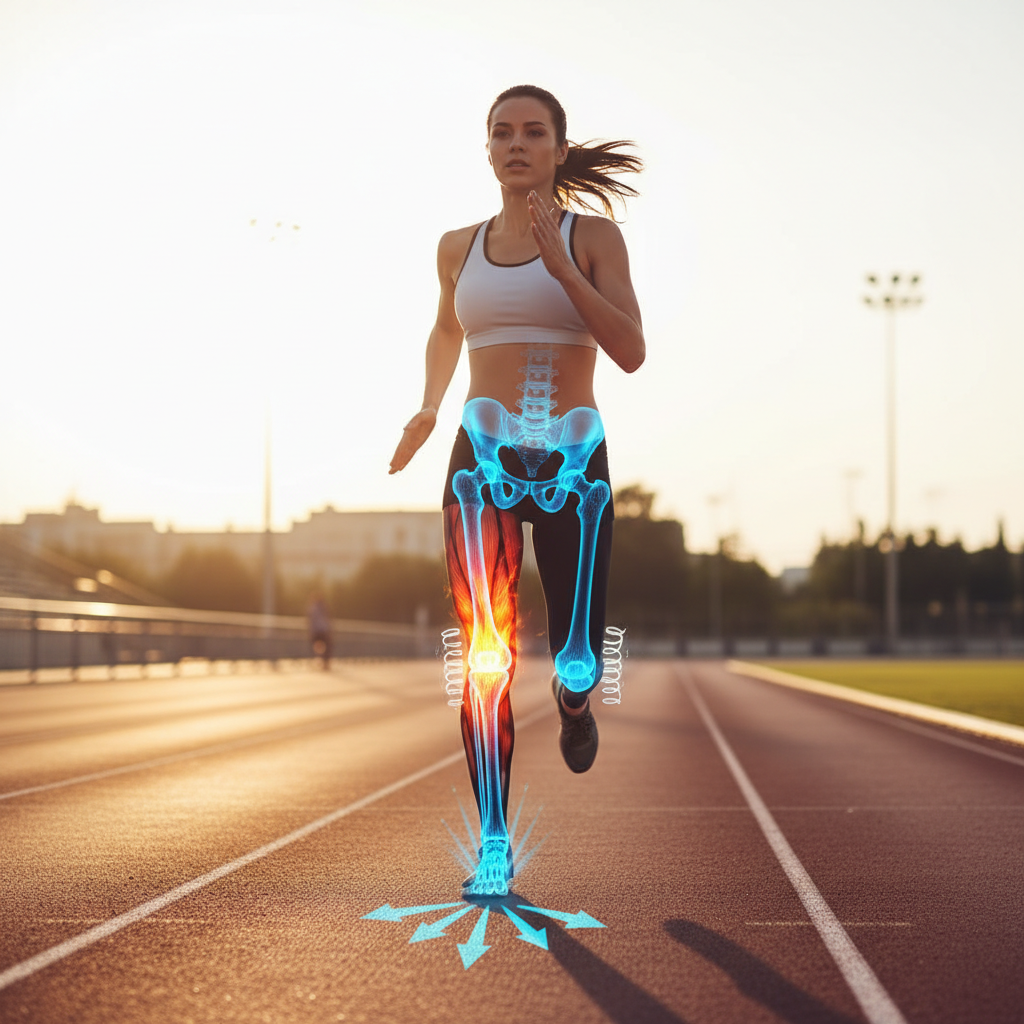
Running is not a series of steps. It is a high-frequency interaction between biological springs and the vector of gravity. At every landing, your body solves an equation of energy absorption and redistribution. An error of 1 degree or 5 milliseconds, repeated 10,000 times per workout, leads to inevitable structural breakdown. We analyzed the methods of 10 of the world’s leading running experts to derive the Formula for the Perfect Run.
Key Takeaways
Efficient, injury-resistant running treats the leg as a spring, fixes overstriding first by raising cadence, and protects the kinetic chain from the foot up; Nordic walking is the ideal low-impact cross-training, cutting joint impact 25 to 30 percent.
- #1 enemy: overstriding creates a braking vector at every landing.
- Fix order: raise cadence first (2 weeks), then adjust foot-strike position (4 weeks).
- Foot power: a jammed or weak big toe costs up to 15% of push-off power.
- Cross-training: Nordic walking maintains fitness and coordination while reducing joint impact 25-30%.
- Spring model: pre-activation lets the leg store and return energy rather than absorb it as damage.
1. Vertical Stiffness: Your Leg Is a Spring, Not a Lever
Running is a bouncing activity. Your leg must function as a dynamic spring — stiff enough to return elastic energy, but compliant enough to absorb impact. If your leg is too “soft” (excessive knee and ankle flexion at contact), impact energy dissipates as heat in soft tissues instead of propelling you forward. This is called an energy leak.
Pre-Activation: The Key
Muscles must engage before ground contact, not after. If you are relaxed during the flight phase, you “collapse” at landing, dramatically increasing load on the patellofemoral joint (kneecap). The solution: think of your legs as loaded springs in the air, ready to catch and rebound.
| Leg Stiffness | Energy Return | Injury Risk | Efficiency |
|---|---|---|---|
| Too soft (excessive flexion) | Low — energy absorbed as heat | High — patellar, ITB, shin stress | Low — muscular, not elastic |
| Optimal (tuned spring) | High — tendon elastic recoil | Low — force distributed across system | High — biological springs do the work |
| Too stiff (rigid landing) | Medium — but transmitted as shock | High — stress fractures, joint impact | Medium — jarring, not flowing |
The “Big Toe Test” from Jay Dicharry: Can you independently lift your big toe while keeping the other four toes on the ground? If not, your deep front line is disconnected. This single weakness causes energy leaks throughout your entire gait cycle. Practice “Toe 1” isolation daily.
2. The Braking Vector: Why Overstriding Is the #1 Enemy
Heel striking is a symptom. The real disease is overstriding — landing with your foot far ahead of your center of mass. When your foot “stabs” the ground in front of your body, the ground reaction force vector points against your direction of movement. You create a braking peak with every step.
| Landing Pattern | Force Direction | Braking Effect | Knee Load | Efficiency |
|---|---|---|---|---|
| Overstriding (foot ahead) | Backward + upward | Peak braking = 2-3x body weight | Extreme — direct impact | Terrible — you fight yourself |
| Under center of mass | Mostly vertical | Minimal braking | Low — absorbed by elastic system | Optimal — gravity-assisted |
The ice test: Imagine running on thin ice. Your instinct would be to place each foot softly beneath you, using a whole-body lean from the ankles — not just bending at the waist. That instinct is correct biomechanics.
3. Pelvic Torque: The Power Distribution Hub
If the foot is the foundation, the pelvis is the power station. When the pelvis “wanders” (lateral sway, anterior tilt, rotation collapse), the knee is doomed — it becomes a hostage between a dysfunctional ankle and a lazy hip.
The External Rotation Method
Feet should be maximally parallel. At stance, generate external rotational torque — as if “screwing” the hip outward into the ground. This activates the gluteus medius, preventing pelvic drop on the unsupported side.
| Pelvic Control | Glute Medius | Knee Position | Result |
|---|---|---|---|
| No torque (common) | Inactive | Collapses inward (valgus) | Runner’s knee, IT band syndrome, meniscus wear |
| Active torque | Engaged — pelvis level | Tracks over 2nd toe | Stable, efficient, injury-resistant |
4. Cadence: The Biomechanical Safety Switch
Low cadence (150-160 steps/min) means longer flight time, which means higher fall height, which means greater impact force. The physics is simple: F = m × a. The higher you bounce, the harder you land.
| Cadence | Vertical Oscillation | Ground Contact Time | Injury Risk | Efficiency |
|---|---|---|---|---|
| < 160 spm | High (8-12 cm) | Long (280+ ms) | High — more time under load | Low — bouncing, not running |
| 170-180 spm | Optimal (6-8 cm) | Moderate (200-250 ms) | Low — elastic recoil window | High — tendon springs engaged |
| > 190 spm | Very low (4-5 cm) | Short (< 200 ms) | Low but shuffling risk | Variable — may reduce stride too much |
The shift: Stop pulling your leg forward. Focus on pulling your foot off the ground faster. Cadence increases naturally when you think “quick pickup” instead of “long reach.”
5. The Kinetic Chain: Foot Controls Hip
Functional flat foot (arch collapse under load) triggers a devastating chain reaction: arch drops → tibia rotates internally → knee collapses inward (valgus) → pelvis tilts → lower back compensates.
The Short Foot Exercise
Contract the arch of your foot without curling your toes. Imagine shortening the distance between your heel and big toe base by pulling the arch upward. This creates an “active foundation” that prevents knee collapse under running load. Practice standing, then walking, then integrate into your run.
6. Tissue Capacity: The Load Bucket
There is no “perfect technique” separate from your current tissue readiness. Every runner has a “load bucket” — the capacity of tendons, bones, and cartilage to handle stress. If you abruptly change technique (e.g., from heel strike to forefoot), you instantly overflow the bucket in a different location (usually the Achilles tendon).
Any gait change must take months, not weeks. Collagen remodeling (tendon adaptation) takes 6-12 months to reach full structural maturity. Change one variable at a time. Increase cadence first (2 weeks). Then work on foot strike position (4 weeks). Then add hip stability drills (ongoing). Never change everything at once.
7. Running Economy: Kill the Parasitic Movements
Gas exchange analysis in the lab reveals where oxygen is wasted. The biggest culprits:
| Parasitic Movement | Energy Cost | Fix |
|---|---|---|
| Arm crossover (hands crossing midline) | Core fights rotation instead of driving forward | Arms swing front-to-back, elbows < 90°, hands relaxed |
| Excessive bounce (vertical oscillation > 10 cm) | Energy goes up instead of forward | Increase cadence 5-10%, think “smooth and level” |
| Shoulder tension (shrugged, rigid) | Wasted muscle contraction, restricted breathing | Drop shoulders, shake hands every 5 minutes |
| Head bob (looking down at feet) | Shifts center of mass, tightens posterior chain | Eyes 20-30 meters ahead, chin level |
8. Terrain Biomechanics: Uphill vs Downhill
| Terrain | Center of Mass | Foot Strike | Stride | Cadence | Common Error |
|---|---|---|---|---|---|
| Uphill | Shift to forefoot | Midfoot/forefoot | Shortened 30-40% | Increased | Leaning from waist (should lean from ankles) |
| Downhill | Stay centered (lean INTO the slope) | Midfoot, quick turnover | Slightly shortened | Increased | Leaning back = quad overload + heel slam |
| Flat | Slight forward lean from ankles | Under center of mass | Natural, not forced | 170-180 spm | Overstriding for speed (more force, less efficiency) |
Downhill rule: Lean into the void. If you lean back on descents, you quadruple knee impact. Trust gravity, shorten your stride, and let the hill carry you.
9. The Windlass Mechanism: Your Big Toe Is a Power Generator
Your foot is a dynamic winch mechanism. During push-off, the big toe extends (dorsiflexes), pulling the plantar fascia taut. This automatically transforms the foot from a soft shock absorber into a rigid power lever. If your big toe is jammed in a narrow shoe or too weak to extend, the foot stays “jelly” — and you lose up to 15% of push-off power.
Running in worn-out or narrow shoes kills your natural power generation.
10. Shoe Rotation: Stack Height and Drop as Angle Adjusters
| Shoe Parameter | High (10-12mm drop) | Zero Drop (0mm) | Best Practice |
|---|---|---|---|
| Calf/Achilles load | Reduced | Increased significantly | Transition gradually to lower drop |
| Knee load | Increased (heel striking encouraged) | Reduced | Zero drop aligns pelvis better |
| Pelvic alignment | Anterior tilt encouraged | Neutral pelvis promoted | Zero drop is biomechanically superior |
| Proprioception | Reduced (thick cushion) | High (ground feel) | Rotate between shoes for varied stimulus |
Rotation protocol: Own 2-3 pairs of running shoes with different drops and stack heights. Alternate daily. Different shoes force different load distribution patterns — the best injury prevention strategy available.
Running Shoes Ranked by Biomechanical Principle
Altra Torin 7
Zero drop · FootShape toe box · Ego Max cushion · Road running · Windlass-friendly
Hoka Bondi 9
5mm drop · Max cushion · Meta-Rocker · Joint-friendly · High stack for protection
Brooks Ghost Max
6mm drop · DNA Loft v2 · GlideRoll rocker · Neutral · Daily trainer workhorse
Vivobarefoot Primus Lite IV
Zero drop · True barefoot · 6mm sole · Maximum proprioception · For experienced runners
Gait Analysis and Correction Tools
Garmin Forerunner 965
Cadence · Ground contact time · Vertical oscillation · Stride length · Running power
Polar H10 Chest Strap
Medical-grade HR · HRV · Zone training · Pairs with all watches · Running dynamics
TriggerPoint GRID Foam Roller
Release calves, IT band, quads, hip flexors · Pre/post-run tissue maintenance
Fit Simplify Resistance Bands
Glute activation before every run · Clamshells + monster walks = pelvic torque
The Self-Audit: 4 Tests Before Your Next Run
| # | Test | What It Reveals | Pass | Fail Action |
|---|---|---|---|---|
| 1 | Sound test: Run without music. Can you hear your footfalls? | Vertical stiffness | Silent or near-silent | Increase cadence, shorten stride |
| 2 | Shoe wear test: Check outsole wear pattern | Overstriding | Even midfoot wear | Outer heel destroyed = overstride |
| 3 | Cadence test: Count single-leg steps for 30 seconds | Cadence optimization | ≥ 42 (= 168+ spm total) | < 40 = high injury risk zone |
| 4 | Balance test: Stand on one leg, eyes closed, 30 seconds | Proprioception readiness | 30 sec stable | Not ready for high-mileage running |
The 3-Level Optimization Matrix
| Level | Focus | Key Metric | Expert Source |
|---|---|---|---|
| I: Braking Control | Eliminate overstriding + increase cadence | Cadence ≥ 170, vertical osc < 8 cm | Cucuzzella, Dunne, Canaday |
| II: Structural Core | Pelvic torque + short foot activation | Single-leg stability, no knee valgus | Starrett, Horschig, Goom |
| III: Elastic Efficiency | Windlass mechanism + vertical stiffness | Silent footfalls, toe independence | Dicharry, Gait Guys, Pribut |
From Running to Nordic Walking: The Recovery Bridge
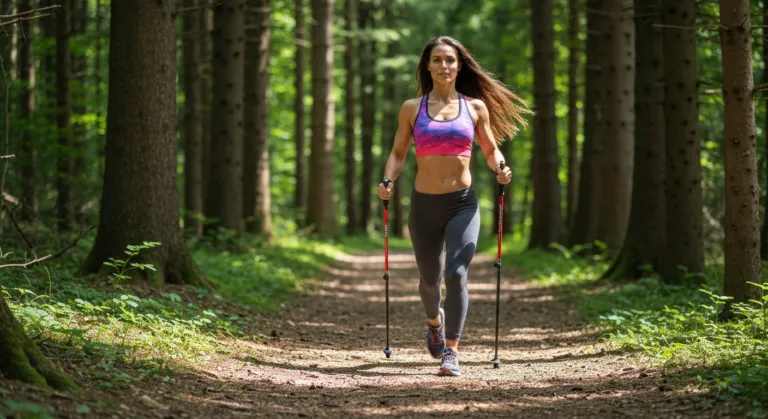
Nordic walking is the ideal active recovery tool for runners. It maintains cardiovascular fitness and the cross-body coordination pattern while reducing joint impact by 25-30%. For runners dealing with overuse injuries, Nordic walking poles provide the load reduction that allows training to continue without aggravating damaged tissues.
For complete walking biomechanics, see our companion article: Walking Biomechanics: The Gold Standard.
Bottom Line
Running biomechanics is not about belief — it is applied physics and neurology. Your body is a system of biological springs. Tune them correctly (cadence ≥ 170, foot under center of mass, active glutes, engaged big toe), and running becomes what it was designed to be: flight on elastic energy. Tune them wrong, and 10,000 repetitions of error per workout will find the weakest link in your chain.
Your movement is your greatest investment. Make it with precision.
Our Top Pick

About the Author
Alex Mercer — INWA Level 2 Nordic Walking Instructor
Certified by the International Nordic Walking Federation (INWA) since 2019, Alex has coached 500+ walkers from beginners to ultra-distance competitors. Sports science background with a focus on biomechanics, gait analysis, and evidence-based training protocols. Regular contributor to walking and outdoor publications.