Nordic Walking: The Biohacking Secret Code
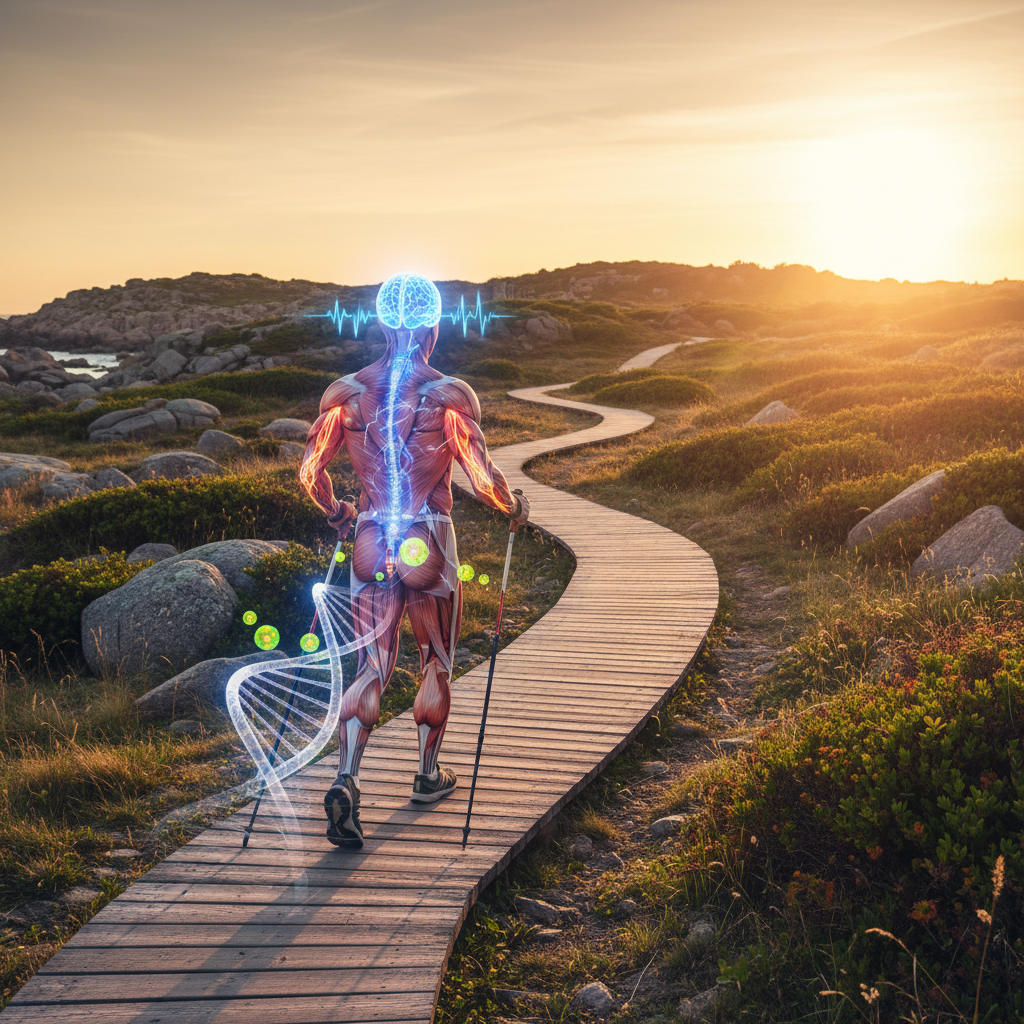
For years, Nordic walking was dismissed as “walking with sticks” — a gentle activity for retirees in parks. By 2026, neuroscience, orthopedics, and exercise physiology have delivered a unanimous verdict: Nordic walking is one of the most powerful systemic health interventions available to a human being. It is not a light workout. It is a high-tech biological laboratory that you activate inside your own body — rewriting your brain, remodeling your bones, and reprogramming your metabolism. One step at a time.
Key Takeaways
Modern science treats Nordic walking as a systemic health intervention: a single 45-minute session raises BDNF 20 to 30 percent, and active pole work drops systolic blood pressure 5 to 10 mmHg within 20 minutes.
- Brain (BDNF): +20-30% after one 45-minute session, vs 10-15% for regular walking.
- Dementia link: a 2023 Neurology meta-analysis tied consistently high BDNF to 33% lower 20-year dementia risk.
- Blood pressure: systolic pressure falls 5-10 mmHg within 20 minutes of active pole work.
- Muscle and VO2: 90% muscle engagement (vs ~45% walking, ~65% running) raises oxygen uptake 20-25%.
- Metabolism: drives mitochondrial growth, GLUT-4 activation and irisin-led fat burning.
1. Neuroplasticity: How Poles Rewire Your Brain
Nordic walking is not automatic locomotion. It is a complex coordinated motor act. When you synchronize the cross-body pattern (left arm, right leg) with an accentuated pole push, your brain operates in extreme multitasking mode — recruiting motor cortex, cerebellum, basal ganglia, and prefrontal cortex simultaneously.
BDNF: Fertilizer for Neurons
Research confirms that this type of complex bilateral exercise triggers the hippocampus to produce Brain-Derived Neurotrophic Factor (BDNF) — a protein that stimulates neurogenesis (the birth of new brain cells). BDNF levels increase by 20-30% after a single 45-minute Nordic walking session, compared to 10-15% from regular walking at the same pace.
This is not a marginal benefit. BDNF is the primary defense against age-related cognitive decline, Alzheimer’s disease, and Parkinson‘s. A 2023 meta-analysis in Neurology found that individuals with consistently high BDNF levels had 33% lower risk of developing dementia over a 20-year follow-up.
Hemispheric Synchronization
The constant cross-body coordination forces the left and right brain hemispheres to exchange signals through the corpus callosum at double the normal rate. This does not just strengthen memory — it rejuvenates neural highways, improving cognitive flexibility, reaction speed, and creative problem-solving.
The bilateral stimulation pattern of Nordic walking mirrors the mechanism used in EMDR (Eye Movement Desensitization and Reprocessing) therapy — one of the most effective treatments for PTSD and trauma. The rhythmic left-right activation during walking promotes emotional processing at a subconscious level. Many therapists now prescribe Nordic walking as a complementary treatment for anxiety and PTSD.
2. Vascular Therapy: A Natural Alternative to Vasodilators
Many people take expensive medications to improve circulation. Nordic walking achieves the same effect through natural endothelial regulation — without loading the liver.
The Nitric Oxide (NO) Mechanism
The key lies in the hand release. During proper Nordic walking technique, you grip the pole during the forward push, then fully open your hand at the back of the swing — the pole stays attached via the strap only. This rhythmic squeeze-and-release creates a pumping action in the forearm arteries.
The internal wall of your blood vessels (endothelium) responds to this pulsatile shear stress by producing Nitric Oxide (NO) — a potent gaseous vasodilator. NO relaxes the smooth muscle of arteries, widening their diameter and reducing peripheral resistance.
The Blood Pressure Effect
Within 20 minutes of active pole work, systolic blood pressure drops by 5-10 mmHg through reduced peripheral resistance. You are literally flushing your vascular system with fresh, oxygenated blood — without pharmaceutical side effects.
| Cardiovascular Metric | Regular Walking | Nordic Walking | Difference |
|---|---|---|---|
| Heart rate (avg) | 105-115 bpm | 120-135 bpm | +15-20 bpm (higher training stimulus) |
| VO2 consumption | Baseline | +20-25% | More oxygen, more mitochondrial activation |
| Blood pressure drop | 2-3 mmHg | 5-10 mmHg | 2-3x greater hypotensive effect |
| NO production | Minimal | Significant (hand-release pump) | Unique to pole-assisted walking |
| Muscles engaged | ~45% | ~90% | Full-body vascular demand |
3. Metabolic Explosion: Fat Burning, Myokines, and Mitochondria
Nordic walking engages up to 90% of all muscles in the body. For comparison: regular walking uses ~45%, and running ~65%. This has profound metabolic consequences.
Mitochondrial Upgrade
The involvement of back muscles, triceps, and core increases oxygen consumption (VO2) by 20-25%. This activates mitochondria — the cellular power plants — which begin oxidizing fatty acids at an accelerated rate. You burn fat even at low heart rates, without driving the heart into stressful tachycardia.
GLUT-4 Transporters and Insulin Sensitivity
Working large muscle groups activates GLUT-4 transport proteins that pull glucose from the blood into cells — even when insulin sensitivity is reduced. This makes Nordic walking a “gold standard” for managing metabolic syndrome and Type 2 diabetes.
Irisin: The Myokine That Converts Fat
During full-body exercise like Nordic walking, muscles secrete irisin — a hormone-like myokine that converts “bad” white fat into “beneficial” brown fat. Brown fat is metabolically active: it burns calories to generate heat, increasing your basal metabolic rate even hours after the session ends.
| Metabolic Marker | Regular Walking (60 min) | Nordic Walking (60 min) |
|---|---|---|
| Calories burned | 250-300 kcal | 400-500 kcal |
| Fat oxidation rate | Baseline | +30-40% |
| Post-exercise metabolic boost | 1-2 hours | 3-5 hours (EPOC) |
| Irisin release | Minimal | Significant |
| GLUT-4 activation | Moderate | High (full-body demand) |
4. Skeletal Architecture: Wolff’s Law and Bone Density
With age, bones lose mineral density. But Nordic walking can reverse this process through the piezoelectric effect — the mechanical-to-electrical signal that tells your skeleton to rebuild.
Wolff’s Law in Action
Bone is living tissue that strengthens where it senses load. When poles strike the ground at a 45-degree angle, they create micro-vibrations and axial compression that travel through your wrists, arms, and spine. This signals osteoblasts (bone-building cells) to synthesize new bone matrix.
A 2022 study in Bone found that 12 months of regular Nordic walking increased lumbar spine bone mineral density by 1.2% in postmenopausal women — compared to a 0.8% loss in the non-exercising control group. That is a 2% net difference in one year.
Joint Off-Loading: The 15-20% Rule
By using poles as levers, you transfer 15-20% of vertical load from your knees and ankles to your shoulder girdle. Over the course of a one-hour walk, your knees “miss” several tons of cumulative impact. This preserves cartilage and makes Nordic walking safe for people with osteoarthritis, post-surgical recovery, and joint replacements.
5. Joint Hydraulics and Lymphatic Drainage
Your joints are hydraulic systems without their own pumps. They are nourished exclusively through diffusion — and Nordic walking is the ideal pump mechanism.
The Synovial Pump
Cartilage works like a dense sponge. During the proper Nordic walking gait cycle, cartilage undergoes rhythmic compression and release. In the compression phase, “used” synovial fluid is squeezed out. In the release phase, fresh fluid — rich in hyaluronic acid — is absorbed. This is how cartilage feeds itself, and it only works with movement.
Lymphatic Drainage Engine
The body has no “heart” for lymph. Lymphatic fluid movement depends entirely on muscle contractions. The combination of hand grip work (via the strap) and the heel-to-toe foot roll creates a powerful lymphatic pump. This reduces hidden edema, clears the intercellular space of metabolic waste, and radically strengthens immune response.
The Biomechanical Gold Standard: Technical Checklist
To activate all the biological cascades above, you must execute proper technique. Carrying poles is not enough — biomechanics matter:
| Technique Element | What to Do | What It Activates |
|---|---|---|
| Shoulder pendulum | Arm swing from the shoulder, not elbow. Arm straight but relaxed. | Full-range muscle recruitment, BDNF production |
| Hand release (key!) | Open palm fully at back of swing. Pole held by strap only. | Venous return, Nitric Oxide synthesis, blood pressure reduction |
| Foot roll | Heel strike → outer arch → push off from big toe. | Calf “second heart” pump, lymphatic drainage, GLUT-4 activation |
| Attack angle | Pole strikes at ~45° angle to ground. | Forward propulsion vector, spinal decompression, bone piezoelectric signal |
| Core engagement | Gentle rotation of torso with each step (counter-rotation). | Deep core stabilization, spinal disc nutrition, irisin production |
For a complete technique guide, see our Biomechanics of the Perfect Step.
Gear That Maximizes the Science
Not all poles trigger these mechanisms equally. To get the full neurological, vascular, and skeletal benefit, your poles need: a proper strap system (for the hand-release NO pump), correct length (for the 45° attack angle), and responsive material (for the piezoelectric bone signal).
Leki Micro Flash Carbon
Carbon fiber (max piezoelectric signal) · Shark strap (optimized hand-release) · 7.4 oz · Folds to 15″
Black Diamond Trail Ergo Cork
Cork grip (temperature regulation) · Flicklock Pro · Carbon · 4-season · 8.5 oz
TrailBuddy Adjustable Poles
Aluminum (good for beginners) · Cork grip · Adjustable length · Budget-friendly · 9.6 oz
Track Your Biology
The biohacking approach means measuring what you are changing. These tools let you objectively track the physiological effects described above:
Oura Ring 4
HRV (autonomic balance) · Resting HR · Sleep quality · Readiness score · Body temperature
Garmin Forerunner 965
VO2max tracking · Training status · HR zones · Body Battery · Sleep score · GPS
Polar H10 Chest Strap
Medical-grade HR accuracy · HRV data · Works with all apps · Swimming-proof · Gold standard
Recovery Supplements (Evidence-Based)
| Supplement | What It Supports | Mechanism | Buy |
|---|---|---|---|
| Magnesium L-Threonate | BDNF production + sleep + muscle recovery | Crosses blood-brain barrier, amplifies neuroplasticity | Check Price |
| Omega-3 (EPA/DHA) | Joint inflammation + cardiovascular + brain health | Reduces IL-6 inflammatory markers, supports neuronal membrane | Check Price |
| Vitamin D3 5000 IU | Bone density (Wolff’s Law amplifier) + immune function | Regulates calcium absorption, essential for osteoblast activity | Check Price |
| Collagen Peptides | Cartilage repair + tendon health + synovial fluid | Provides amino acid building blocks for connective tissue | Check Price |
The Biohacker’s Nordic Walking Protocol
| Target System | Session Type | Duration | Frequency | What to Track |
|---|---|---|---|---|
| Brain (BDNF) | Complex terrain, varied pace, new routes | 45-60 min | 4x/week | Cognitive tests, sleep quality |
| Cardiovascular (NO) | Steady Zone 2, emphasis on hand release | 30-45 min | 5x/week | Resting BP, resting HR trend |
| Metabolic (fat burn) | Fasted morning walk, Zone 2 | 60-90 min | 3x/week | Body composition, waist circumference |
| Bone density | Hard surface (asphalt), firm pole strikes | 30-40 min | 3x/week | DEXA scan annually |
| Joint health | Varied terrain, full range of motion | 30-45 min | Daily | Morning stiffness duration, pain scale |
| Immune (lymph) | Forest bathing pace, full hand release | 60-90 min | 2x/week | Illness frequency, recovery time |
Bottom Line
Nordic walking is conscious management of your own biology. It is the only activity that simultaneously heals joints, trains the cardiovascular system, rejuvenates the brain, and reprograms metabolism — without injury risk. Every pole strike sends a piezoelectric signal to your bones. Every hand release floods your arteries with Nitric Oxide. Every cross-body step produces BDNF in your hippocampus. Every full-body stride releases irisin from your muscles.
If you have been looking for a longevity pill — it is in your hands. Literally. Take the poles, learn the technique, and take your first scientifically correct step.
Our Top Pick

About the Author
Alex Mercer — INWA Level 2 Nordic Walking Instructor
Certified by the International Nordic Walking Federation (INWA) since 2019, Alex has coached 500+ walkers from beginners to ultra-distance competitors. Sports science background with a focus on biomechanics, gait analysis, and evidence-based training protocols. Regular contributor to walking and outdoor publications.