Off-Grid Power for Hikers: Solar, Power Banks, and Energy Independence on the Trail
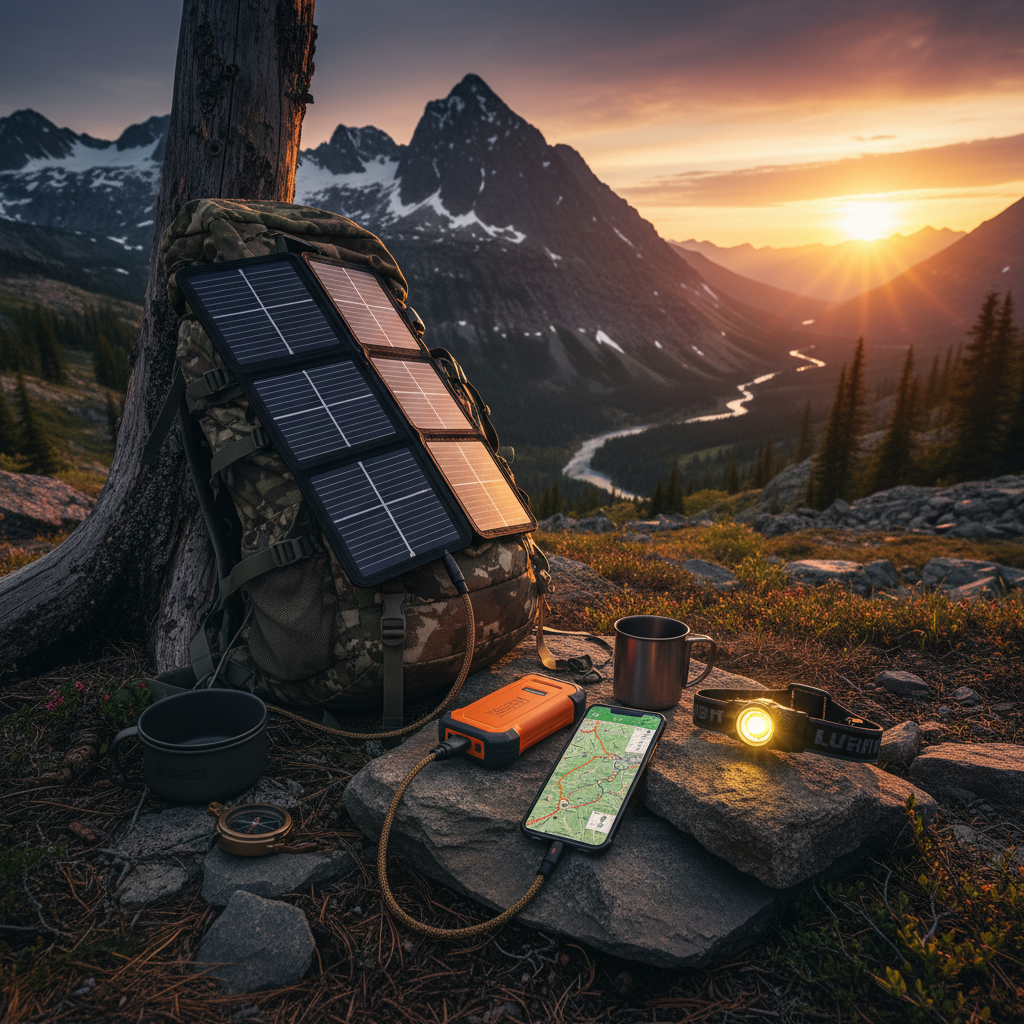
Your phone is your map, your camera, your emergency beacon, and your weather forecast. Your headlamp runs on lithium. Your GPS watch needs a charge every 5 days. Your satellite communicator eats batteries in the cold. In the backcountry, there are no outlets — and a dead device is not an inconvenience, it is a safety risk. This guide covers every way to generate, store, and conserve power when the grid is 50 miles behind you.
Key Takeaways
Off-grid power for hikers is layered: power banks are the foundation, with solar panels for multi-day trips; smart settings can stretch a phone from about 5 hours to 15+ hours.
- Battery life: airplane mode with GPS and 30% brightness extends a phone from ~5 to 15+ hours.
- Solar reality: a 10 W panel charges a phone in 2-3 hours, but clouds cut output 50-80%.
- Foundation: a compact power bank (e.g. Nitecore NB10000) covers most weekend trips.
- Panel weight: a trail solar panel around 21 oz can charge while strapped to your pack.
- Backup: a hand crank gives roughly 5 minutes of radio per minute of cranking.
The Energy Equation: What Drains Your Devices
Before buying gear, understand what consumes power and how fast:
| Device | Battery | Trail Use | Drain Rate | Days Without Charge |
|---|---|---|---|---|
| Smartphone (GPS + camera) | 3,500-5,000 mAh | Offline maps, photos, journal | High — 15-25% per hour with GPS | 0.5-1 day |
| Garmin inReach Mini 2 | 1,250 mAh | Satellite texting, SOS, tracking | Low — 10-min tracking interval | 14 days |
| GPS Watch (Garmin/Suunto) | ~400 mAh | Navigation, HR, activity | Medium — GPS mode heavy | 3-7 days |
| Headlamp (rechargeable) | 1,200-2,600 mAh | Night hiking, camp | Medium — depends on brightness | 2-5 days |
| Camera (mirrorless) | 1,000-2,000 mAh | Photography | Medium — 200-400 shots per charge | 1-3 days |
| E-reader (Kindle) | 1,500 mAh | Reading at camp | Very low | 14-30 days |
The #1 power drain on the trail is your phone screen. Put it in airplane mode with GPS enabled, brightness at 30%, and only check maps when needed. This extends a phone from 5 hours to 15+ hours on a single charge. That alone may eliminate your need for heavy solar gear on short trips.
Level 1: Power Banks — The Foundation
A power bank is the simplest, most reliable backcountry power source. No sun needed, no moving parts, works in any weather. The question is: how much capacity do you need?
| Trip Length | Capacity Needed | Our Pick |
|---|---|---|
| Day hike | 5,000 mAh | Phone emergency backup — most phones have enough |
| Weekend (2-3 days) | 10,000 mAh | Nitecore NB10000 — 1 full phone charge + headlamp top-up |
| Week-long trek | 20,000-26,800 mAh | Anker 737 — 3-4 phone charges, charges laptop |
| Thru-hike (2+ weeks) | 10,000 + solar panel | NB10000 + BioLite Solar — infinite power in sun |
Best Power Banks for Hiking
Nitecore NB10000 Gen 3
5.3 oz · 10,000mAh · USB-C PD 20W · Carbon fiber shell · IPX5 · Phone charge 2x
Anker 737 PowerCore 24K
1.1 lbs · 24,000mAh · 140W USB-C · Charges MacBook · Smart display · 4 phone charges
BioLite Charge 40 PD
8.5 oz · 10,000mAh · USB-C PD 18W · Slim profile · LED indicator · Rugged build
Level 2: Solar Panels — Harvesting the Sun
Solar extends your power indefinitely — as long as the sun is out. The trade-off is weight, and it does not work well in forests, cloudy days, or winter. Best for above-treeline hiking, desert treks, and multi-week expeditions.
How Solar Works on the Trail
- Strap to pack. Clip the panel to the outside of your pack with carabiners. It charges your power bank while you hike.
- Midday sun = peak output. 10 AM – 2 PM gives the strongest charge. Orient the panel directly at the sun.
- Clouds cut output by 50-80%. Solar is a supplement, not a guarantee. Always carry a pre-charged power bank as backup.
- Cold does not matter. Solar panels actually work better in cold weather. Efficiency drops in heat.
BioLite SolarPanel 10+
10W · Built-in 3200mAh battery · Sundial kickstand · 21 oz · USB-A output
Goal Zero Nomad 20
20W · Foldable · 1.2 lbs · Charges power bank or device direct · Smart IC chip
Nitecore FSP100
100W · Ultralight foldable · ETFE coating · USB-C PD · For base camp and car camping
Level 3: Alternative Power — Beyond Solar
Hand Crank + Solar Radio
The ultimate backup. Zero batteries, zero sun dependency. A hand crank generates power through muscle effort — 1 minute of cranking = ~5 minutes of radio or ~30 seconds of flashlight. Essential for emergency kits.
RunningSnail Emergency Crank Radio
Hand crank + solar + USB · AM/FM/NOAA weather · LED flashlight · SOS alarm · Phone charging
Thermoelectric: Burn Wood, Make Electricity
The BioLite CampStove converts heat from burning wood into USB electricity via thermoelectric modules. You cook dinner and charge your phone simultaneously — using fuel that is free and everywhere. Genius engineering for long-distance hikers in forested areas.
BioLite CampStove 2+
Burns sticks/twigs · 3W USB output · 2,600mAh battery · Fan-assisted combustion · Cooks + charges
Level 4: Efficient Lighting
Camp lighting drains power fast if you use your headlamp at full blast all evening. Dedicated lanterns with diffused light are 3-5x more battery-efficient than a headlamp pointed at the ceiling.
Goal Zero Lighthouse Mini
210 lumens · Dual USB recharge + crank · 500h on low · 8.8 oz · Collapsible legs
LuminAID PackLite Nova USB
75 lumens · Inflatable · Solar + USB charging · 1.5 oz · Waterproof · Packs flat
BioLite AlpenGlow 500
500 lumens · ChromaReal color LED · USB-C · 200h on low · Ambient mode · 11 oz
Power Conservation Tactics
The cheapest, lightest power source is the one you do not need. These habits save 50-70% of your battery life:
| Tactic | Savings | How |
|---|---|---|
| Airplane mode + GPS | 60-70% | Cell radio is the #1 drain. GPS works without cellular. |
| Screen brightness 30% | 20-30% | OLED screens: dark mode saves even more. |
| Download maps offline | 15-20% | No data fetching = no radio power. Use AllTrails or Gaia GPS offline. |
| Disable Bluetooth/Wi-Fi | 5-10% | Your watch syncs later. No need for real-time on the trail. |
| Camera instead of phone | Major | Dedicated camera saves phone battery for navigation/emergency. |
| Cold battery management | 30-50% | Keep devices in inside pocket (body heat). Cold lithium drains fast. |
| Turn off, not sleep | 10-15% | Power off devices not in active use. GPS watches: use UltraTrac mode. |
The Off-Grid Power Kit: By Trip Type
| Trip | Power Bank | Solar | Light | Total Weight |
|---|---|---|---|---|
| Day Hike | Phone battery only | None needed | Headlamp (just in case) | ~3 oz |
| Weekend | Nitecore NB10000 | None | Headlamp | ~9 oz |
| 5-Day Trek | Nitecore NB10000 | BioLite SolarPanel 10+ | LuminAID | ~1.8 lbs |
| Thru-Hike (2+ weeks) | Anker 737 + NB10000 | Goal Zero Nomad 20 | GZ Lighthouse Mini | ~3.5 lbs |
| Base Camp | Anker 737 | Nitecore FSP100 (100W) | AlpenGlow 500 | ~6 lbs |
Nordic Walking + Off-Grid Power
Nordic walkers have a unique advantage for solar charging: the upright posture and wide arm swing mean your pack’s back panel is exposed to direct sunlight more than a bent-over backpacker. A solar panel clipped to the top of your pack gets better angle alignment and more consistent charging than almost any other hiking style.
For long-distance Nordic walking treks like pilgrimage routes, the combination of a Nitecore NB10000 + BioLite SolarPanel 10+ provides infinite power at under 2 lbs — enough to keep your fitness tracker, phone, and satellite communicator running indefinitely.
Common Mistakes
- Bringing too much capacity. A 26,800mAh bank for a weekend trip is 1+ lb of dead weight. Match capacity to trip length.
- Relying on solar alone. Cloud, forest, rain, short winter days. Solar is supplemental, not primary. Always carry a charged bank.
- Forgetting the cable. A 24,000mAh power bank with no USB-C cable is a paperweight. Carry 2 cables — one is one, two is one.
- Charging at full brightness. Charging while the screen is on wastes energy as heat. Charge devices while they are off or in airplane mode.
- Not pre-charging. Start every trip with 100% on all devices and power banks. Charge the night before.
- Ignoring cold. Below 32°F, lithium batteries lose 30-50% capacity. Keep power banks in your sleeping bag at night and inside jacket pockets by day.
Bottom Line
Energy independence in the backcountry comes down to three principles: conserve first (airplane mode, low brightness, power-off habits), store smart (right-sized power bank for your trip), and harvest when possible (solar panel on your pack during the day).
For most hikers, a Nitecore NB10000 (5.3 oz, 2 phone charges) is all you need for trips up to 5 days. Add a BioLite SolarPanel 10+ for anything longer. Together they weigh under 2 lbs and give you unlimited power on any sun-exposed trail.
The grid ends at the trailhead. Your adventure does not have to.
Our Top Pick
📚 See also:
- packrafting gear and energy planning — Packrafting Guide

About the Author
Alex Mercer — INWA Level 2 Nordic Walking Instructor
Certified by the International Nordic Walking Federation (INWA) since 2019, Alex has coached 500+ walkers from beginners to ultra-distance competitors. Sports science background with a focus on biomechanics, gait analysis, and evidence-based training protocols. Regular contributor to walking and outdoor publications.