Smart Walker’s Toolbox: Best Fitness Trackers for Nordic Walking 2026
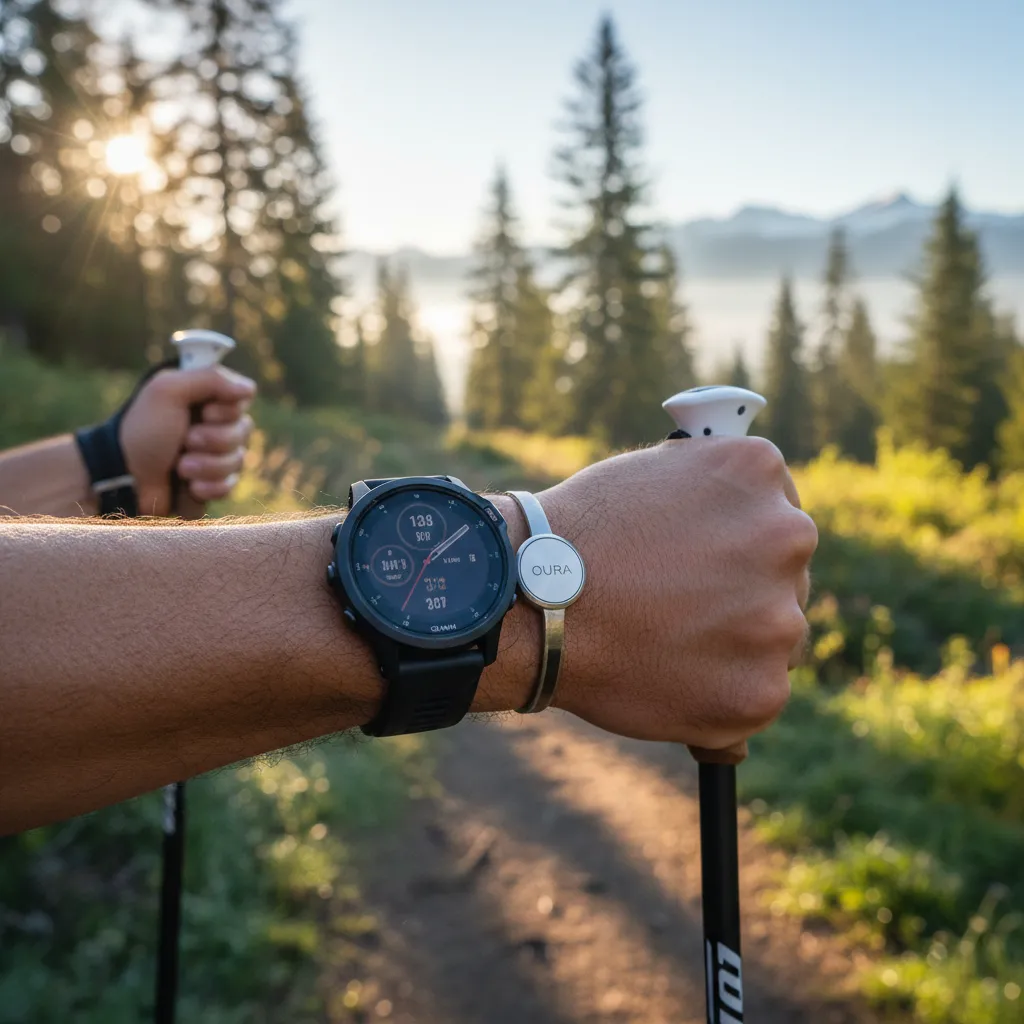
Data-driven Nordic walking is not about being obsessive — it is about having objective feedback on the variables that actually drive progress. Heart rate, HRV, step cadence, GPS distance, and recovery status: together these metrics tell you more in 30 seconds than subjective feel can tell you in a month of training.
The wearable market in 2026 has consolidated around three dominant ecosystems, each with a distinct philosophy. Here is how to choose the one that fits your training style.
Key Takeaways
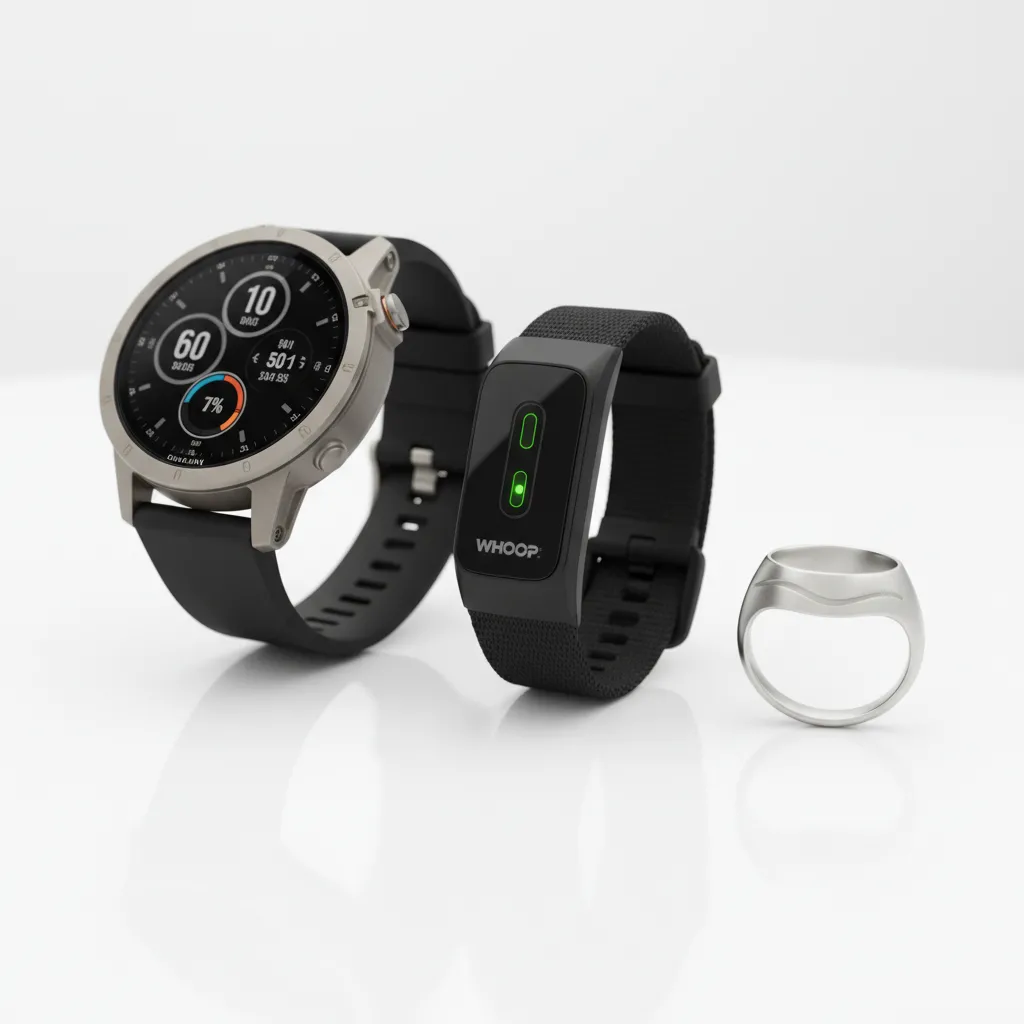
The three fitness-tracker ecosystems for Nordic walking are Garmin (performance and GPS), WHOOP (recovery and HRV), and Oura (sleep and longevity); choose by which metric drives your training.
- Recovery signal: a 10%+ drop below your HRV baseline is a clear instruction to take a rest day.
- Garmin: best GPS performance, the Forerunner 965 even has a dedicated Nordic Walking mode.
- WHOOP: continuous HRV, resting heart rate and recovery scoring over a 30-day baseline.
- Oura: sleep-first tracking aimed at longevity and readiness.
- Zone 2 target: 150 to 180 minutes per week at 60-70% max heart rate for mitochondrial gains.
What Metrics Actually Matter for Nordic Walking?
Not all fitness tracking metrics are created equal for Nordic walking. GPS watches designed for runners often undercount Nordic walking distance due to shorter, more deliberate strides. Wrist-based optical heart rate sensors can struggle with the arm-swing motion central to the technique.
- Heart Rate Zone Distribution: Percent time in Zone 2 (fat oxidation), Zone 3 (aerobic), Zone 4 (threshold) — the most actionable training metric
- HRV (Heart Rate Variability): Morning HRV trend indicates recovery quality; below baseline means rest or reduce intensity
- Cadence (steps/min): Target 90–100 steps per minute for optimal gait mechanics — higher cadence reduces impact per step
- Estimated VO2max: Progress metric; Nordic walking should increase this by 10–15% over 12 weeks
- Sleep quality: The single biggest predictor of next-day performance
- Active calories: Use our Calorie Calculator to cross-reference and calibrate device accuracy
Garmin Fenix 8 / Forerunner 965 — Best GPS Performance Tracker
Get Your Free 12-Week Training Plan
Join 2,500+ Nordic walkers. Receive a proven training program PDF and weekly technique tips — free.
Garmin dominates GPS accuracy for outdoor activities. The Fenix 8 multi-band GPS locks in 30 seconds and maintains 2-meter accuracy even in urban environments with signal interference. For Nordic walking route tracking, no other platform competes.
The Nordic Walking activity profile on Garmin records pole usage and adjusts calorie calculations accordingly — one of the few watch ecosystems that recognizes Nordic walking as a distinct activity category with specific MET values. The Forerunner 965 adds a dedicated Nordic Walking mode that records upper body engagement metrics through accelerometer data.
Pros
- Best GPS accuracy of any consumer wearable
- Dedicated Nordic Walking activity mode
- 60+ day battery on solar version
- Best-in-class topographic mapping
Cons
- Large form factor 51mm case
- Learning curve for Garmin Connect
- Premium pricing for flagship models
- No strong social community features
WHOOP 4.0 — Best Recovery-Focused Tracker
WHOOP philosophy is opposite to Garmin: it does not care about GPS routes or real-time performance. It cares about recovery. WHOOP 4.0 tracks HRV, resting heart rate, respiratory rate, and skin temperature continuously — building a 30-day baseline and giving you a daily Recovery Score.
For Nordic walkers following structured periodization, WHOOP recovery data prevents the most common training mistake: going hard on days when your body is not recovered. An athlete with a 20% Recovery Score who pushes a Zone 4 interval session is not getting fitter — they are accumulating fatigue debt.
The screen-free design is worth noting. WHOOP has no display — you wear it 24/7 without screen distractions. A monthly subscription is required in addition to hardware.
Check WHOOP 4.0 on AmazonOura Ring Gen 4 — Best for Longevity-Focused Walkers
The Oura Ring occupies a unique niche: it is a ring, not a watch. For Nordic walkers, this matters — a ring on the finger does not interfere with pole grip or strap mechanics. The optical sensors in the finger (closer to digital arteries) provide more accurate HRV readings than wrist-based optical sensors.
Oura Gen 4 temperature sensing is clinical-grade — it detects pre-illness temperature elevation 1–2 days before subjective symptoms, giving you an early warning to reduce training load. The Sleep Score algorithm is considered the most accurate consumer sleep staging tool, validated against polysomnography in independent studies.
For the longevity-focused walker prioritizing healthspan optimization, Oura biometric trend data over months and years provides the most meaningful picture of how your walking practice is affecting your biological age.
Check Oura Ring Gen 4 on AmazonHead-to-Head Comparison: Which Tracker Wins?
| Feature | Garmin Fenix 8 | WHOOP 4.0 | Oura Ring Gen 4 |
|---|---|---|---|
| GPS accuracy | Excellent | None | None |
| HRV quality | Good | Excellent | Excellent |
| Sleep tracking | Good | Very Good | Excellent |
| Battery life | Up to 60 days | 4–5 days | 7 days |
| Nordic Walking mode | Yes | No | No |
| Price | Check Price | Check Price + subscription | Check Price + subscription |
| Best for | Performance tracking | Recovery optimization | Longevity and health span |
Combine platforms for maximum data: use Garmin for GPS route and real-time zone training, Oura Ring for nightly HRV and sleep scoring. Garmin tells you what you did; Oura tells you whether your body absorbed it. Check current pricing on Amazon for both devices.
Budget Alternatives
Whatever tracker you choose, the data only makes sense if your technique is consistent. Inconsistent gait creates noisy metrics. Study the biomechanics of a perfect step first, then let the data guide you. Walkers combining data tracking with the biohacking protocol report faster HRV recovery improvements.
If premium trackers are not in your budget, two options deliver solid value. The Garmin Vivoactive 5 includes the Nordic Walking activity profile and GPS accuracy at nearly half the Fenix price. For pure HRV-based recovery tracking, the Polar H10 chest strap is the gold standard for accuracy.
Check Garmin Vivoactive 5 on Amazon Check Polar H10 Chest Strap on AmazonMaking Sense of Your Data: Metrics That Actually Drive Progress
Owning a fitness tracker is not the same as using one intelligently. Most wearables display 15–25 metrics per session. Nordic walkers need to focus on 4–5 core variables and ignore the rest — signal-to-noise ratio is everything when building a sustainable data practice.
Heart Rate Variability (HRV). The single most valuable metric for any endurance athlete or longevity-focused walker. HRV measures the variation in time between consecutive heartbeats — high variability indicates the autonomic nervous system is recovering well; low variability signals accumulated stress, underrecovery, or illness. For Nordic walkers doing 4–5 sessions per week, tracking morning HRV over 7-day rolling averages reveals whether training load is sustainable. A 10%+ drop below your personal baseline is a clear instruction to take a recovery day regardless of how you feel subjectively.
Zone 2 Time. Nordic walking at a pace that keeps heart rate at 60–70% of maximum HR (Zone 2) produces the most mitochondrial adaptation per hour of any exercise modality studied. Garmin’s color-coded HR zones and WHOOP’s strain score both track this, but Garmin provides precise zone time breakdowns that WHOOP does not. Target 150–180 minutes per week in Zone 2 for longevity optimization.
Cadence. Step cadence (steps per minute) is the most direct measure of Nordic walking technique quality. Target 100–120 spm. Only Garmin watches with the Nordic Walking activity profile track this metric accurately. Oura Ring does not track in-session cadence. WHOOP’s stride metrics are designed for running and are unreliable for Nordic walking cadence.
Set a HRV baseline before starting any new training program. Measure for 14 consecutive mornings upon waking, before looking at your phone. This baseline anchors all future recovery interpretations — without a personal baseline, HRV numbers have no meaningful reference.
The App Ecosystem: Where the Real Value Lives
The hardware is the entry point; the app ecosystem determines long-term utility. Garmin Connect offers the most comprehensive training load analysis, with 7-day acute vs 28-day chronic load ratios that flag overtraining risk. The Garmin Coach feature (free with the app) builds structured Nordic walking programs based on your fitness level and goals.
WHOOP’s journal feature — where you log sleep variables, nutrition, stress, and alcohol consumption — is uniquely powerful for identifying behavioral patterns that affect recovery. After 60 days of journaling, the AI engine surfaces correlations specific to your physiology. This is the feature that justifies the subscription model for data-driven athletes who take recovery as seriously as training.
Oura’s Third-Party Health Platform integration allows data export to Apple Health, Google Fit, and research platforms. For users participating in longevity research programs or medical monitoring, this interoperability has real clinical value that Garmin and WHOOP do not currently match.
Frequently Asked Questions
Does WHOOP track Nordic walking accurately?
WHOOP tracks strain (exertion) accurately, but does not recognize Nordic walking as a specific activity type. You can manually log it as Nordic Walking after the session. For calorie accuracy, the lack of GPS means estimates are less precise than Garmin. WHOOP strength is recovery tracking, not activity-specific metrics.
Is HRV a reliable training guide for walkers?
Yes, highly reliable when used as a trend metric rather than a daily absolute. A single low HRV reading means little; a 7-day declining trend indicates accumulated fatigue. For Nordic walkers training 4–5 times per week, HRV trend monitoring prevents overtraining and maximizes the adaptive response. See our 8-Week Training Plan for structured periodization guidance.
Which is better: Garmin or Apple Watch for Nordic walking?
Garmin wins for outdoor athletic use. Apple Watch GPS consumes battery 3x faster than Garmin for the same GPS usage. Apple Watch has no dedicated Nordic Walking mode. Garmin ecosystem is purpose-built for multi-sport athletes and provides route navigation, weather alerts, and advanced training load metrics that Apple Watch does not offer at equivalent price points.
How accurate are smartwatch calorie counts during Nordic walking?
Typically 15–25% error from actual expenditure. Optical heart rate sensors on the wrist struggle during arm-swing movement, creating HR misreads that cascade into calorie errors. For better accuracy: use a chest strap paired to your GPS watch, and cross-reference with our Calorie Calculator which uses validated MET values for Nordic walking.