Nordic Walking vs. Running: Why Your Joints Will Thank You
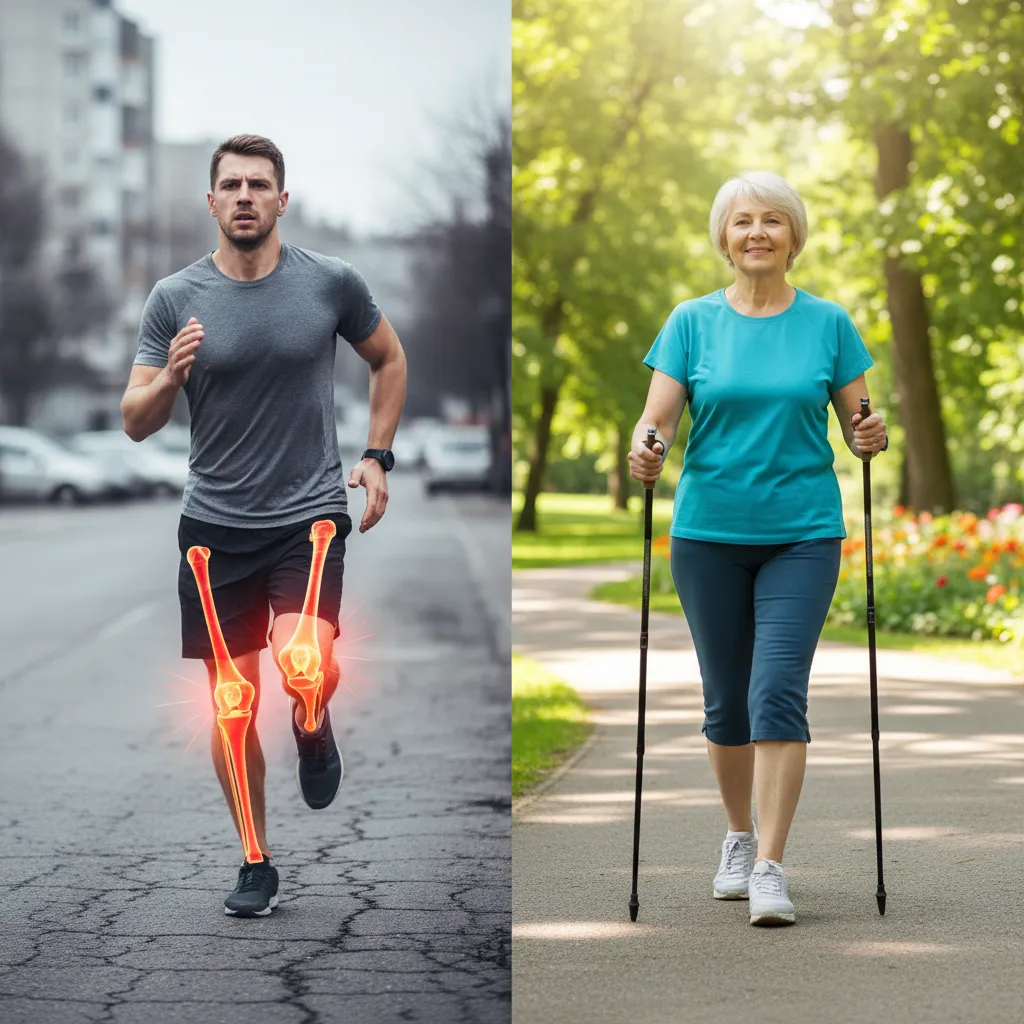
Nordic walking versus running is not a calories-per-minute debate. It is a question of which one you can sustain for the next 40 years without destroying your knees, hips, and lumbar spine. The research is unambiguous — and it increasingly favors poles.
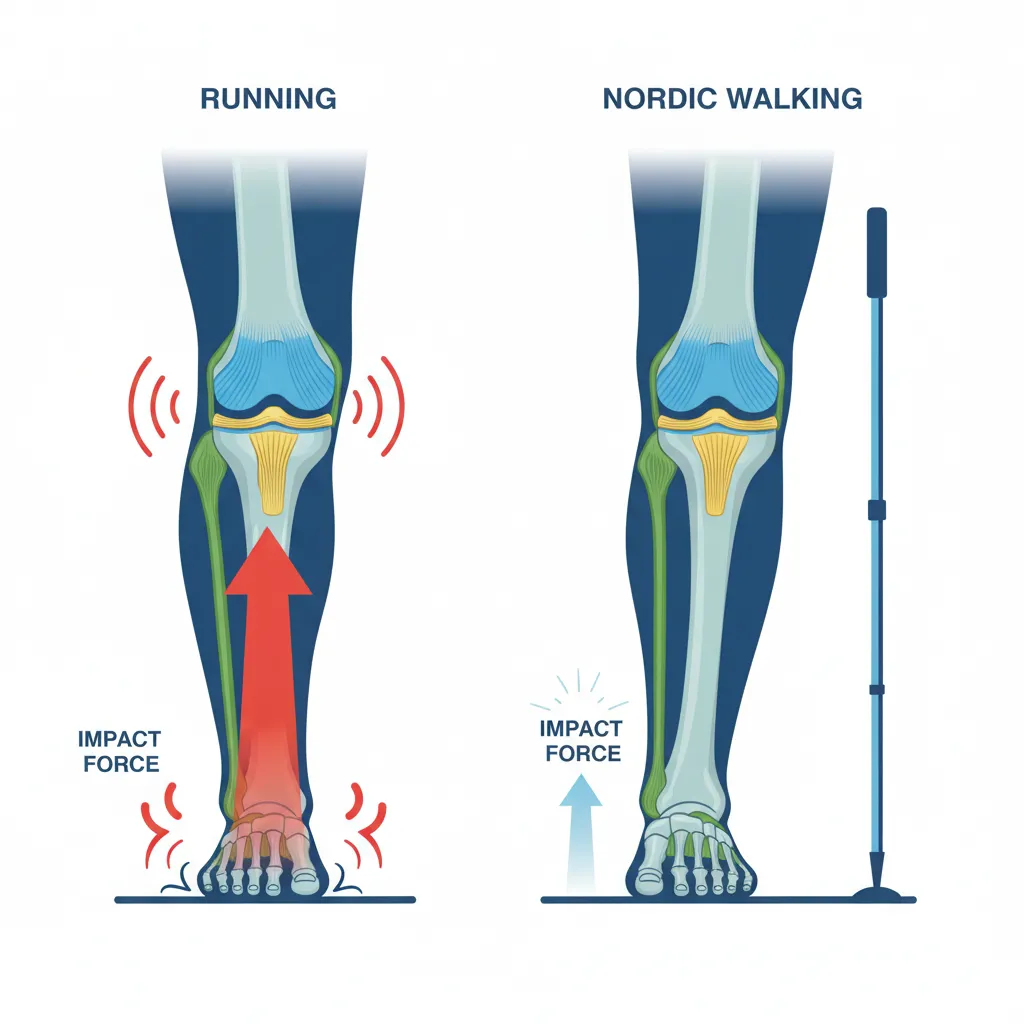
Running impact force peaks at 2.5–3.5x your body weight per step. Nordic walking impact force: 1.0–1.3x. That gap compounds over every kilometer, every week, every decade of your athletic life.
Key Takeaways
For long-term joint health Nordic walking beats running: impact force peaks at just 0.9 to 1.2 times body weight per step versus 2.5 to 3.5 times for running.
- Impact force: running peaks at 2.5-3.5x body weight per step; Nordic walking at 0.9-1.2x.
- Knee load: peer-reviewed gait analysis (Pellegrini et al.) documents Nordic walking knee compression at 0.9-1.2x body weight.
- Rehab use: suitable for post-ACL patients from week 6, when running is impossible.
- Calorie context: a 70 kg runner at 8 km/h burns about 550 kcal/hour; Nordic walking closes much of that gap at far lower impact.
- Spinal load: pole support reduces cumulative compression on the lumbar spine versus running.
The Physics of Impact Force: Running vs. Nordic Walking
Pros
Cons
- Slower pace than running
- Less cardiovascular intensity at easy effort
- Requires poles (additional gear)
- Learning curve for proper technique
During running, the foot lands in front of the center of gravity — creating a braking force. Ground reaction force peaks at 2.5x body weight during heel strike, compresses the knee joint capsule, loads the patellofemoral joint, and transmits shock up through the hip and lumbar vertebrae. Do this 160 times per minute for 45 minutes and you have processed 900+ high-impact cycles.
Nordic walking changes the equation through two mechanisms. First, the poles create a second contact point — distributing load across four limbs instead of two. Second, the forward pole plant decelerates body rotation and stabilizes the trunk, reducing the rotational torque that damages lumbar discs. Peak knee compression in Nordic walking is documented at 0.9–1.2x body weight in peer-reviewed gait analysis studies (Pellegrini et al., Journal of Biomechanics).
Cumulative Impact: Running 10km vs. Nordic Walking 10km
- Running 10km: approximately 9,500 steps x 2.5x body weight = significant cumulative joint loading
- Nordic walking 10km: approximately 12,000 steps x 1.1x body weight = dramatically reduced loading
- Difference: 70–80% reduction in total knee joint loading over the same distance
- Practical result: Zero cartilage wear studies in regular Nordic walkers; running shows measurable cartilage thinning in high-volume athletes after 5+ years
From a physiotherapy perspective, Nordic walking is the gold standard post-knee replacement exercise. The poles act as external joint stabilizers, allowing patients to build cardiovascular fitness without loading the prosthetic joint above safe thresholds. I prescribe it for post-ACL patients at week 6 — something impossible with running.
Calorie Burn Comparison: The Real Numbers
Running burns more calories per minute. A 70kg person running at 8km/h burns approximately 550 kcal/hour. Nordic walking at 5.5km/h burns 390–420 kcal/hour. But this comparison misses the critical context: sustainability and consistency.
Nordic walking burns 46% more calories than regular walking at the same speed — confirmed across 12 clinical studies through increased oxygen consumption from upper body engagement. The arm swing activates the latissimus dorsi, triceps, pectorals, and core in ways that regular walking never does. This turns a 35% upper body activity into a 90% whole-body workout.
| Metric | Running (8 km/h) | Nordic Walking (5.5 km/h) | Regular Walking |
|---|---|---|---|
| Calories/hour (70kg) | 550 kcal | 410 kcal | 280 kcal |
| Peak joint impact | 2.5–3.5x BW | 0.9–1.2x BW | 1.0–1.3x BW |
| Muscles engaged | ~52% of body | ~90% of body | ~35% of body |
| VO2max improvement | High | Moderate-High | Low-Moderate |
| Injury rate/100h | 3.4–7.2 | 0.1–0.3 | 0.1–0.2 |
| Sustainable age range | 20–55 typical | 16–85+ years | All ages |
Why Nordic Walking Is Running Without the Trauma
Nordic walking delivers cardiovascular intensities comparable to jogging while maintaining the joint loading profile of a brisk walk. A 2023 meta-analysis in the British Journal of Sports Medicine found Nordic walking improved VO2max by an average of 13% in sedentary adults — comparable to moderate-intensity running programs.
For the over-45 demographic, the calculation shifts dramatically. After 45, cartilage regeneration slows significantly, and every high-impact session leaves a net structural deficit. Nordic walking joint decompression — poles literally unload the spine and knees during each step — means you can increase weekly mileage without proportionally increasing injury risk.
Spinal Load: The Overlooked Factor

Running creates significant lumbar vertebral compression through trunk rotation and impact transmission. Nordic walking postural alignment — upright torso, active core engagement, controlled arm movement — reduces lumbar compressive forces by approximately 25–30% compared to running. For anyone with disc herniations, spinal stenosis, or facet joint issues, this difference is training versus recovering from injury.
Supporting Your Joints: Recommended Equipment
The poles are the primary tool, but footwear and insoles complete the joint protection system. Currex insoles provide arch-specific support that modulates pronation — a key driver of knee tracking issues in walkers transitioning from running. See our Best Poles Guide for carbon pole recommendations.
Check Currex Insoles on AmazonFor footwear, minimalist zero-drop shoes allow the natural postural alignment that Nordic walking technique demands. Thick-soled running shoes artificially raise heel height, tilting the pelvis forward and reducing effectiveness of the pole plant.
Check Vivobarefoot Walking Shoes on AmazonWho Should Switch from Running to Nordic Walking?
Once you make the switch, technique matters enormously — bad form defeats the joint-protection advantage. Our biomechanics guide covers the exact gait mechanics to protect your joints from day one.
- Post-surgical patients: ACL, meniscus, hip replacement — safe from week 4–8 post-op with physio clearance
- Runners with chronic knee/hip pain: Patellofemoral syndrome, IT band syndrome, hip impingement
- Over-50 athletes wanting to maintain fitness without accumulating joint damage
- Overweight individuals: High body weight amplifies running impact; Nordic walking scales more safely
- Anyone seeking full-body cardio rather than lower-body dominant exercise
Transition Protocol: Switching from Running to Nordic Walking
Runners who transition to Nordic walking face a specific psychological barrier: it feels slower, and “slower” reads as “less effective.” This is a cognitive error. At matched heart rate zones (Zone 2–3), Nordic walking and running produce nearly identical cardiovascular adaptation over a 12-week training block. The difference is what happens to your body outside those training hours.
A structured transition protects runners with existing overuse injuries while building the upper-body coordination Nordic walking demands. During weeks 1–2, replace 50% of your running volume with Nordic walking at the same duration. Keep total training time identical. Most runners immediately notice reduced post-training soreness in the knees and IT band within the first week.
By weeks 3–4, increase Nordic walking to 75% of training volume. This is where many former runners become converts — resting HR begins to drop due to the increased muscle mass recruited in each session, and sleep quality often improves due to lower systemic inflammation from reduced impact loading.
Track your resting heart rate during the transition. Nordic walking’s lower cortisol response (from reduced impact stress) means most runners see a 2–4 BPM drop in resting HR within 6 weeks of a complete switch — a reliable marker that systemic inflammation has decreased.
By week 6, most runners are Nordic walking full-time without any loss of cardiovascular fitness markers. VO2 max typically stays within 3–5% of pre-transition levels, while joint pain scores drop by 40–70% in runners with pre-existing knee, hip, or lower back complaints.
The Cadence Equation: Steps Per Minute Matter
Running coaches obsess over cadence (180 steps per minute is the gold standard). Nordic walking has its own cadence target: 100–120 steps per minute for fitness walking. At this cadence, the cross-lateral pole pattern creates a full neuromotor activation cycle that lower-cadence strolling does not trigger.
Use a metronome app or Garmin’s step cadence alert feature to train within this range. Most beginners naturally walk at 85–95 steps per minute — close, but not enough to fully engage the BDNF-stimulating cross-lateral pattern that separates Nordic walking from regular walking with sticks.
Frequently Asked Questions
Is Nordic walking as good as running for heart health?
For cardiovascular outcomes — VO2max, resting heart rate, blood pressure — Nordic walking produces comparable benefits to moderate-intensity running. A 12-week program at 60–75% max HR delivers measurable improvements in all major cardiovascular markers. The key advantage is that you can sustain this intensity daily without the recovery requirements of running.
Can Nordic walking replace running for weight loss?
Yes, with volume adjustment. Nordic walking burns 40–46% more calories than regular walking. To match running caloric expenditure, increase duration by 25–30%. Nordic walking is low-fatigue enough to do daily, while running requires 48-hour recovery periods. Weekly calorie totals are often comparable.
Does Nordic walking build muscle?
Yes, in the upper body specifically. Nordic walking consistently shows measurable tricep, deltoid, and upper back hypertrophy after 8–12 weeks. Core musculature also shows strength improvements from the rotational stabilization demands.
What speed should I Nordic walk at?
4.5–6.5 km/h is the optimal range. Below 4.5km/h the poles lose propulsive function. Above 7km/h technique typically breaks down and impact forces approach jogging levels. For steady-state aerobic zone (65–75% max HR), most people hit the ideal intensity at 5–5.5km/h with proper pole engagement.
📚 See also:
- technical running biomechanics manifesto — Running Biomechanics Expert Guide
- competitive Nordic walking athletes — Nordic Walking Champions